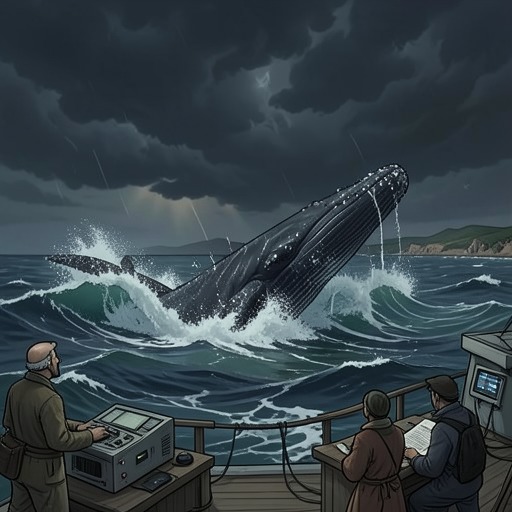
Anthropocene
The WhaleAnthropocene is the name the book gives to a geological epoch beginning around 1800, with the Industrial Revolution, and to the growing reach of human activity into systems once imagined as beyond human control. Its significance emerges through the fate of whales: industrial energy demand and weaponry turned them into resources, while later industrial change and warming seas altered the conditions on which they depend. Against that history, the ocean remains both a material force shaping human life and a wilderness whose future humans cannot confidently predict.
An epoch measured against the sea
The book presents the Anthropocene as a scientific announcement that the Holocene has ended and a new epoch has begun. The date around 1800 links that change to industrialization, but the ocean makes its scale difficult to grasp. It covers more than three-quarters of the earth; its smallest organisms help provide every other breath of oxygen, while tides and shores shape human movement and borders. People may treat the sea as distance to be crossed, or presume it has been tamed, yet its reach and activity exceed the measures of ordinary human life.
That contrast is also temporal. Cities and civilizations rise and fall, while the sea appears to persist as an ancient, unfathomable wilderness. Its visible surface can be glassy and almost indistinguishable from the sky, or surge into a spectacle of water and force; in either state it gives and takes. The account insists that apparent calm does not mean stasis: the ocean is a continuous drama, largely unseen by people who glimpse only a fraction of it. The Anthropocene therefore describes not the disappearance of nature into human history, but the growing pressure of human history upon a world that remains more powerful and less knowable than its observers suppose.
Extraction, energy, and the whale
The history of whaling gives the epoch a concrete industrial chronology. On Christmas Eve 1868, Norwegian hunter Sven Foyn recorded gratitude for the grenade harpoon he had just patented. Its explosive charge made it possible to pursue large, fast rorquals that earlier hunters could not reliably catch. Steamships and harpoon-launchers extended that technological advantage: once sighted, a whale could be treated as virtually doomed. Norwegian whalers soon killed a thousand fin whales a year, and humpback whales were also caught heavily. The advance arrived after sperm whales and right whales had been depleted, making the new weapon part of a succession in which pressure shifted to species that had previously escaped commercial pursuit.
The demand that made killing profitable was itself changing. Whale oil had become less valuable after petroleum and gas entered use, and the first electric light was switched on in 1879. Yet a new industrial use prolonged the slaughter. As American whaling declined, armed Norwegian and British steamships opened Antarctic waters in 1904 to obtain whale products for nitro-glycerine. During the two world wars, fifty thousand whales died; their oil helped prevent soldiers from suffering trench foot, while whale-derived material also served the manufacture of munitions. The South Atlantic population of humpback whales had been driven to extinction by 1918. In this sequence, animals that had supplied light and industrial goods became part of the material chain of modern warfare: the same industrial world that killed whales also used their bodies to sustain and intensify human conflict.
The scale of extraction increased again with factory ships. In 1925 Norway launched the Lancing, the first such vessel; within twenty years of the opening of sub-Antarctic whaling grounds, the book reports, one and a half million rorquals had been killed. The image of a seagoing abattoir makes the change in method legible: hunting was no longer confined to the range of a small boat or a coastal station, but organized as mobile industrial processing across distant waters. Human arrangements aboard ship were also sharply unequal. On a whaling vessel, families might share compact quarters, with children doing schoolwork at a table built around the mast and a mother sewing as the ship rolled; low-ranking sailors, by contrast, slept in crowded forecastle bunks beneath a scant, watery light. The whale economy thus had a human social world as well as an ecological cost, distributing comfort and hardship within the same confined machinery of extraction.
Ecological consequences and uncertain futures
The book sets commercial killing alongside a second industrial transformation: the warming of the oceans and the retreat of polar ice. A medieval whale mural in a cathedral in a walled city has endured through successive human empires, but the whale’s polar citadels are receding. As freshwater locked in polar ice enters the sea, the North-West Passage becomes a permanent reality and nations prepare to exploit Arctic resources anew. The contrast is pointed: a fragile image of a whale can outlast empires, while the habitat of living whales can be altered within a human lifetime.
The biological consequences remain uncertain rather than uniform. Krill feed on algae beneath the ice, so their decline could diminish a key food source. At lower latitudes, warming waters are already pushing whale food farther north; animals may move toward polar feeding grounds only to find that familiar ice habitats have vanished. At the same time, nutrients released by the same process around Antarctica might benefit the food chain and cetaceans. The book refuses to turn these competing possibilities into a confident forecast: the unfolding change is described as a vast experiment, and no one knows its outcome.
The migration of humpback whales makes the dependence of large animals on linked ocean systems especially clear. After six months fasting and mating in Caribbean waters, they travel north on an annual journey of up to eight thousand miles, following routes established by ancestors millions of years ago. Off the north-eastern seaboard, the meeting of the Gulf Stream and cold Labrador currents drives upwelling, bringing nutrients from the ocean floor and setting a seasonal food chain in motion. The whales feed on sand lances and herring in the resulting abundance. Such movement depends on distant waters, inherited routes, currents, and prey; climate disruption threatens relationships that cannot be understood by looking at a single shoreline or season in isolation.
Human knowledge and the limits of control
The Anthropocene account is also a story about knowledge arriving alongside loss. Researchers studying sperm whales describe social learning, distinctive clan patterns, and click repertoires; different groups can use different foraging methods learned from mothers and passed between generations. Hunting may have damaged these societies by removing matriarchs who carry essential knowledge and by killing large bull males. As scientific understanding becomes more detailed, the communities being studied face new threats and may disappear before their social lives are fully known.
The book places this possibility within a wider extinction crisis. It reports that plant and animal life is vanishing at an average of one hundred species a day, and that the Yangtze River dolphin had been declared extinct between the beginning and completion of the book. It warns that half of all animal species, including right whales in Cape Cod Bay, might follow by the end of the century. Sperm whales, slow to breed, may also suffer delayed consequences from hunting. These statements distinguish documented losses from predictions, but both expose the same problem: human actions can produce effects that unfold beyond the moment of decision, and scientific observation cannot guarantee that the knowledge gained will arrive in time to prevent further disappearance.
The ending leaves the Anthropocene suspended between damage and speculation. Melville’s imagined world in which whales inherit a flooded earth supplies a counter-image to the confidence of human progress, not a settled prediction. The future may bring losses in food webs and habitats, or changes whose consequences remain unknown; the enduring whale image in stone does not ensure the survival of whales in the sea. The term’s force lies in that imbalance: humanity has acquired the power to transform oceanic conditions, but neither mastery of the ocean nor certainty about what those transformations will mean.