Anthropomorphism and human projection onto whales
The WhaleAnthropomorphism and human projection onto whales names a tension at the heart of human encounters with these animals: whales invite recognition because they share mammalian life with people, yet their scale, senses, and ocean habitat resist interpretation on human terms. The book neither dismisses emotional identification as mere error nor treats it as transparent knowledge. Feeling can open a path toward attention, but the whale remains more than the image people make of it.
Recognition and Its Limits
The sea establishes the conditions for that tension. Henry David Thoreau describes an ocean that has remained wild and unfathomable while civilizations rise and fall around it. It covers most of the planet, sustains human life through its smallest organisms, and shapes movement and borders; nevertheless, people often treat it as distance to cross or terrain already subdued. Its changing surface can appear glassy and nearly absent, then surge into a spectacle capable of taking as readily as it gives. This unstable, immense setting makes the whale visible as a sign of a world that human observers cannot fully see.
The narrator’s memories show how the sea can persist even in its absence. In Red Cloud, Nebraska, a public pool becomes a blue trace of the ocean on the Great Plains; far from the shore, the missing sea feels more potent rather than less. Later, from a sea wall on an autumn afternoon, the calm water makes the idea of giant creatures beneath its surface seem improbable. These moments locate human perception between glimpses and imaginings: the ocean is physically present in the world, but much of its life remains beyond ordinary sight.
Encounters That Invite Projection
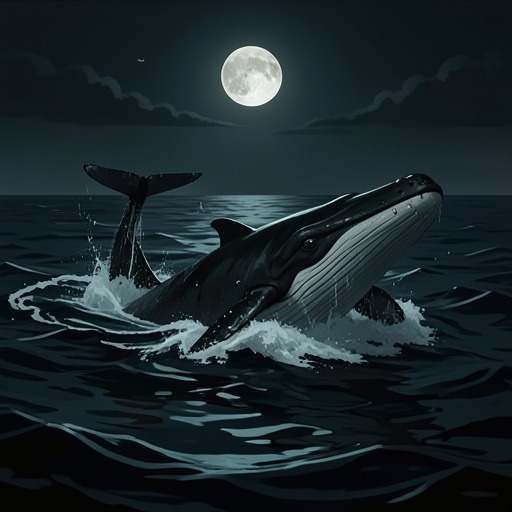
A close encounter with Humpback whales makes that distance suddenly intimate. Off the bows, whales surface and blow; a young animal launches itself from the water, exposing its pale, ridged underside. Others raise their tails and slap their flippers. Their movements appear exuberant, and the narrator reads their effortless swimming as freedom. The reaction is emotional before it is analytical: the whales’ bodies seem to make visible a kind of life that terrestrial observers cannot share.
The animals’ annual migration gives that spectacle a history independent of the human gaze. After months in the Caribbean, Humpback whales travel north to the Gulf of Maine, following ancestral routes that extend back millions of years. Their journey can span thousands of miles, guided by signs invisible to people; at the meeting of the Gulf Stream and cold Labrador currents, upwelling brings nutrients into a food chain on which the whales feed. They gorge on fish, while their breaching and rolling have earned them the hunters’ nickname the merry whale. The human language of playfulness arises from observable behavior, but the migration, feeding, and navigation are not simply performances for human spectators.
Emotional Meaning and Mediated Knowledge
The book acknowledges why observers reach for human terms. A whale shares a heart, lungs, and mammalian qualities with a person, while its size and movement can seem almost supernatural. Whales make otherwise hidden ocean life perceptible; they can appear dreamlike, as if they belonged to another dimension. Yet their physical reality unsettles idealization. They eat in great quantities, have bad breath, and can be helpless on land, where their bodies collapse under their own weight. Even bones, recovered and examined, give limited access to the living animal. Awe and classification alike fail to contain the whale completely.
Reports of a whale calling at 52 hertz sharpen the emotional pull of the unknown. Its calls were tracked for more than a decade as it travelled between California and the Aleutian Islands. Researchers considered whether the call might be a mating signal, whether the whale was broadcasting on an unusual frequency, or whether it might be a hybrid. The proposed explanations differ, but the story’s image of a caller receiving no response encourages human feeling about isolation. That response reveals as much about the imaginative force of the report as it does about what is known of the whale.
Modern media have altered the terms of this relationship. The book contrasts a century that began with active whale hunting and ended with passive watching, and connects changed attitudes to encounters mediated by photographs, film, and television. Scientific knowledge has demystified whales while also disclosing their remarkable lives. In the modern imagination they can become emblems of innocence under threat; older traditions, by contrast, made the great fish a danger, a devourer, or a monstrous presence. Neither image is the animal itself. Each frames the whale through human fears, hopes, and available forms of knowledge.
Animal Lives Beyond the Human Mirror
The book marks a boundary between humane attention and the presumption that human feeling explains animal life. It is difficult not to be moved when entire families follow a stricken whale toward a beach, or when other whales support a wounded female injured by a ship’s propeller. Such scenes invite comparison with care and loyalty among people. At the same time, the book insists that whales have their own habits, appetites, and vulnerabilities; emotional recognition should not replace attention to those particulars.
The contrast between vulnerability and power further resists a simple portrait of the gentle giant. Sperm whales may retreat from a seal or the click of a camera, yet they are formidable predators, eating hundreds of squid a day and consuming fish on a scale comparable to the annual human marine catch. Their deep-diving lives remain largely unknown: stomach contents disclose what they eat, but not the full circumstances of how they find it. Their clicks and immense sound-producing system suggest a sensory world organized in ways human observers cannot readily inhabit. Projection can make that difference feel emotionally legible, but it cannot abolish it.
The concept therefore holds two claims together. Humanizing whales may be one way people begin to understand and care about animals whose lives otherwise seem remote; it can also turn them into mirrors for human innocence, loneliness, freedom, or fear. The book keeps the animal on both sides of that image: close enough to stir recognition, and other enough to exceed it.