Arctic Ocean
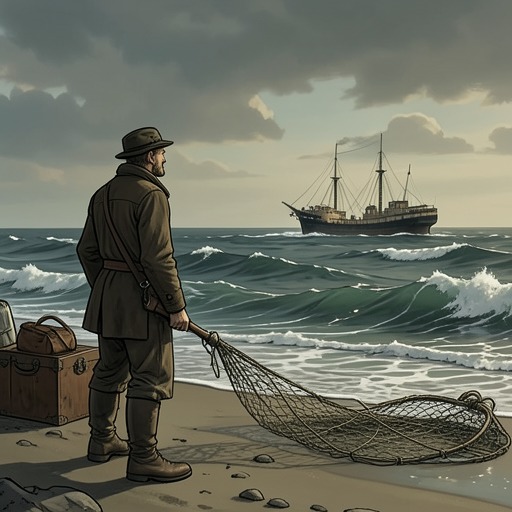
The WhaleThe Arctic Ocean is presented as both a frontier of commercial whaling and part of a larger marine wilderness that humans have never fully mastered. Ships entered its waters in pursuit of whales, while the animals themselves ranged across oceanic distances and into polar temperatures; the contrast between extraction and incomplete knowledge gives the region its significance in the book’s account of the sea.
A polar reach of the global sea
The Arctic belongs to an ocean that the book describes as older and wilder than human settlements: cities and civilizations change, but the sea remains. It covers more than three-quarters of the Earth, sustains human life through its smallest organisms, and shapes movement and borders. From land or the air, however, it can be mistaken for empty distance or a space already subdued. The Arctic’s remoteness sharpens that contradiction: it is a region of the same sea that touches human life everywhere, yet one whose scale and conditions resist ordinary observation.
The water is not a static backdrop. Under close attention, the sea becomes a succession of changing scenes, from still, glass-like surfaces to sudden force; it can give as readily as it takes. This account of oceanic change is especially pertinent to the Arctic, whose place in the book is defined less by a settled description of its coasts than by the movements of ships and whales across immense waters.
Whaling ground and commercial frontier
The Arctic appears directly in the history of commercial whaling. By the time the Mayflower set sail, ships were already leaving Dutch ports to hunt whales there. Two members of the Mayflower’s crew had themselves whaled off Greenland. Their experience shaped how they regarded the whales they saw in Cape Cod Bay: they calculated the animals’ abundance in terms of the wealth that a properly equipped hunt might have yielded. The episode connects Arctic whaling to the wider commercial imagination of the Atlantic world, in which whale populations were read as potential returns before they were understood as living communities.
The account also distinguishes this pursuit from the whale harvests of Indigenous people, which supplied sustenance. European whaling, by contrast, sought profit, continuing a commercial practice that had already taken ships as far as Labrador. The Arctic therefore enters not as an isolated polar wilderness but as one destination in a maritime economy that linked distant waters, ports, vessels, and markets.
Whales across polar waters
The sperm whale’s range makes the Arctic part of a global habitat rather than a remote exception. Sperm whales live across every latitude and in every ocean, from the North Atlantic to the South Pacific and the Mediterranean; the book also describes them as able to range between tropical and Arctic temperatures. Their lives depend on deep water and broad movements, conditions that kept them largely out of sight of anyone other than whalers until relatively recently.
Visual surveys from ships and planes have estimated that about 360,000 sperm whales remain, roughly a quarter of the population that flourished before the iron harpoon. The figures are given alongside a warning about the limits of knowledge: because these whales favour deep water and steep continental shelves, their study is still at an early stage. The Arctic thus belongs to a geography that humans have entered to hunt more readily than they have learned to observe.
Northern animals in human displays
The book’s examples of live northern whales being transported to urban aquaria show another route by which people encountered animals from cold northern waters, though they do not identify these captures as having taken place in the Arctic Ocean itself. In 1861, Phineas T. Barnum imported two belugas caught off Labrador for his American Museum in New York. They were placed in a basement tank measuring fifty-eight by twenty-five feet but less than seven feet deep, and filled with fresh water. Their display turned the living whale into a public attraction even as their owner expected their time in captivity to be brief.
A later beluga, also caught off Labrador, travelled by sloop to Montreal, by train to New York, and then by steamship to Southampton on its way to London. During the sea passage it was kept in a wooden box lined with seaweed and wetted with salt water every three minutes; despite this care, it had begun to live off its own blubber. Set beside the older history of Arctic whaling, these journeys reveal a related but distinct human traffic in northern whales: pursuit and exhibition brought animals into human view, without making their lives or their ocean fully knowable.