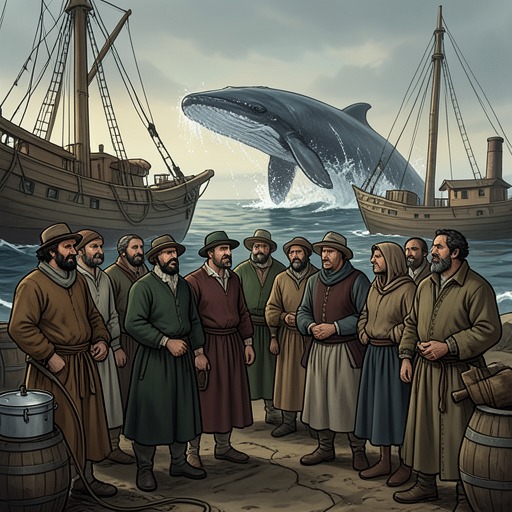
Azorean whaleboat
The WhaleThe Azorean whaleboat, known locally as a canoa, was the small working vessel at the centre of the Azores’ traditional whale hunt. In footage from the 1970s, its double-prowed hull, whale-bone cleats and trim, and reliance on sail and oars made the hunt appear strikingly continuous with nineteenth-century whaling. The boat was both a practical tool and the point where shore-based surveillance, local labour, and the dangerous encounter at sea converged.
Design and Historical Continuity
The canoas used the same kind of boats as Yankee whalers, but in the later period shown in the film, motorboats towed them out to sea. Their double-prowed shape and whale-bone fittings marked them as working craft, adapted to the island’s continuing hunt rather than preserved as a display of a distant past. The footage gives the boats a double historical aspect: they carried older methods into a modern era, even as motor power changed how they reached the hunting grounds.
Launch and Use in the Hunt
A lookout, or vigia, watched the sea from a tower on a clifftop promontory. When a whale’s blow appeared, the watcher sent up a rocket, summoning crews who might otherwise be farming or fishing. Attendance was required by law, with fines for those who failed to answer the call. The canoas waited ready at the harbour; once launched, crews could remain at sea through the day and night.
When a whale surfaced, the men raised their sails and rowed quietly toward it. The approach depended on timing: the animal had to remain at the surface to replenish its oxygen before it could dive again. The crew used harpoons and lances, and the boat itself became a working platform during the hunt. If a shaft bent in the struggle, the men straightened it against the canoa’s boards before using it again. The sequence shows how the vessel’s structure was incorporated into the labour of the hunt, not merely used to transport the crew.
Decline and Material Remains
The Azores’ commercial whaling, begun in 1850, lasted until 1986. By the 1970s the hunt persisted with traditional boats and methods, but the practice was already becoming a dying art. A surviving canoa at the former whaling works in São Roque lies beached among abandoned buildings: its wood is splintered, and fragments of whale bone remain attached with copper nails. This wrecked craft gives the boat a final role as evidence. Its form and remains connect the island’s working whaling history to the later disappearance of the hunt.