Azores Archipelago
The WhaleThe Azores Archipelago is a nine-island chain in the mid-Atlantic where volcanic terrain, profound ocean depths, and whale migrations have shaped both local life and transatlantic movement. Claimed by Portugal in the fifteenth century, the islands became a provisioning stop for American whaling ships and, from 1850, the base of a local whaling industry. Its history is written into island streets, working practices, and the remains of a whaling factory, even though commercial whaling ended in 1986.
Atlantic setting and volcanic geography
The islands lie about 1,500 miles east of Cape Cod and 1,000 miles from Lisbon, scattered across the Atlantic. Though they may appear as small points on a map, they are the exposed peaks of enormous sea mounts, part of an underwater ridge extending along the ocean floor. Their setting puts the archipelago within a much larger geography of deep water and moving plates: three islands lie on the Eurasian plate, three on the African plate, and the rest on the American plate. The western islands are gradually moving farther from Europe and closer to America.
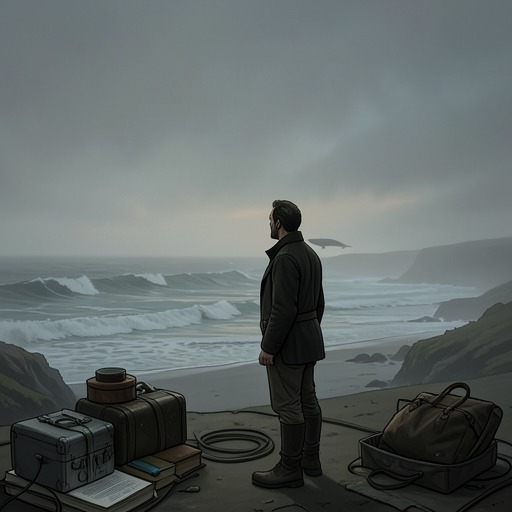
The coastline is marked by dark volcanic rock rather than broad sandy beaches. Pico, the youngest island, emerged roughly a quarter of a million years ago; its volcano remains active, and earthquakes recur with deadly consequences. On the island’s southern shore, Lajes sits between the force of the sea and the instability of the earth. The ocean’s depth intensifies that exposure: within a hundred yards of shore, the seabed falls to a depth of a mile and then descends farther. Waves crossing the Atlantic strike the rocks and rise in spouts several storeys high. The archipelago’s landscape therefore makes the ocean not a distant horizon but a powerful presence immediately beyond the settlements.
A maritime crossroads
Portugal claimed the islands in the fifteenth century, and Columbus stopped there to hear Mass on his return from America. Later, prevailing winds and the islands’ position made them an important waypoint in the American whaling trade. Ships including the Charles W. Morgan called for fresh food and crew. Azoreans, in turn, signed on to whaling vessels bound for the New World. The prevailing winds did not carry those ships back by the same route, and many Azorean sailors remained in America. The resulting migration linked the islands to the Portuguese and Azorean communities of the Massachusetts coast; the account estimates that people of Portuguese or Azorean descent made up half that coast’s population.
The relationship was also visible in the built environment. Azorean streets and houses were described as recalling the whaling towns across the Atlantic, with narrow cobbled streets, clapboard buildings, and rooftop lanterns—familiar forms adapted to an island setting. In the nineteenth century, Frederick Douglass, after escaping slavery in 1838, lived and worked for four years in New Bedford, a port shaped by the same whaling economy that employed sailors from many backgrounds. Whaling ships were thus more than vessels crossing the ocean: they connected island communities to distant ports, labor markets, and new homes.
Whales in island life and work
Whales appear in the islands’ public and religious life as well as their economy. Pavement mosaics, souvenirs, and café signs carry whale imagery; in one bar, a sperm whale’s lower jaw hangs above the brandy bottles. At the church in Lajes, a glass cabinet holds scrimshaw harpoon models, a small votive whale, and religious objects dedicated to Our Lady of Lourdes by whalers. These objects bring maritime labor into a devotional setting. They also register a longstanding local association with whales, even before the islands began hunting them for themselves.
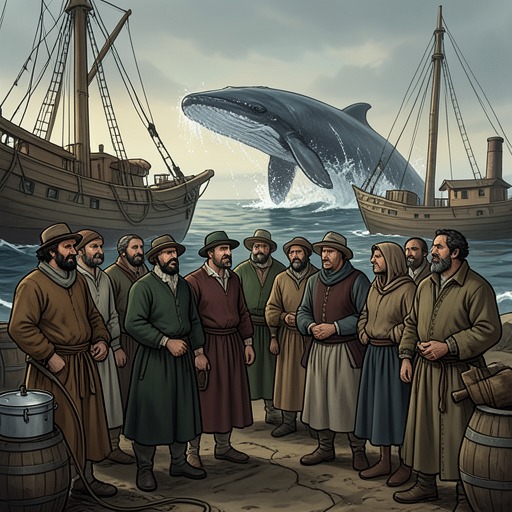
American ships brought both work and practical knowledge. In 1850, Azoreans began their own whaling, adopting techniques learned from the crews who had previously employed them. By the time the practice was well established, about one hundred local crews hunted whales. Lookouts called vigias watched from towers on clifftop promontories, scanning the sea through field glasses for the blows that signaled whales. The canoas used in the hunts resembled Yankee whaleboats; in later years, motorboats towed them offshore. In 1979, 150 sperm whales were caught off the islands. The trade still supported local livelihoods, but its specialist skills were becoming scarce: by the late 1970s, only one blacksmith remained who could forge harpoons and lances in their traditional forms.
The end of whaling and its material remains
The local industry ended through converging economic and political changes. Islanders found other work, demand for whale products declined, and the Azores’ entry into the European Union brought a prohibition on whaling. The final year of the industry was 1986. The transition was not automatic. Serge Viallelle, who came from France in the 1980s and stayed after discovering the whales, had to persuade islanders that visitors would pay to see them. Al Avellar, a whale-watching operator from Provincetown of Portuguese descent, helped teach the new trade. Whale-watching replaced whale hunting, redirecting the islands’ maritime expertise toward observing living whales rather than taking them.
The shift left a complex legacy rather than erasing the older industry. In São Roque, a concrete ramp leads to a former whaling factory whose lettering advertises oils, meal, fertilizers, and whaling equipment. Behind the façade stand abandoned outbuildings and blackened chimneys; nearby, the broken remains of a canoa are held together with copper nails and fragments of whale bone. These structures preserve the scale and practical character of the enterprise, while the new whale-watching economy depends on the same animals being treated as a reason to visit. The Azores’ maritime history therefore turns on a striking change in use: the routes and knowledge built through whaling became part of a later relationship with whales based on their presence in the sea.