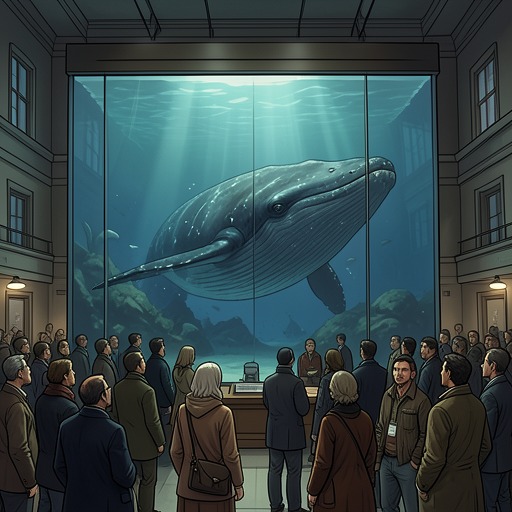
Blue Whale Model at the Natural History Museum
The WhaleThe Blue Whale Model at the Natural History Museum is not a preserved whale but a vast, hollow construction of wood, wire netting, and plaster. Built inside the museum’s hall and suspended from the ceiling, it makes an absent animal monumental: a likeness assembled from measurements and imagination before people had seen an entire living whale in its element. Its scale invites wonder, while its inaccuracy and changing role—as scientific exhibit, wartime memorial, and object of everyday museum ritual—show how a museum’s image of nature is itself made by history.
A whale for the Whale Hall
The model arose from a long effort to give large whales a place in the Natural History Museum, London. A new Whale Hall had been proposed as early as 1914, but the war halted the project. In 1923, the museum’s director, Sidney Harmer, argued that its displays of large whales were inadequate. The subject of whaling was prominent, and the Trustees had expressed sympathy with efforts to protect whales from extinction. Harmer proposed representations of the Greenland Whale, the Blue Whale, and the Humpback Whale, so visitors could gain a satisfactory idea of what these important species looked like. The hall would also showcase research being carried out by the Discovery expeditions in South Georgia alongside the British whaling fleet in the Southern Ocean.
The project developed slowly. Announced in June 1929 with a glass roof supported by steel girders, the hall was not completed until 1931. An initial proposal to obtain a life-size whale, hang it by its tail in an engraving dock, and take a mould proved too experimental and expensive. The plan depended in part on selling the blubber and marketing models made from the mould to American museums; it was abandoned before it could be realized. The alternative would be built directly in the museum, not taken from an animal’s body.
Making an animal out of a building
In April 1937, the museum’s Technical Assistant and taxidermist, Percy Stammwitz, proposed making the whale inside the hall itself. With his son Stuart, he spent nearly two years constructing it to measurements taken by scientists in South Georgia. Giant paper patterns were used to cut transverse wooden sections, joined at three-foot intervals by slats. Wire netting covered the armature and took the final plaster coat; Stuart painted the eye. During construction, the interior served as a canteen for the workers. The hall did not merely contain the model: its scale and arrangement allowed the whale to be made within it.
The rising timber structure suggested a ship with its keel laid in the museum, or an airship about to cross the Atlantic. Once suspended, it swayed enough to make the painters working on it seasick. These images of ships and flight echo the movement the model could never perform: the whale appears to travel through an element, but its motion is an illusion secured by a ceiling. Unlike the real animals whose migrations drew scientific attention, this one would remain fixed in an exhibition space.
An approximation made monumental
When the model was completed in December 1938, just before the outbreak of war, it looked convincing enough that a casual visitor might mistake it for a stuffed whale. Yet it was an effigy, not a specimen. Constructed in the 1930s, before anyone had seen an entire living whale in its element, its makers relied on carcasses hauled from the water. Deflated by the loss of their natural form, those bodies could not fully convey the living animal’s streamlined shape or beauty. The result is an object of error as well as wonder: a large, authoritative-looking image of an animal whose actual appearance remained only partly known.
At nearly one hundred feet from its nose to its twenty-foot flukes, the model is the largest object in the museum. Its enormous mouth seems to grin; its small eye, set in a wrinkled socket, can appear amused or pleading. Its scientific name, Balænoptera musculus, carries a double meaning: musculus can mean both muscular and mouse. But the creature’s impressive scale is not evidence of fidelity. The model is hollow, made of plaster and chicken wire over a wooden frame, and Philip Hoare recalls having imagined as a child that it enclosed the animal’s skeleton. That mistaken assumption captures the power of the display: the apparent body encourages visitors to supply an interior that is not there.
A monument with a changing audience
A telephone directory and coins of the realm were placed inside the whale on completion, making its hollow body a kind of time capsule. With war about to begin, the placid model took on the character of a memorial to a brief peace. It also became a good-luck object for museum warders, who left pennies on its flukes in the hope that visitors would follow suit; when the museum closed, the warders collected the coins and spent them in the pub. The practice transformed an inaccessible ceiling-hung exhibit into a participant in ordinary acts of hope, habit, and exchange.
That small ritual has since been replaced by a notice warning visitors not to throw coins onto the tail because they cause damage. Still, coins lie beside it on the plaster flukes. The rule and its breach coexist in plain view: the model is both vulnerable object, requiring conservation, and an inviting surface onto which visitors project custom and desire. Its public life is not exhausted by the original scientific purpose.
From single giant to suspended school
The whale now hangs in a gallery compared to an aircraft hangar, amid other cetacean models. Early attempts by Stammwitz to stuff dolphins were unsuccessful, and a flotilla of fibreglass animals eventually took their place, ranging from a tiny Ganges River dolphin to a Sowerby’s beaked whale. Suspended as if following a leader, these models extend the display beyond the solitary giant. They offer a procession of different bodies, but remain fixed in the gallery, watched by school parties and glass eyes.
Elsewhere, the contrast between model and animal becomes sharper. At the New Bedford Whaling Museum, an actual Blue whale skeleton—recovered after washing ashore on Rhode Island in 1998—was cut into sections, lowered into the river in cages, and cleaned by the small organisms of the Acushnet over two years before being reassembled for display. The Natural History Museum’s model has a different material history: no whale was moulded to make it, and its apparent fullness conceals an empty interior. Together, such displays reveal not a single definitive way of seeing whales but the choices by which institutions turn them into public knowledge. The model’s achievement and limitation are inseparable: it makes a gigantic animal imaginable, while its constructed body preserves the distance between the exhibit and the living whale.