Burton Constable Hall
The WhaleBurton Constable Hall is a country house in Holderness, Yorkshire, whose history is closely bound to a sperm whale stranded on the nearby coast in 1825. The whale’s skeleton passed through burial, neglect, outdoor display, and rediscovery before being brought into the Hall. Its changing setting makes the estate more than a backdrop: the whale is repeatedly reorganized as a specimen, a family possession, a local memory, and a literary presence associated with Moby-Dick.
The Hall and its setting
The Constable family has lived at Burton Constable Hall since the sixteenth century. Its red-brick towers and battlements stand in a low-lying part of Yorkshire where the coastline is steadily eroded by the North Sea. The family maintained its Catholic faith in a private chapel during a period when distance from London left that practice relatively undisturbed. The estate’s position—remote from the capital but exposed to a changing coast—shapes the account of the whale: the animal arrives from the sea, becomes an object on the land, and eventually enters the domestic and historical space of the house.
The Hall also appears as a repository of collecting interests. Its cabinets hold objects gathered across disciplines, including shells, polar-bear skulls, Roman and Greek coins, and early electrical apparatus made up of wooden wheels, brass cylinders, rubber belts, and Leyden jars. Teeth from the Tunstall whale are displayed among these varied holdings. The whale is therefore not isolated from the Hall’s wider culture of collecting; its remains share space with natural-history specimens and objects that express the owner’s broad curiosity.
The whale’s arrival and early neglect
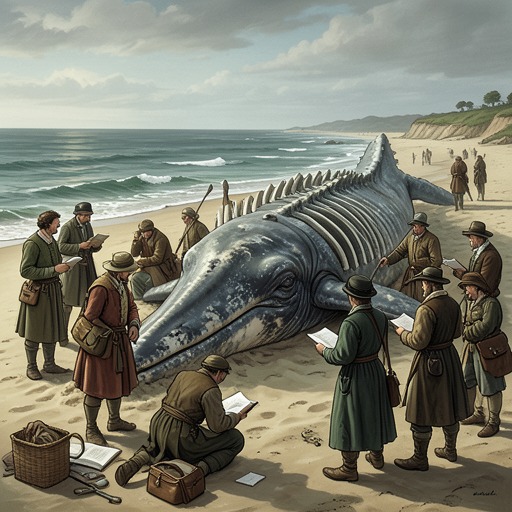
In April 1825, a large dead whale was sighted off Holderness. Fishermen initially kept clear of it, concerned that it might damage their boats. The tide carried the carcass to Tunstall beach on 28 April. Its remains were buried in pits, with the intention that they might be preserved, but burial did not lead to prompt care or study.
The new owner of the Hall, Sir Thomas Aston Clifford Constable, was eighteen when the whale came ashore. His immediate concerns lay elsewhere: he had inherited a substantial fortune, married Marianne Chichester two years later, and spent much of his time away from the Yorkshire estate. By 1829, the cleaned bones were reported to be lying in an irregular heap in a field. Seven years later, the geologist John Phillips found most of them in a barn, while the tail bones were in a tree. In 1836, when Sir Thomas had finally moved to the family home, surgeon, anatomist, and astronomer Edward Wallis was engaged to articulate the skeleton. The work gave the scattered bones a form in which visitors could once again perceive an animal.
Display, use, and disappearance
The skeleton was arranged outdoors on iron supports, posed to suggest a whale in the water. That display made the specimen a conspicuous feature of the grounds, but it also left the bones exposed to weather. The whale endured for decades in the field, gradually deteriorating as its supports corroded. According to the current tenant, John Raleigh Chichester-Constable, he played among the skeleton as a boy more than seventy years before the account was written, using it as a climbing frame. The memory records the whale not only as a scientific object but as part of childhood life on the estate.
The old display eventually disappeared. The bones were removed from their former position, and the remains later lay in outbuildings, separated from one another. In 1996, zoologist and historian Michael Boyd excavated them. He used Thomas Beale’s account in The Natural History of the Sperm Whale as a guide, a description that had also assisted Herman Melville. Though the Victorian ironwork had corroded, Boyd recovered most of the skeleton, working through the bars that held the ribs and vertebrae in place. A tooth that had not erupted was found in the split jaw, a detail consistent with the account’s emphasis on the whale’s young age.
The whale in the Hall
The recovered skeleton was brought into the great hall, where it lies on the floor beneath family portraits and narwhal tusks. In a house that also displays mounted animals and decorative figures, the whale becomes part of a collection shaped by human possession and arrangement. Yet the bones cannot fully represent the animal that once moved through the sea: the reconstructed skeleton is a reduction of a body that would have exceeded the scale of the chamber.
The account presents the whale’s association with Moby-Dick as compelling but not conclusive. A groundsman calls it the only whale from the novel to exist, linking the surviving skull to the fictional animal through its brain, senses, and clicking sounds. That claim is a literary gesture rather than proof that this was the whale Melville described. The historical specimen’s importance lies instead in how it brings the novel’s whale imagery into contact with an actual animal, a particular coastline, and the long process by which bones become evidence and story.
Local memory and significance
Burton Constable Hall’s whale has repeatedly changed status: a stranded carcass, buried remains, a neglected heap, an articulated outdoor display, a childhood climbing frame, and finally a skeleton preserved inside the house. Each transition reflects a different way of looking at the animal, from the practical handling of a large specimen to scientific reconstruction and literary interpretation. The estate preserves these layers without making them identical. Its whale is a real sperm whale with a recoverable history, while its connection to Moby-Dick remains an evocative point of contact between local history and fiction.