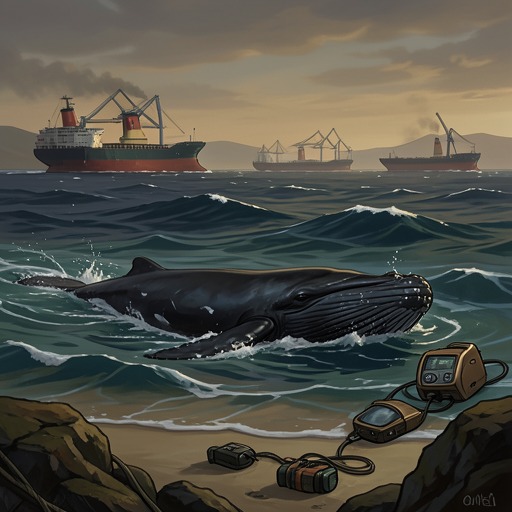
Cape Cod Bay of Early Whale Sightings and Whaling
The WhaleCape Cod Bay of Early Whale Sightings and Whaling occupies a turning point between land and open sea: a place where the Pilgrims saw whales in such numbers that they imagined the animals as a source of immense wealth, and where the book’s long history of whaling acquires a local beginning and an endangered present. Its significance lies not only in the hunts it made possible, but in the contrast between abundance once treated as an invitation to profit and the vulnerable populations that later generations may lose.
A Bay of Abundance
For the Pilgrims, Cape Cod Bay was at first an unfamiliar and difficult shore. Yet the whales in its waters made the place seem promising: hundreds appeared close to land, moving slowly enough to suggest that they were almost anchored there. The settlers regretted that they lacked the instruments and means to capture them. The contrast with Indigenous harvesting is important: local inhabitants had taken whales for sustenance, while European ventures increasingly regarded the animals as commercial wealth, a practice with earlier precedents in Basque voyages to Labrador.
The whales helped prompt the Pilgrims to consider settling at Provincetown. Two men aboard the Mayflower had previously whaled off Greenland and estimated that the whales in the bay might have yielded £4,000. Whale oil became a staple commodity of the colony, and the Mayflower itself was later put to work as a whaler, sailing across the bay from Plymouth. The location was thus connected from the outset to both settlement and extraction: the same animals that made the coast appear rich also helped shape the colony’s economic prospects.
From Coastal Sightings to a Wider Fishery
The bay’s early abundance belongs to a wider history of changing hunting grounds and targets. In 1712, Christopher Hussey’s sloop was reportedly blown beyond the usual limits of the Nantucket fisheries, where he encountered the Sperm whale in deep water. That discovery shifted the ambitions of the regional trade: the Sperm whale became a prized quarry, while Right whales grew scarcer. By 1730, Nantucket had twenty-five vessels in its fleet, and by the end of the eighteenth century it had become a world leader in whaling. This history does not make the Nantucket discovery an event in the bay; it shows how a fishery first imagined in waters rich with visible whales broadened into a far-ranging pursuit.
The change in the wider industry eventually came from beyond the sea. In 1859, Edwin L. Drake drilled for oil at Titusville, Pennsylvania. Petroleum and gas altered the market for whale oil, and the new oil discovery marked a decisive decline for the Sperm whale fishery even as it opened another phase of resource extraction. Later, Sven Foyn’s patented grenade harpoon made fast-moving whales, including the Blue whale and Fin whale, newly accessible to commercial hunters. As established fisheries were depleted, the industry expanded into distant waters: in 1904, Norwegian and British steamships opened Antarctic grounds, where whales supplied raw material for nitro-glycerine. These developments were not confined to Cape Cod Bay, but they illuminate the wider commercial system into which its once-abundant whales had been drawn.
The Human World of Whaling
The regional trade depended on ships that functioned as workplaces and tightly ordered communities, not merely as vessels moving between ports. On the Charles W. Morgan, space was arranged first for processing and storing whales. Officers occupied cabins according to rank, while ordinary sailors slept in crowded forecastle bunks; even daylight was unequally distributed, with fewer deck prisms illuminating their quarters. Families sometimes travelled aboard, fitting children’s lessons and a mother’s sewing into the ship’s cramped shared rooms. The contrast between domestic routines and the severe conditions endured by the crew reveals how thoroughly the ship organized human life around the whale’s capture and processing.
The people who carried out that work came from many backgrounds. In 1838, Frederick Douglass arrived in New Bedford after escaping slavery and spent four years doing hard labour, including rolling casks, stowing ships, sawing wood, and working at a blacksmith’s bellows. By the second quarter of the nineteenth century, Black residents made up a substantial proportion of New Bedford’s population, alongside communities with Azorean, Cape Verdean, and other origins. Whaling offered some Black sailors employment and, for a few, advancement to captain or mate; it did not erase racial hierarchy. Bunks remained segregated, and the difficult conditions eventually meant that men of colour predominated in many crews. This port history supplies a human context for the industry associated with the bay: its profits and dangers were borne by a diverse workforce whose opportunities were sharply unequal.
Remains, Memory, and Continuing Risk
The history of whaling also survives in collections far from the bay. In New Bedford, a fifty-ton Blue whale that washed ashore on Rhode Island in 1998 became the subject of a dispute between a local museum and the Smithsonian Institution. The compromise required the whale to be placed on public view. Its carcass was cut into sections, lowered into the river in cages, and left for two years while small river animals consumed the flesh; the cleaned skeleton was then reassembled in an atrium. The display turns the body once treated as an exploitable resource into a public specimen, while preserving a physical trace of the animal and the processes used to prepare it for exhibition.
The bay’s final appearance in this historical arc is not as a full hunting ground but as a habitat at risk. The account warns that right whales of Cape Cod Bay may be among the animals lost as extinction accelerates. It also notes that whaling can damage more than numbers: when hunting removes matriarchs, it may take with them socially transmitted knowledge needed by whale communities. The contrast is stark. The early sighting of hundreds of whales suggested abundance so immediate that it seemed to invite harvest; the later warning makes that abundance a measure of what may disappear. Cape Cod Bay therefore stands both at the beginning of a commercial history and at the edge of a conservation crisis.