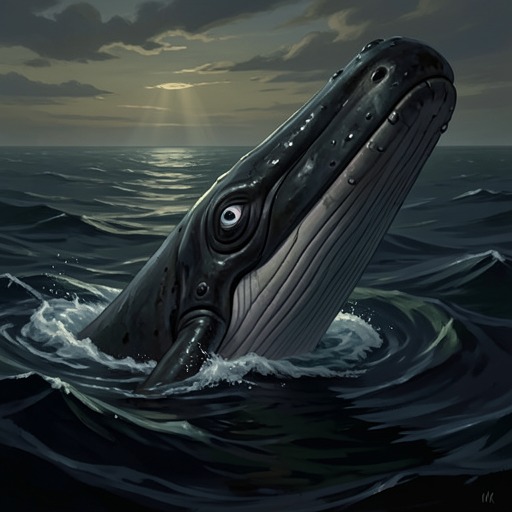
Cetacean cultural transmission
The WhaleCetacean cultural transmission is the passing of learned knowledge and behavior through social interaction rather than inheritance alone. The book develops the idea most fully through Sperm whale research: these whales may learn how to use particular habitats, how to find food, and how to communicate within socially distinct groups. This possibility changes the meaning of whaling. Killing a whale can remove an individual, but the loss of a knowledgeable animal may also diminish what its community can teach the next generation.
What Culture Means in Cetacean Societies
Studies cited in the book find that Cetaceans can solve problems, use tools, experience joy and grief, and live in complex societies. Cultural transmission gives these observations a collective dimension: abilities and information can be acquired through social contact and passed on, rather than being understood solely as individual capacities. Hal Whitehead describes culture as information learned through social interaction, and argues that Sperm whales have used it to adapt to demanding ocean environments.
The account does not treat culture as a human monopoly. Instead, it draws attention to the limits of human categories: whale communities inhabit a different medium and depend on forms of perception and social organization that people do not fully know. Whitehead’s research supports the view that Sperm whales are cognitively advanced, but the book also preserves an important qualification. Their lives remain largely inaccessible to human observation, and the complexity of their behavior suggests more than researchers can yet specify.
Learning Across Groups and Generations
The book describes ocean-wide Sperm whale clans whose members follow distinctive patterns and use different repertoires of clicks. Groups that are genetically similar and geographically close can nevertheless behave differently, including in how they forage. The methods are learned maternally and passed from one generation to the next. In this account, clan membership functions somewhat like nationality: it marks a shared social identity expressed through learned practices, not merely a biological division.
The comparison is especially revealing because it joins communication to practical knowledge. A group’s way of finding food is not presented as an isolated trick; it belongs to a socially maintained repertoire that can persist across generations. Whitehead’s research suggests that whales share information about feeding grounds and other experiences. The older animals may therefore matter to the survival of the group as repositories of knowledge: their continued presence can help maintain communal memory in an environment that keeps changing.
Clicks as Communication
Whitehead organizes Sperm whale clicks into four functional groupings. Foraging whales make usual clicks at about two per second. Creaks are more rapid and regular, associated with a whale homing in on prey or scanning other whales near the surface. Codas are communicative sequences, including patterns such as click-click-click-pause-click; they suggest conversation, although what information they convey remains unknown.
The fourth grouping is the most mysterious: slow clicks, or clangs, made by mature males at intervals of about seven seconds. These distinctions make clear that whale sound is not presented as one undifferentiated call. Different patterns are associated with different activities, and some appear to carry social information. Yet the book does not claim to translate them. The codas may function as a kind of cetacean Morse code, but their precise meanings remain beyond current knowledge. The tension between recognizing communication and being unable to interpret it is central to the account: evidence of social complexity does not amount to access to the lives whales lead.
Whaling and the Loss of Knowledge
Commercial whaling threatens cultural transmission alongside individual animals. Hal Whitehead warns that twentieth-century whaling may have destroyed not only numerous Sperm whales but also knowledge held by them about using particular habitats. The book links this loss to the removal of matriarchs, who may carry essential knowledge, and to the killing of large males. The harm is therefore not only a reduction in numbers. It may also disrupt the social relations through which information is retained and passed on.
Population decline compounds that disruption. Sperm whales breed slowly, and the population is described as growing at only about one per cent a year. Although the book distinguishes their experience from the more severe reductions suffered by Mysticetes such as the Right whale, it suggests that the 1986 moratorium may have arrived only just in time for the Sperm whale. The issue is not simply whether a population can increase again: even when animals remain, the loss of experienced individuals may have lasting consequences for collective knowledge.
Evidence, Uncertainty, and Extinction
The argument remains deliberately provisional. Whitehead’s research has not provided direct evidence for every claim about Sperm whale intelligence; instead, complex social behavior suggests communal recollection and the transmission of information. The book treats this as a serious inference, not as a license to translate whale experience into familiar human terms. It even raises the possibility that whales may have emotions, abstract concepts, or religion, but those possibilities remain speculation rather than established findings.
That uncertainty sharpens the conservation stakes. The book notes that the Yangtze River dolphin had been declared extinct during the period in which it was being written, and warns that other species may follow. In this setting, the possible loss of cetacean culture is both a scientific problem and an irreversible historical one: knowledge may disappear with the animals who carry it, before people have learned what it was. Cetacean cultural transmission thus connects social learning to conservation, making the survival of communities—not just the survival of individual whales—part of what is at risk.