Cetology
The WhaleCetology is the study of whales and other cetaceans, presented here not as a detached catalogue but as a practice shaped by observation, human contact, and the limits of what can be known. The book sets accounts of living animals beside shipboard experience, historical images, and conservation evidence: the whale must be studied in the water, but also in the stories and industries that have made it visible to people.
Observation and representation
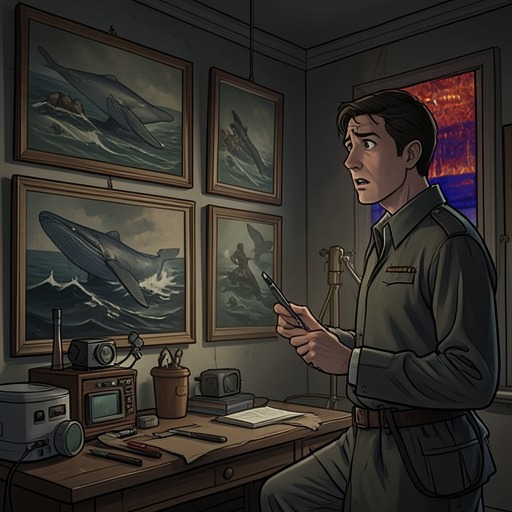
The book distinguishes knowledge acquired through close observation from images that merely give whales a familiar or fashionable shape. In its account of the “Monstrous Pictures of Whales,” Ishmael criticizes imaginary portraits and points to Frédéric Cuvier’s 1836 depiction of the Sperm whale as an example of the distortions encouraged by mistaken classification. When authorities claimed there were fourteen species of Sperm whale, artists produced images that varied wildly in proportions and features. Cetology therefore has a visual problem as well as a taxonomic one: a picture can present itself as knowledge while recording the expectations of its makers instead.
The visual record also has historical value when read in context. At the New Bedford Whaling Museum, images of whales include Esaias van de Velde’s Whale Beached between Scheveningen and Katwijk, depicting sightseers around a stranded whale in 1617. The scene belongs to a series of Sperm whale strandings on the Dutch coast in the sixteenth and seventeenth centuries. Such events were reproduced in engravings and on Delft plates and tiles, where the stranded animal could signify both the fortunes of the Dutch Golden Age and threats to them. Another image, described as an unusually accurate depiction, records a sixty-foot Sperm whale washed ashore at Beverwijk on 19 December 1601. Together, these examples show why images are evidence not only about whales, but also about the meanings people assigned to them.
Practical knowledge at sea
The book describes field encounters as lessons in natural history. In one observation, a group of three female Sperm whales dived in sequence, leaving a calf at the surface; when the adults returned together, the nearest slapped the water with her flukes. The sequence offers a concrete account of adult care and a warning about the observers’ proximity. Such details make practical cetology an encounter with animals behaving in relation to one another, not simply a process of identifying specimens.
That encounter belongs to a wider account of the whale-ship as both workplace and social world. Its cramped interior used every inch: shelves fitted into corners, drawers sat above the sofa, chests were stowed beneath bunks, and lamps, pots, and pans were secured for life at sea. Families sometimes travelled aboard; children worked at school around the mast, their mother sewed as the ship moved, and a four-year-old named Eugene nearly fell from a whaleboat while playing. These details situate whale knowledge in the ordinary routines of ships as well as in deliberate observation.
The ship’s social boundaries could be as unusual as its physical ones. A gam—a meeting with another vessel for news, letters, and social contact—carried a story to young Haley about a crew member who had concealed that she was a woman. The crew had mocked her appearance, and her identity became known when she fell ill. The episode shows how the ship’s male-coded working life could include people whose circumstances were not apparent to their shipmates. More generally, the book describes months aboard as an enclosed but mobile society, governed by watches, officers, and the unpredictable movements of whales; adventure existed alongside difficult conditions and poor pay.
The shore communities connected to this maritime world were diverse. By the second quarter of the nineteenth century, one in twenty residents of New Bedford was Black, a higher proportion than in New York, Boston, or Philadelphia. The city’s South End was known as Little Faial because of its Azorean community, while another neighborhood was called New Guinea. The book places these communities alongside the multiracial crews and harpooneers associated with Ishmael’s account of the Pequod. It also recounts Frederick Douglass’s arrival in New Bedford after escaping slavery in 1838: for four years he worked at varied jobs, including rolling casks and stowing ships. These contexts make the human world of whaling part of cetology’s subject: the study of whales takes place within labor systems and communities formed around the sea.
Population knowledge and conservation
Cetology also entails attention to population size, reproduction, behavior, and the effects of human activity. The Right whales that frequent Cape Cod Bay were especially vulnerable to historical hunting because their buoyancy kept them near the surface and their tendency to stay close to shore made them accessible. The book reports that fewer than four hundred remained in the North Atlantic. Although Right whales became the first cetaceans protected from hunting in 1935, their numbers remained static. The account identifies continued exposure to busy shipping routes as a threat: rules moved the shipping lane north and instructed vessels to stay five hundred yards from whales, yet ship strikes continued to kill animals, including females of breeding age. The restricted gene pool and small number of breeding whales led the book to warn that the population might not survive the century.
Stormy Mayo’s work gives this population-level concern a practical dimension. As a sixteen-year-old fishing with his father on Stellwagen Bank, he saw a Right whale at a time when the animals were already close to extinction. He later helped found the Center for Coastal Studies in Provincetown in 1976, collected data on Right whales, and became the first person licensed by the government to rescue whales entangled in fishing gear. The book reports that more than sixty per cent of Right whales had been caught in fishing line. It stresses the significance of each surviving breeding female: saving one could affect whether the species persisted or disappeared.
The same conservation argument extends to Sperm whales. Studies described in the book show cetaceans solving problems, using tools, experiencing joy and grief, and living in complex societies. They also transmit knowledge culturally. Hal Whitehead’s warning is that whaling may have removed not only individual animals but cultural knowledge of how to use particular habitats. The account adds that surviving animals experienced lower birth rates and that the slow-breeding Sperm whale population was growing at only one per cent a year. It presents the 1986 moratorium as arriving perhaps just in time for the species.
The risk is not confined to one population. The book notes that the Yangtze River dolphin was declared extinct between the beginning and completion of the work, and warns that many animal species could disappear by the end of the century. Its treatment of cetology thus connects the close study of individual behavior with questions that observations alone cannot answer: whether populations can recover, whether knowledge passes between generations, and whether protection can keep pace with human-caused losses.