Frederick Douglass
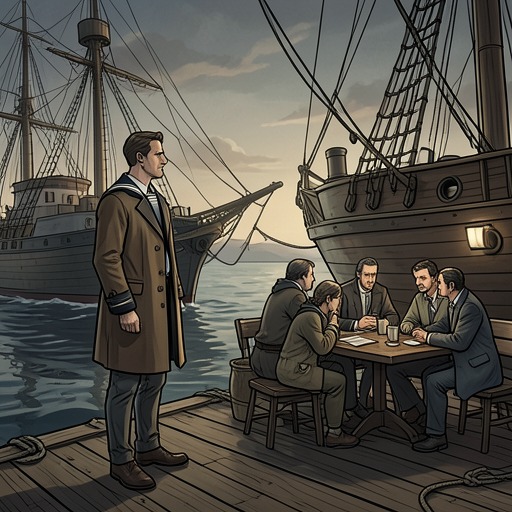
The WhaleFrederick Douglass is presented as an abolitionist whose life connects the whaling port of New Bedford with the struggle against slavery. In 1838, he escaped from Baltimore dressed as a sailor and made his way to New Bedford, where he lived and worked for four years. There, the ships and shipyards offered employment and a route into maritime life, while the port’s position within the Underground Railroad made it a place of refuge for people escaping slavery. The book sets that possibility of freedom against the exploitation built into whaling itself: New Bedford’s maritime world could shelter fugitives and still be bound to systems that treated human beings as cargo.
Escape and Work in New Bedford
Douglass was the son of an enslaved mother and a white father whose identity he never knew. His arrival in New Bedford followed an escape made possible, at least in part, by the disguise of a sailor. For four years he supported himself through demanding manual work: rolling casks, stowing ships, sawing wood, sweeping chimneys, and working at a blacksmith’s bellows. The account emphasizes not a sudden ascent out of hardship but the range of labor by which he established a life in the port.
The whaling industry supplied work to a population drawn from many places. In the book’s portrait of New Bedford, African and Indigenous workers, Azoreans, and Cape Verdeans appear alongside the sailors who pursued whales. By the second quarter of the nineteenth century, one in twenty residents was Black, a proportion greater than in New York, Boston, or Philadelphia. Neighborhood names and the languages heard on the streets register the city’s varied communities. The port was not simply a white New England town receiving occasional outsiders; people of color were part of its daily life and maritime economy.
That participation did not mean equality. Black sailors could find employment with shipowners who either did not ask questions or opposed slavery through Quaker belief, and some rose to become mates or captains. Yet shipboard bunks remained segregated, and the conditions of service could be so poor that by the end of the century men of color were the ones still willing to sign on. The prominence of Black faces in crew photographs therefore records both presence in the whaling trade and the limited, unequal terms on which that presence was sustained.
The Port as Refuge and Contradiction
New Bedford’s connection to the wider rail network began in the same year Douglass arrived. For him and other fugitives, however, the more consequential network was the Underground Railroad, a secret system that helped enslaved people escape northward and into Canada. A port offered a useful setting for such clandestine movement: shipping already involved departures, arrivals, concealment, and shifting identities, while whaling provided both jobs and a maritime tradition of disguise. The same mobility that served the commercial fleet could help people evade capture.
The book also places Douglass’s experience beside that of Henry ‘Box’ Brown, who was smuggled out of the South in a crate and emerged in New Bedford. Their stories make the city’s transience more than a feature of commerce: movement itself could become a kind of liberty. Douglass’s account of finding a near approach to freedom in New Bedford is carefully qualified. The refuge mattered precisely because slavery remained in force elsewhere, and because the freedom available in the port was not a universal condition.
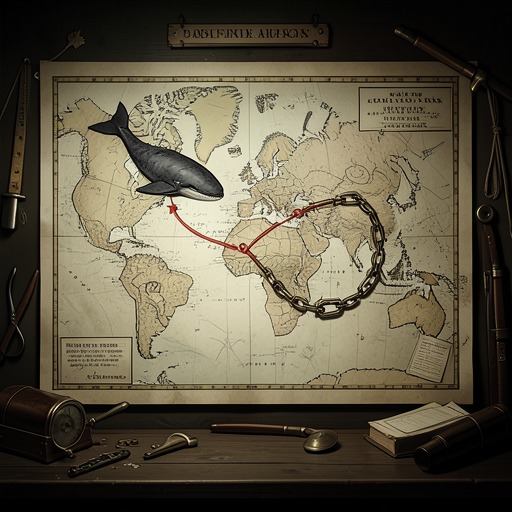
The contrast runs deeper than geography. Whaling and slavery coexisted as lucrative, transoceanic industries, each depending on the extraction and movement of lives or bodies for profit. Whale ships sometimes disguised themselves as warships to deter pirates and could shelter fugitives; during the Civil War, slave ships seeking to evade Union blockades sometimes masqueraded as whale ships. Such exchanges of disguise make the boundary between the two trades unstable. The book treats their relationship not as a simple equivalence, but as a shared history of exploitation, maritime traffic, and concealment.
Abolitionist Activism and Public Exposure
Douglass did not remain only a worker in the port. Determined to protect other fugitives from slave catchers, he began a public campaign against the injustice of slavery and is described as the first Black man in America to oppose it publicly. In the same year that Herman Melville sailed from New Bedford, Douglass was publicly recognized as an abolitionist lecturer at the Nantucket Atheneum. The book notes that historians have imagined the two men crossing paths in New Bedford’s streets, but does not establish that they met. Their connection is instead made through overlapping places, dates, and the conflicts their lives and writing confronted.
After publication of his memoir, Douglass faced violent opposition and attacks on his authenticity. His appearance, which unsettled the racial categories imposed on him, became a target for those who questioned whether he could have written his own account. The book presents this response as part of the hostility generated by his public voice: opponents sought to make his testimony seem impossible even as it challenged the authority of those who defended slavery.
In May 1850, Douglass’s appearances at the New York Society Library were disrupted by Captain Isaiah Rynders and the Law and Order Party, whose members attacked abolitionists, foreigners, and Black people. Later, as Douglass walked along Broadway with his English friends Julia and Elizabeth Griffiths, passersby reacted with open hostility; near the Battery, the group was attacked. The account connects this public violence to a scene in Herman Melville’s earlier novel Redburn, where a sailor’s interracial companionship is represented as something that would provoke a mob in New York. The parallel places Douglass’s experience within a broader climate in which even ordinary public presence could become a confrontation over race.
Historical and Literary Significance
Douglass responded to the New York assaults in his essay Colorphobia in New York! He later became an adviser to Abraham Lincoln on slavery during the war that followed. These developments carry his story from the refuge of a seaport into national political conflict, without erasing the practical labor and local networks that had shaped his earlier years. The book’s portrait thus links individual escape, communal assistance, public argument, and the violence directed against abolitionists.
Douglass also gives the account of New Bedford’s whaling economy its sharpest moral counterpoint. The city’s ships could provide work and concealment for fugitives, but the same maritime world depended on a trade that reduced whales to oil and other commodities. In the year Herman Melville began writing Moby-Dick, slavery had become an increasingly urgent national crisis. The book reads the whale’s blackness and whiteness, and the novel’s treatment of color, against that historical pressure. Douglass’s presence clarifies why the port cannot be understood as a simple sanctuary or a simple engine of commerce: it was both a near approach to freedom and a place shaped by industries and racial arrangements that denied freedom to others.