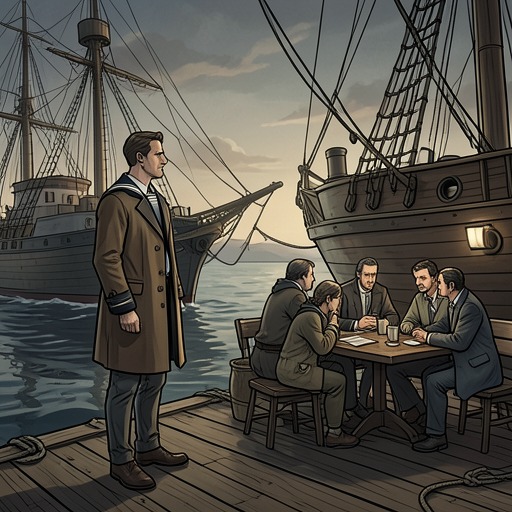
Frederick Douglass's escape from slavery
The WhaleFrederick Douglass's escape from slavery began in Baltimore in 1838, when he dressed as a sailor and made his way to New Bedford. He stayed there for four years, working at a range of manual jobs. The port became both a place of refuge and a vantage point from which the book examines the limits of freedom in a society whose maritime wealth depended on hard, unequal labor.
Escape and Arrival
Douglass was the son of an enslaved mother and a white father whose name he never knew. In 1838, dressed as a sailor, he escaped from Baltimore and arrived in New Bedford. The disguise connected his flight to the port’s seafaring world: a place where ships, maritime work, and movement between communities could help make escape possible.
New Bedford was connected to the New England rail network in the same year Douglass arrived. It was also an important stop on the Underground Railroad, the clandestine network that helped enslaved people escape to the North and Canada. The city’s port offered a practical advantage: its traffic and tradition of disguise could conceal illicit movement as well as provide work. For Douglass and other fugitives, the city’s transience offered a measure of liberty unavailable in a slaveholding state, though the account describes that freedom as an approach rather than an uncomplicated condition.
Work and the Port Community
For four years, Douglass lived and worked in New Bedford. His labor included rolling casks, stowing ships, sawing wood, sweeping chimneys, and working at a blacksmith’s bellows until his hands became hardened. The range of jobs places his life in the ordinary work of a busy port, where the movement of ships and goods depended on strenuous labor ashore as well as at sea.
The city’s population made visible the international and racial diversity of American whaling. By the second quarter of the nineteenth century, one in twenty New Bedfordians was Black, a greater proportion than in New York, Boston, or Philadelphia. The South End was known as Little Faial after its Azorean residents, while another downtown neighborhood was called New Guinea. A dozen languages could be heard in the streets. The book sets this varied community against a whaling industry in which men of color were prominent among crews, even as shipboard bunks remained segregated and working conditions could be harsh.
Freedom and Maritime Labor
New Bedford offered employment to Black sailors, including men hired by shipowners who did not ask questions and Quakers whose beliefs opposed slavery. Some Black sailors became captains or mates; others worked in maritime supply trades. Yet the city’s whaling economy did not escape the coercions and inequalities that marked American labor. On the Acushnet, for example, crew members’ shares varied sharply by rank: the foremost hand received a smaller fraction of profits than the captain or first officer, while a New York greenhand’s share was smaller still. Contracts restricted sailors from leaving before the hold was full, and onboard expenses could consume their earnings or leave them in debt.
The book draws the parallel between whaling and slavery without treating them as identical. Both were lucrative, exploitative industries extending across oceans; ships could disguise their purpose, and whaling vessels sometimes sheltered fugitives. The same maritime world that offered Douglass passage and work also bound sailors to severe discipline and unequal economic arrangements. His arrival in New Bedford therefore marks a real change in circumstances, but it does not erase the structures of exploitation surrounding the port.
The Event's Wider Significance
A half-scale whale-ship replica in New Bedford’s purpose-built hall makes the comparison tangible: its cramped lower decks recall the confinement of slave ships, though one vessel carried the products of dead whales and the other transported living people. Nearby, a daguerreotype of Douglass presents the abolitionist whose presence in the city complicates any simple celebration of its whaling prosperity. New Bedford was at once a center of an economy built on whales and a place where an escaped man could find work and a community near freedom.
The account connects the episode to the national crisis that surrounded the writing of Moby-Dick. In 1850, as Melville began the book, a new Fugitive Slave Law expanded slaveholders’ power to pursue people they claimed as property across state boundaries. Against that context, Douglass’s 1838 arrival in New Bedford becomes more than a biographical episode: it exposes the contested ground between escape, labor, and freedom in a maritime republic whose wealth and mobility depended on systems of unequal power.