Fugitive Slave Act of 1850
The WhaleThe Fugitive Slave Act of 1850 gave slaveholders extraordinary powers to pursue people they claimed as property across state boundaries. In the book’s account of the crisis surrounding Herman Melville’s composition of Moby-Dick, the law marks an intensification of slavery’s reach and gives the novel’s treatment of ownership, race, and whales a charged political context.
The Law and the Crisis of 1850
The law arrived as disputes over slavery threatened to divide the nation. Its authorization to pursue people across state limits extended slaveholders’ claims beyond the places where they held power, making the question of who could be treated as property a national conflict. Ralph Waldo Emerson condemned the measure, while the book places Melville’s writing of Moby-Dick in the same year, when the crisis was coming to a head.
The law’s consequences also appear in the actions of people who opposed its enforcement. Bronson Alcott, Emerson’s neighbour in Concord, sheltered fugitives in a concealed space compared to a priest-hole. His community at Fruitlands had rejected cotton because its production exploited enslaved people, as well as oil lamps because their fuel came from the deaths of whales. The juxtaposition connects resistance to slavery with an ethical refusal of other forms of extraction, without making those causes identical.
Slavery, Whaling, and the Problem of Property
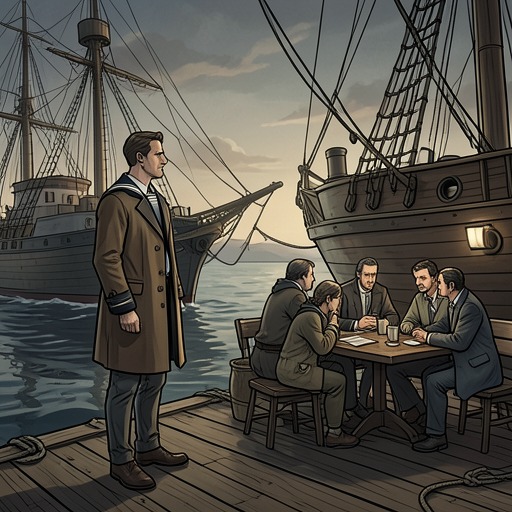
The book sets the law against the economic world of whaling. In the eighteenth and nineteenth centuries, slavery and whaling were both lucrative, exploitative industries operating across oceans. Whaling vessels sometimes disguised themselves as men-of-war to deter pirates and sometimes sheltered fugitives; conversely, slave ships seeking to evade Unionist blockades could masquerade as whalers. These crossings make the law’s language of property especially consequential: the same maritime world could conceal people escaping enslavement and vessels transporting enslaved people.
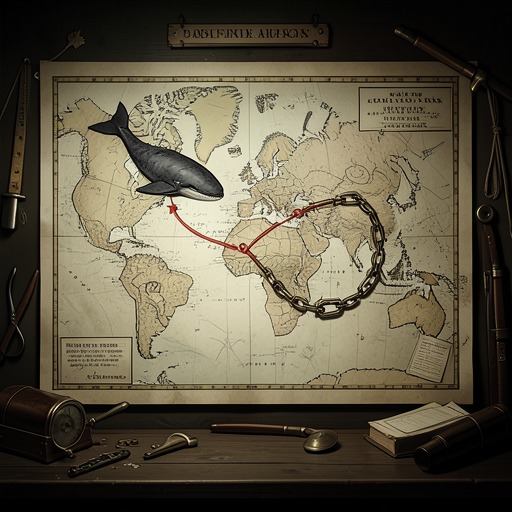
Melville’s cetological analogy turns the political crisis toward the classification of whales. Ishmael observes that English and American names for the Greenland whale and the right whale rest on distinctions without a decisive factual basis. The passage makes elaborate divisions in natural history resemble the divisions used to organize human difference. Elsewhere, Ishmael describes a dark-hued whale hunted until its heart burst, while the whiteness of Moby Dick becomes a reflection of American preoccupation with color. The novel does not restate the statute; it places its conflict over racial categories and ownership beside its scrutiny of how humans classify and pursue whales.
Resistance and Public Backlash
Frederick Douglass responded to the law by campaigning publicly against it and seeking to protect other fugitives. The book describes his abolitionist appearances in the Nantucket Atheneum in the same year that Melville sailed from New Bedford, while treating any imagined meeting between the two men in New Bedford’s streets as speculation rather than established fact.
The response to Douglass’s public work extended beyond disagreement with his arguments. After his memoir appeared four years later, opponents questioned whether he had written it and attacked his racial identity. In May 1850, his appearances at the New York Society Library were disrupted by Isaiah Rynders and members of the Law and Order Party, who attacked abolitionists, foreigners, and Black people. A newspaper urged readers to use violence. These episodes show the law’s controversy unfolding not only through legislation but also through efforts to silence those who challenged slavery.
Property, Jurisdiction, and Later Regulation
The book’s other examples of law and whales illuminate a broader tension over who may claim living bodies as property, though they belong to different jurisdictions and are not consequences of the American act. On the English coast, a whale washed ashore at Tunstall became the property of the Lord Paramount of Holderness under a local privilege; elsewhere, such a whale would have belonged to the Crown. A separate English rule, established in 1324, made whales, dolphins, porpoises, and sturgeons found on shore royal property. By the twenty-first century, administration of that inheritance had become a costly responsibility for the Receiver of Wreck, rather than a profitable royal claim.
The book also traces a distinct shift from commercial entitlement toward international restriction of whaling. An agreement drafted in 1935 and negotiated further at Oslo in 1936 sought to limit the whaling season and the number of catcher boats. In 1982, the International Whaling Commission instituted a worldwide moratorium, which took effect in 1987. These measures did not arise from the Fugitive Slave Act; set beside it, however, they show how legal systems can define the uses, ownership, and protection of living beings differently over time. The statute’s central human consequence remains a stark warning within that comparison: legal recognition of a property claim can authorize pursuit across boundaries, even where the claim itself denies the person pursued full protection.