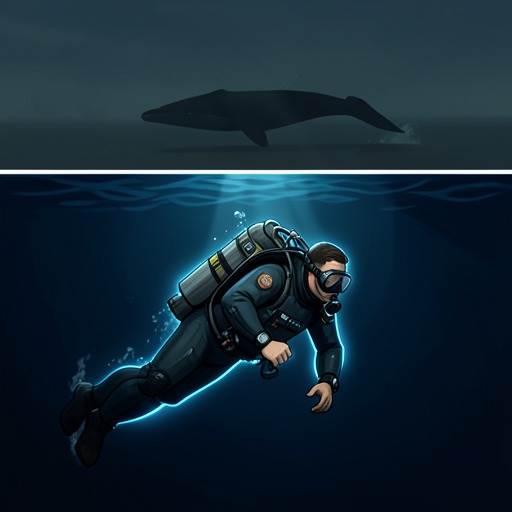
Hoare swims alongside a juvenile sperm whale
The WhalePhilip Hoare swims alongside a juvenile sperm whale in an encounter that changes the terms of his fear: entering the sea begins as a test of nerve, but becomes a brief, close encounter whose movement the whale largely controls. After repeated waits and failed attempts to approach, Hoare gets into the water and sees the animal underwater. Its beauty quiets his fear; swimming together, the two remain physically close but radically unequal in their understanding of the encounter. The whale eventually circles, raises its head, lifts its flukes, and vanishes.
Waiting and the attempt to enter
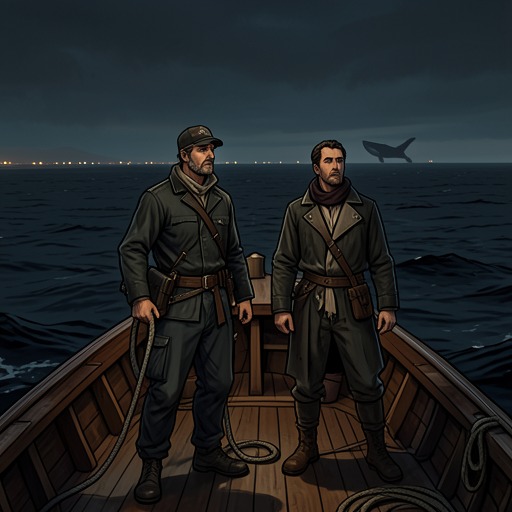
The swim follows a period of waiting that begins again after the whales have appeared as prehistoric presences. Hoare spends the day in his wet suit, sitting in the boat and remaining ready, but the approach fails two or three times. João Quadresma cannot get the boat ahead of the whales, and approaching from another angle would be futile. The scene therefore makes access dependent not simply on Hoare’s willingness, but on the position of the boat and the whales’ movement. Readiness does not guarantee that the encounter will happen.
When the opportunity comes, João gives the brief instruction to go. Hoare is better protected against the sea’s deceptive chill than before, insulated in a way he compares to the whale. He drops from the boat, releases his fingertips from its edge, and lets his body bob until it finds its buoyancy. João’s shouted directions recede with the boat. In that transition from boat to water, Hoare loses the practical support of the group and begins moving alone toward the animal. The approach is still guided by another person’s directions, but the experience itself becomes immediate and bodily.
Seeing the whale
The animal that comes into view is a juvenile, about ten years old, as João later estimates. Its pronounced melon identifies it as male, while its grey body shines in the sun. Hoare has learned that older whales grow paler, so this animal’s greyness also locates it within a life that will alter its appearance. Yet age and sex do not diminish its physical scale: it is bigger than the boat from which Hoare has entered the water.
Underwater, the sight of the whale changes Hoare’s response. His fear subsides as he takes in what he experiences as its extraordinary beauty. He forces his body downward, then feels unexpectedly calm; his heart rate slows, and he tries to widen his eyes so he can see more. Rather than immediately turning the encounter into an explanation, he concentrates on registering the animal’s features as they appear. The scene gives bodily perception its own sequence: the fear lessens, the body relaxes, and attention sharpens.
Hoare observes skin that shifts from smoothness to wrinkled flanks, muscles rippling beneath it, and flukes whose slatted shape recalls an aeroplane’s tailfins. The whale’s jaw is tightly clamped, but this does not make it seem threatening to him; instead, he reads the animal as placid and even playful. It does not appear hurried to leave. It hangs in the water, then turns toward him. These details make the encounter intimate without suggesting that Hoare can know what the whale intends.
An encounter on the whale’s terms
As the whale moves toward him, Hoare recognizes an asymmetry in their awareness. He comes to understand that the whales have assessed him, even though he cannot comprehend them. In his account, the animal places him within a four-dimensional map and appraises him through six senses; the image conveys an order of perception beyond his own access. He can notice the whale’s movements, but cannot translate them into a complete understanding of the whale’s experience.
The contrast is also a contrast of control. Hoare struggles to maintain his balance and remain part of the encounter, while the whales control its choreography. This realization complicates the apparent simplicity of a human approaching a wild animal to see it. Hoare is present and observant, but he is not directing the scene. The animal’s movements take account of his, while his own effort to stay steady makes clear how dependent he is on the whale’s continued tolerance of his presence.
The juvenile then moves alongside him. For minutes that seem to stretch into hours, they swim together, eye to eye, fin to fin, fluke to fluke. Their movements mirror one another in parallel. Hoare sets the black neoprene of his suit against the whale’s grey blubber, and his scrawny human body against the animal’s muscular one. The repeated pairings hold proximity and difference together: they share a direction and a rhythm, but not a body, scale, or means of apprehending the world. By this point, Hoare is no longer afraid.
Departure and significance
The swim ends when Hoare returns to the boat. From there, he watches the whale turn in a circle, raise its head once more, dip down, and lift its flukes before disappearing. The ending belongs to the animal’s movement away, not to any action by Hoare that secures or prolongs their contact. The whale’s final emergence and dive leave the encounter with a visible conclusion but no claim that its meaning has been settled.
The episode’s significance lies in the shift from nervous preparation to a moment of shared movement, and in the limits that remain even at closest range. Hoare can describe the whale’s skin, muscles, jaw, and gestures, and can record how his own fear and heartbeat change. He can also recognize that the animal responds to his movements. But the whale’s fuller perception remains inaccessible. Swimming in parallel gives Hoare a rare bodily closeness, not mastery of the animal’s inner life; the whale’s quiet departure preserves that distinction.