Holderness
The WhaleHolderness is a coastal landscape in Yorkshire where the North Sea continually reshapes the boundary between land and water. The book brings its physical instability into focus through the 1825 stranding of a sperm whale at Tunstall: a rare spectacle that drew a large crowd, invited scientific scrutiny, and exposed the rules by which a stranded whale could become private property. The animal’s later dispersal into fragments makes the place a meeting point of natural history, human ownership, and the persistent power of the sea.
A Coastline in Motion
Holderness Plain is a level, alluvial landscape whose apparent flatness offers little protection from the water. The coastline is described as retreating by yards rather than feet each year. The North Sea wears away the boulder clay, and whole villages have crumbled into the waves; fossilized forests lie beneath the surf. The coast is not simply a setting in which human events occur. Its ongoing erosion places houses, settlements, and inherited claims within a landscape that is itself being taken apart.
The approach to Burton Constable Hall passes through this exposed terrain. A straight drive leads inland to the red-brick towers and battlements of the estate, where the Constable family has lived since the sixteenth century. The family maintained its Catholic faith in a private chapel, while the land around its seat was gradually eaten away by the sea. The distance from London mattered: the book observes that, in this part of Yorkshire, the family’s religious practice attracted little attention. The estate thus represents continuity of residence and belief within a region whose physical ground is anything but fixed.
The Tunstall Stranding
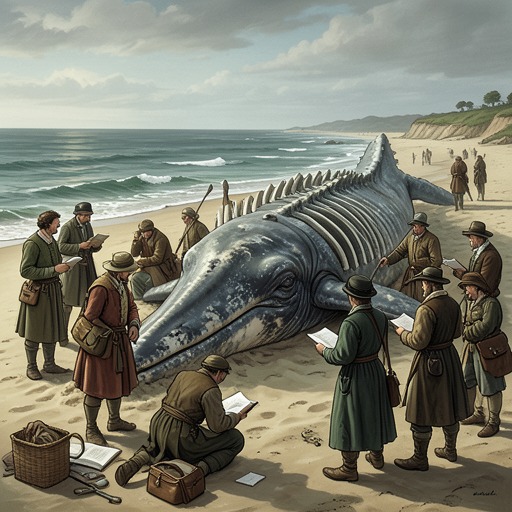
In April 1825, a dead whale was sighted offshore near Holderness. Such strandings were not unknown along this coast, but the scale of this animal made it remarkable. Fishermen initially avoided it, concerned that it might damage their boats. The tide eventually carried the carcass ashore, and on Thursday afternoon, 28 April, it came to rest on Tunstall beach beneath the low cliffs. Its arrival turned a familiar danger of the coastline into a local public event.
The next day, Reverend Christopher Sykes, an amateur scientist, came to record the whale’s measurements. By Sunday, roughly a thousand people had gathered to see it. The animal was identified as a bull sperm whale measuring fifty-eight feet. Its appearance differed from the expected image of a sleek, dark creature: after being cast ashore, it had begun to decay, and the exposed surface beneath its skin seemed strange to onlookers. The crowd’s interest brought attention and scrutiny, but also hastened the removal of parts of the body. The episode therefore joined observation to disturbance: people came to see a marine giant, and their handling of it altered the specimen they had come to examine.
The stranding also entered private correspondence. Sara Stickney reported the bustle it caused in the neighbourhood, while describing the increasingly unpleasant condition of the whale. Her response registers a contrast between the wonder that drew people to the beach and the difficulty of enduring the animal as it decomposed. Holderness’s whale was at once a spectacle, a scientific object, and a physical presence that challenged the comfort of those who gathered around it.
Ownership and the Whale’s Remains
The whale’s arrival brought a legal claim into view. Ishmael notes that, once washed ashore, it became the property of the Lord Paramount of the Seigniory of Holderness, the Squire of Burton Constable Hall. On much of the English coast, a whale would have counted as a Royal fish and belonged to the Crown. Here, however, the Lord Paramount exercised the right across his own territory, which extended from Flamborough Head to Spurn Point.
Richard Iveson, the Constables’ steward, was among the first to reach the beach. He measured and sketched the whale, actions that also asserted his employer’s claim. His drawing was later reproduced as an engraving, placing the huge animal within a record of estate authority as well as natural history. The whale had crossed from the sea into a system of human possession: its stranding made it available for observation, but also determined who could claim it.
The whale’s remains did not stay together. In the later account of Burton Constable Hall, its bones are scattered among outbuildings, including backbones and ribs awaiting reconstruction. The narrator finds that the bones once displayed outside have been removed; a groundsman offers to show some vertebrae. Elsewhere on the grounds, the empty space and remnants of the structure that supported the whale mark its absence. What had briefly stood as an assembled skeleton survives as a dispersed collection, so that the search for the animal becomes a search among fragments and traces.
Holderness and the Unmastered Sea
The stranding gives Holderness a particular place in the book’s wider account of the sea. Human beings may measure a whale, record it, display its bones, and decide who owns it after it reaches shore. Yet the animal’s arrival depends on tides and currents, and the coast that receives it is itself being steadily worn away. The sea’s action exceeds both the estate’s boundaries and the efforts to preserve a specimen within them.
That tension echoes the book’s broader contrast between the ocean’s enduring wildness and the human tendency to treat it as mastered or merely useful. At Holderness, this contrast is grounded in specific things: a stranded whale, a sketch made to support a claim, bones divided among outbuildings, and a shoreline losing land to the water. The place’s significance lies not only in the extraordinary animal that came ashore, but in how quickly wonder became measurement, possession, and display—and how the changing coast unsettles any sense that those acts can make the sea fully knowable or controllable.