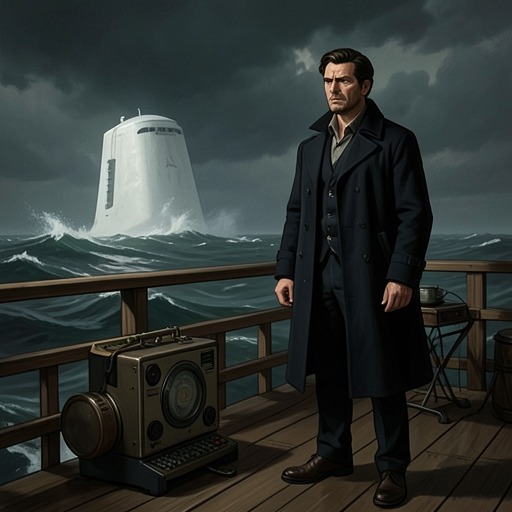
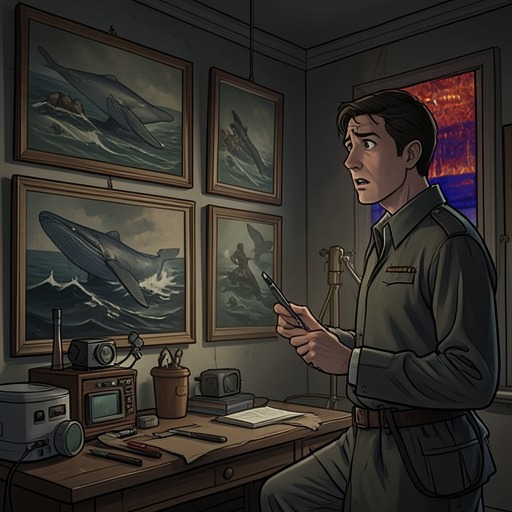
Ishmael
The WhaleIshmael is the sailor and first-person narrator of Herman Melville’s Moby-Dick, a survivor whose account makes a failed whaling expedition into a wide-ranging inquiry into the whale, the sea, and human ambition. He begins with a name that may be a real identity or a chosen disguise, and with a biblical resonance that shadows his status as an outsider. His journey carries him from a life-weary Manhattan to the whaling ship Pequod and eventually back to the world as the sole human survivor of its destruction. Between those points, his voice shifts from practical sailor’s observation to taxonomy, history, sermon, comedy, and speculation, making his way of telling the story as important as the voyage itself.
Identity and Departure
The novel’s opening invitation, “Call me Ishmael.”, establishes both an identity and a qualification: the reader is given a name, but not a guarantee that it is the narrator’s original one. The uncertainty suits a young man who has become profoundly tired of life in Manhattan and chooses the sea as a refuge. His movement toward whaling is not presented as a single, pure calling. The sea offers escape and an object of poetic fascination, while work as a sailor offers the practical advantage of being paid for the voyage. Ishmael can acknowledge both motives without pretending that one cancels the other.
In New Bedford of Whaling's Decline and Whale-Oil Industry Debates, he learns that the next packet for Nantucket will not sail for two days. Seeking inexpensive lodging, he enters the Spouter Inn, where sea imagery and whaling implements surround him, and discovers that he is expected to share a room with a harpooneer. The encounter tests his assumptions about a person he has not yet met. By morning, the initial fear has given way to comfort: he wakes in Queequeg’s embrace and finds the two men’s patterned arms and the patchwork bedcover visually joined in his recollection. Ishmael describes this intimacy as the beginning of a bond so complete that the two would die for one another. Their friendship is also a quiet rebellion against the social boundaries Ishmael had brought with him from the ordinary world.
The Voyage and Its Human Economy
Ishmael joins a voyage that places his own mixed motives beside Ahab’s consuming objective. For Ishmael, going to sea is at once livelihood, movement, and a way of approaching a subject he cannot fully comprehend. For Ahab, captain of the Pequod, the voyage becomes an extended pursuit of revenge against Moby Dick, the sperm whale that had disabled him. Ishmael’s account makes the difference between these aims central: a sailor may enter the trade for wages or experience, while the captain directs the ship and its crew toward a private, increasingly absolute purpose.
The voyage’s daily structure gives that pursuit a material and repetitive foundation. The crew works four hours on and four hours off, keeping watch as the ship crosses stretches of ocean and uncertain time zones. When whales are sighted, routine gives way to the compressed urgency of the chase. The accumulated labor of recruiting, provisioning, searching, and pursuing serves the production of whale oil and the filling of barrels; those barrels in turn secure only a brief interval on shore before another voyage beckons. Ishmael understands this as a cycle from which a sailor may not escape until nature or a whale’s unpredictable action intervenes. The whale is therefore at once animal, quarry, and the force around which human work is organized.
That work does not reduce Ishmael’s attention to economic calculation. In the processing of a sperm whale, he finds a moment of unexpected sensual and spiritual reflection among the dangerous duties of the ship. Handling spermaceti, he describes the task as soothing and imagines the workers’ hands among jars of oil as a scene of angelic labor. Elsewhere, the heated try-pots turn blubber into fuel, making the whale supply the means by which its own body is consumed. Ishmael’s contrasting responses hold the voyage’s contradictions together: labor can prompt reverie even as it belongs to a brutal industrial process, and the same whale can appear as a source of practical value and as a subject that exceeds human use.
A Narrator Who Ranges Beyond the Plot
Ishmael does not tell the expedition as an uninterrupted sequence of events. He repeatedly steps aside from the forward movement of the voyage to address the reader, assemble historical accounts, describe the whale through competing systems of classification, or turn to sermons, anatomy, theatrical imagery, and the properties of spermaceti. The opening materials include a gathered history of references to whales, attributed to a sub-sub-librarian; later, the narrator’s digressions make the attempt to know the animal part of the story. The whale is hunted as if it could be captured and defined, while Ishmael’s changing forms of description keep exposing the limits of that effort.
This manner of narration also places his personal voyage within a larger account of human history. Ishmael presents whaling as an enterprise with consequences beyond a ship’s crew and its cargo, describing it as a powerful influence upon the world. The trade links maritime skill, commerce, and the movement of people; its importance cannot be contained within the narrow drama of a chase. In this wider frame, the whaler’s pursuit participates in national ambition and industrial expansion, even as individual sailors remain tied to a repeating cycle of labor and departure.
The scale of that history does not make Ishmael a master of his subject. His account considers the sperm whale as an opponent of extraordinary size and as a creature that can survive attacks and appear, in sailors’ stories, across distant latitudes. Such reports enlarge Moby Dick beyond the ordinary boundaries of a pursued animal. Ishmael’s narrative thus moves between particular knowledge and imaginative uncertainty: it offers descriptions, facts, and inherited tales without resolving the whale into a single stable meaning. His digressions are not simply interruptions of the adventure; they are the form through which the book keeps testing what can be said about its central creature.
Destruction, Survival, and Meaning
The pursuit ends in a three-day chase that brings Ahab’s objective and the Pequod’s fate together. In the final attack, Ahab strikes at Moby Dick, but the line attached to his harpoon catches him and carries him from the boat. He is last seen bound to the whale’s side, while the rest of the crew is swept toward the ship’s destruction. Moby Dick then stoves in the Pequod, and the vessel sinks with its human company. The catastrophe reverses the voyage’s working order: the crew that had organized its time and labor around finding a whale is erased by the creature it sought to master.
Ishmael alone survives. He clings to Queequeg’s coffin, made into a buoy, until a passing whale-ship finds him while searching for its missing crew members. The survival is both physical and relational: the object that carries him through the sea is associated with the friend whose companionship had first given him a place aboard the voyage. He returns as an orphaned remainder of the Pequod’s company, not as a conqueror who has solved the mystery of the whale. The survivors’ search yields one more person lost from his original company, but Ishmael’s account itself becomes the means by which that vanished voyage can be told.
Narrative and Thematic Role
Ishmael’s importance lies in the tension between participation and distance. He works as a sailor within the whaling enterprise, yet his reflective voice repeatedly draws attention to the cost, scale, and strangeness of that enterprise. He can take pleasure in the physical world of the ship and its work, recognize the force of commercial routine, and still regard the whale as something no catalogue or market can exhaust. His narrative holds the practical and the metaphysical side by side rather than resolving one into the other.
The ending gives this divided role its clearest form. The crew is lost in the attempt to pursue and destroy Moby Dick, while the whale remains beyond the human story’s final accounting and Ishmael lives to narrate it. His survival does not prove that he has understood the sea or the whale; instead, it preserves the possibility of returning to them through language. The narrator who began with an uncertain name ends as the witness through whom the voyage persists, carrying a history of friendship and labor alongside the unanswered question of what the whale means.