James Alderson
The WhaleJames Alderson was a Yorkshire physician and Fellow of Pembroke College, Cambridge, and the Cambridge Philosophical Society. His encounter with a sperm whale washed ashore at Holderness gave him an unusual subject for scientific investigation: a vast animal whose body could be examined only as it was taken apart. Alderson documented its anatomy and the limits imposed on his inquiry, but could not determine its cause of death.
Appointment and scientific opportunity
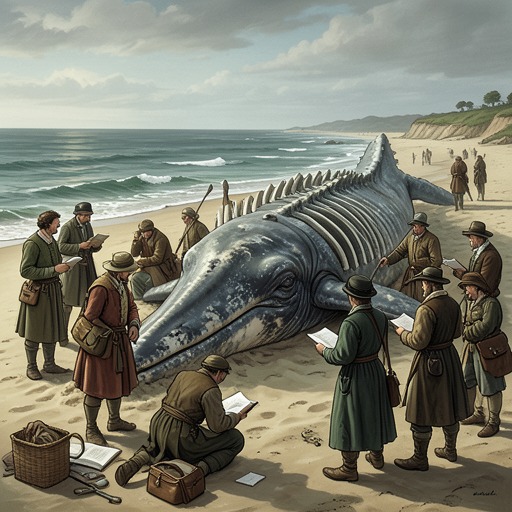
After a crowd gathered to see the stranded whale, Reverend Christopher Sykes recorded its vital statistics. The animal was identified as a bull sperm whale, fifty-eight feet long. Its remains soon became the focus of both commercial interest and scientific scrutiny: the blubber was valued, the head yielded spermaceti, and the meat could have fed families. Alderson was appointed to perform a post-mortem because the specimen offered scientific value beyond its possible uses as a commodity or food.
For Alderson, the examination was also an opportunity to address conflicting evidence about whales and to advance his academic standing. The remains were brought to his laboratory in Hull, but the scale of the animal made the work logistically difficult; he received it in instalments rather than as an intact specimen. In presenting his observations to fellow members of the Cambridge Philosophical Society, he contrasted the living animal’s appearance with the very different impression made by its skeleton, especially the enormous mass around its cheeks and jaw.
Examining the whale
Alderson’s account attended to features that the crowd’s butchering and the work of clearing the bones had made difficult to study systematically. The whale’s eyes had already been removed. He nevertheless recorded their unusual shape and described the iris and the coloured, spotted appearance of the reflective tissue at the back of the eye. His attention to these details gave scientific description a counterweight to the spectacle of a huge carcass being dismantled: even separated from the living animal, its parts could disclose forms of beauty and anatomical difference.
Other observations concerned the whale’s substantial lower jaw, which held forty-seven teeth, and its large heart, later preserved in formaldehyde and presented to the Yorkshire Philosophical Society. These details formed part of an examination conducted amid the practical constraints of processing a body on such a scale. The remains did not reach Alderson as a complete specimen, and dissection was already being directed toward clearing the skeleton.
Limits of the post-mortem
Alderson was frustrated that the viscera had been removed so quickly to clear the bones, leaving him unable to examine every organ. That loss mattered directly to his central question: after investigating the remains, he could not identify the cause of death. He found a five-inch section of a swordfish spear embedded in the whale’s back and another opening that appeared to have been made by a harpoon, but neither finding established what had killed it.
The book sets those embedded objects alongside accounts of whales surviving with foreign material lodged in their bodies. Thomas Beale had recorded swordfish attacks, and Ishmael describes a harpoon travelling through a whale’s flesh before being found much farther from where it entered. These comparisons underscore the uncertainty of Alderson’s conclusion: the remains carried signs of violent encounters, but the evidence available to him did not resolve the whale’s final history. His contribution lies both in the anatomical record he made and in the unanswered question his examination left behind.