Japan
The WhaleJapan’s whaling history moves from long-established coastal practices to a modern, ocean-spanning industry, making the country a pivotal and contested presence in the international struggle over whale exploitation. The account traces how foreign contact and imported techniques opened new grounds, how postwar assistance helped rebuild Japanese whaling at industrial scale, and how disputes over regulation became entangled with food policy, cultural identity, and objections to Western pressure.
Coastal Practice and Expansion
Whaling settlements existed along Japan’s coasts for centuries, but the account distinguishes this history from the later growth of modern pelagic whaling. In 1819 the British ship Syren discovered prolific grounds off Japan and the Bonin Islands. A visit by Tsar Nicholas II in 1891, during which he saw large numbers of whales in the Sea of Japan, is described as a further stimulus to modern whaling in Japanese waters.
By 1934, Japanese vessels, using techniques learned from Norwegian whalers, had begun voyages into the Southern Ocean. That expansion brought Japan into direct relation with the international effort to limit catches. At the 1937 conference in London, delegates hoped that Japan, whose operations were rapidly growing, would join the new convention. Japan did not adhere to the agreements described in the account, and its industry prospered outside their limits. Within five years, six Japanese factory ships were operating in Antarctic waters.
This development took place alongside a striking imbalance in the industry. In the late 1930s, Britain and Norway still accounted for most of the annual toll, while Japan’s operations were expanding beyond the convention’s reach. Catcher boats could fire from elevated prows, reducing the chance for whales to resist; the narrative contrasts that method with the older Yankee whaling in which a whale could fight back. Japan’s rise was therefore not presented in isolation, but as part of a wider industrial transformation in which the scale and safety of the hunt increasingly favoured the hunters.
Postwar Support and the 1948 Expedition
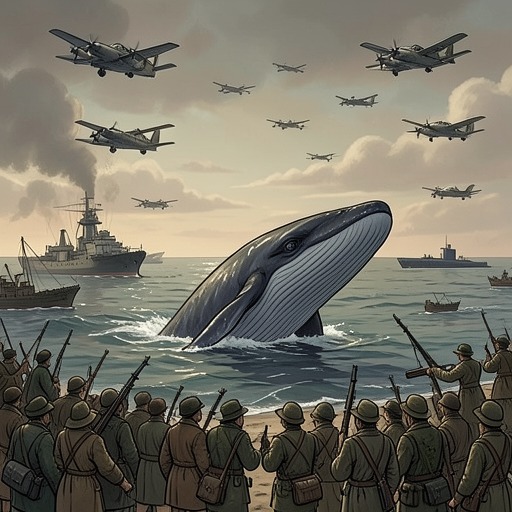
After the Second World War, the Allies encouraged Japan to use whale meat as an inexpensive source of protein during a period of austerity. Under General Douglas MacArthur, decommissioned naval ships were also helped into whaling service. The shift placed former wartime vessels into a new use, directed not against a human enemy but toward the extraction of marine resources. Australia objected that it had not been consulted and raised concerns about Japanese violations of whaling rules and the wastefulness of the operation.
In 1948, a Japanese expedition travelled six thousand miles to the Southern Ocean with a fleet and crew on the scale of a small town: thirteen hundred men, six catcher boats, the ten-thousand-ton factory ship Hashidate Maru, two processing ships, an oil tanker, and two cold-storage vessels. Ships kept apart to avoid collisions with one another and with icebergs, using radar to navigate through dense fog. Their arrival in the whale grounds represented a striking departure from the scale of earlier whaling voyages.
The account follows the fleet’s pursuit of a blue whale that repeatedly sounded before a gunner struck it after two hours. The whale was processed immediately, then hauled to the factory ship and butchered by a large work crew. At 300,000 pounds, it was among the largest whales ever caught; its tongue alone weighed three tons. The ship’s industrial system converted the animal into saleable products rather than treating the catch as a single, indivisible prize. Below deck, blubber was reduced to oil and stored in tanks, while oil was also extracted from the liver. The animal yielded 133 barrels of oil and sixty tons of meat, valued at $28,000. The example makes visible the combination of specialized vessels, onboard processing, and multiple markets that enabled the fleet to turn a single whale into a broad cargo.
The Balaena’s return to Southampton in the same postwar period offers a related but distinct measure of the industry’s scale: that British ship had captured three thousand whales during its season. Its cargo included meat and oil intended for food and industrial uses. Japan’s expedition and the Balaena’s return thus belong to a wider postwar recovery of whaling, in which national food supplies and economic reconstruction were closely tied to the capture and processing of whales.
Regulation, Competition, and Fleet Growth
As restrictions accumulated, Japan’s position became a recurring point of dispute. In 1958, the International Whaling Commission extended limits on hunting humpbacks, but these measures could not constrain countries that had not joined the organization. The account presents the regulatory system as vulnerable to both non-participation and disagreement over quotas: the Netherlands and Norway later withdrew after judging their permitted catches unreasonable, while Japan continued to enlarge its fleet.
By 1963, news reports connected increased Japanese appetite for whale meat with industrial growth, emphasizing that meat mattered more to the Japanese market than whale oil. Japan had acquired the Southern Harvester, a ship previously visited by the Queen’s husband. The account notes that descriptions of Japanese whaling sometimes carried the legacy of wartime hostility, and presents such reporting as potentially biased rather than neutral evidence. At the same time, it records criticism that a free-for-all was emptying the whaling grounds.
The Greek shipping magnate Aristotle Onassis illustrates how the regulatory problem extended beyond national fleets. His ships were registered in Honduras and Panama, outside the International Whaling Commission’s membership, and hunted in protected waters. After Norway publicized the operation and the Peruvian navy and air force fired on the ships for whaling within Peruvian territorial waters, Onassis stopped and found it more profitable to sell the fleet to Japan. The episode links Japan’s growing capacity to the movement of ships and capital across national boundaries, while showing that regulation could be evaded through registration and that enforcement depended on political action as well as formal agreements.
Quotas also converted individual animals into administrative units. For the 1967–68 Antarctic season, the catch limit was expressed as thirty-two thousand Blue Whale Units, a measure that translated different whale species into a shared calculation. The account treats this system as an emblem of a larger reduction: whales became stocks in bureaucratic equations, even as the numbers were meant to restrain hunting.
Cultural Claims and Conservation Disputes
The later dispute over Japan’s whaling is shaped by the history of Western encouragement. Whale meat appeared in Japanese school lunches until the 1970s, and the account stresses the contradiction between that postwar support and subsequent foreign criticism. Ayako Okubo is reported as saying that resistance was not simply about a desire to eat whale meat; it was also about opposition to being told by foreigners not to eat it. The passage does not resolve the competing claims, but places them in the political history of who had promoted the industry and who later claimed authority to restrict it.
Japan framed whaling as part of a long cultural heritage, a claim compared in the account with whaling traditions in Europe and with Indigenous hunts in American waters. This comparison reveals a tension between cultural precedent and contemporary conservation: a practice’s historical presence does not, by itself, settle questions about modern industrial scale or the condition of whale populations. The narrative also suggests that the United States’ own former prominence in whaling, followed by the late-nineteenth-century decline of its industry, shaped the later politics of prohibition. Had the United States maintained a postwar whaling presence, the political impetus for an international ban might have developed differently.
The moratorium that eventually took effect in 1987 did not end Japanese whaling. Under the Antarctic Research Programme and its North Pacific equivalent, JARPN, Japan killed thousands of Minke whales, alongside Bryde’s whales, Sei whales, and sperm whales; sperm-whale hunting resumed in 2000. In 2006, the Antarctic programme took 1,073 Minke whales and fifty Fin whales. The account further states that Japan killed twenty thousand smaller whales, dolphins, and porpoises annually that were not covered by the moratorium. It reports conservationists’ concerns that whale meat was being stockpiled as public demand diminished, or sold for pet food, and notes that scientists disputed whether the programme’s research required lethal methods.
Japan consequently appears neither as a simple exception to international conservation nor as a detached target of criticism. Its modern industry had been assisted by the postwar powers, expanded through imported techniques and mobile factory ships, and defended through appeals to cultural continuity and national autonomy. The account sets these claims against the depleted populations and the limits of international rules, leaving the conflict unresolved: historical participation, political grievance, and conservation responsibility remain intertwined.