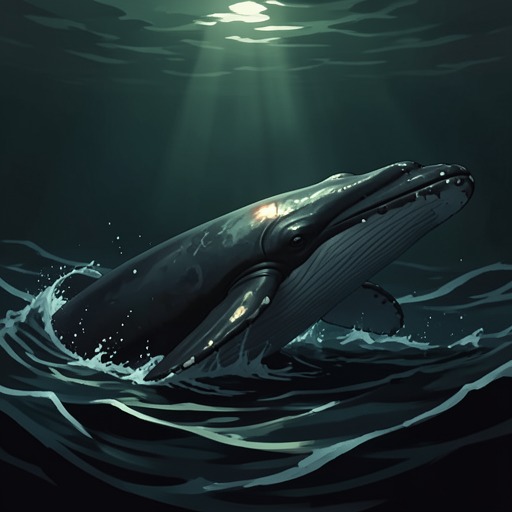
Jonah
The WhaleJonah is the biblical figure through whom the book gives the whale’s power its oldest and most persistent human shape: a person cast into the deep, enclosed within a great fish, and returned to land. The image opens as prayer, recurs in the seamen’s chapel and in stories of men swallowed by whales, and becomes a measure of the opposed fates of Ahab and Ishmael in Moby-Dick. Jonah is not developed here as a character with an independent life beyond those accounts. His importance lies in the pattern his story supplies: engulfment can mean terror and apparent death, but it can also precede deliverance and renewed purpose.
The Scriptural Figure
The book introduces Jonah through the language of the second chapter of his biblical prayer. The speaker says he has been cast into the deep, into the heart of the seas, with flood and waves passing over him. In that brief passage, the sea is not merely a setting: it is an encompassing force that has taken away the speaker’s ordinary ground and surrounded him with the consequences of being cast down. The concluding line, “All thy waves and billows passed over me,” gives the book an image of submersion before it turns to the whale as animal, historical quarry, or literary figure.
The narrative later supplies the decisive action of the scriptural account: “And the LORD appointed a great fish to swallow up Jonah; and Jonah was in the belly of the fish three days and three nights.” The fish’s act places Jonah inside the creature, at the boundary between life and death as human beings imagine it. His confinement is not the story’s final condition. The next biblical sentence reverses the movement of swallowing: “And the LORD spoke to the fish, and it vomited out Jonah upon the dry land.” The return to land distinguishes Jonah’s engulfment from the whale’s more usual place in this book’s imagination as a creature that overwhelms, kills, or eludes human understanding.
Ahab, Ishmael, and the Whale
Jonah’s story becomes a point of contrast in the book’s account of Moby-Dick. Ahab’s voyage aboard the Pequod is presented as vengeance against the sperm whale that dismasted him; the whale will eventually take Ahab’s life as well. Against that fatal pursuit, the book recalls that Jonah was saved by the whale for God’s work, whereas Ahab is destroyed by the devil’s. The parallel does not make the two men’s encounters identical. It makes their opposed outcomes legible: Jonah passes through the fish and returns to a purpose beyond his own survival, while Ahab’s confrontation ends in destruction.
Ishmael’s survival supplies another distinction. The book calls him “another orphan” and associates his survival with martyrdom and rebirth. Jonah’s deliverance and Ishmael’s survival are not equated, but their proximity gives the larger whale narrative a recurring shape in which apparent annihilation may be followed by a different life. Ahab’s end prevents that pattern from becoming a guarantee. The whale is neither simply savior nor simply enemy; the inherited biblical story offers one outcome, while the Pequod’s voyage offers another.
Sermon and Public Memory
Jonah’s story is also given a communal setting at the Bethel, where the book describes a maritime ministry marked by plaques bearing the names of those lost to the sea. In the chapel, the remembered fate of Jonah enters through a hymn about the whale’s ribs and terrors arching over the singer in dismal gloom. The image turns the biblical episode into a language for people whose lives and losses are bound to the ocean. The sea’s danger is not an abstract theological subject there: the plaques record the port’s continuing loss of sons to it.
The chapel scene is layered with Melville’s fiction and its later film adaptation. Father Mapple preaches to a congregation of seafarers from a pulpit shaped like a ship’s prow, and the book connects his sermon to the story of Jonah. The present-day theatrical pulpit was commissioned in 1961 by a local shipwright for visitors expecting to find the object seen in John Huston’s 1954 film. Jonah therefore passes through scripture, novel, film, and a physical chapel furnishing, each setting returning his story to an audience gathered around the hazards of seafaring. The pulpit’s prow makes the sermon seem to face the voyage itself: the biblical account is presented not as a remote marvel, but as a story addressed to those who go to sea.
Engulfment, Refuge, and Retelling
The episode of Jonah also anchors the book’s wider interest in being swallowed. After recounting the danger of a whale’s opened body and the possibility of a human being trapped within it, the narrative returns to the scriptural swallowing and release. That recurrence gives the whale’s belly several incompatible meanings: a place of bodily peril, the setting for a miraculous rescue, and an image that later writers can reshape. Jonah provides the inherited religious story, but the book does not treat every later account as equivalent to it.
George Orwell’s essay Inside the Whale is introduced as an elaboration of the idea that being inside a whale could seem strangely comfortable: the belly becomes a dark, cushioned, womb-like refuge, insulated from the world. That vision reverses the terror of Jonah’s engulfment without cancelling it. The same bodily enclosure can be imagined as protection from reality or as nameless horror, depending on the retelling. The book’s movement from Jonah’s prayer and release, through Ahab’s fatal pursuit and the Bethel’s losses, to Orwell’s imagined refuge keeps those meanings in tension. Jonah matters not because the whale’s meaning is settled by his story, but because his passage into and out of the fish makes the question of what engulfment means impossible to leave alone.