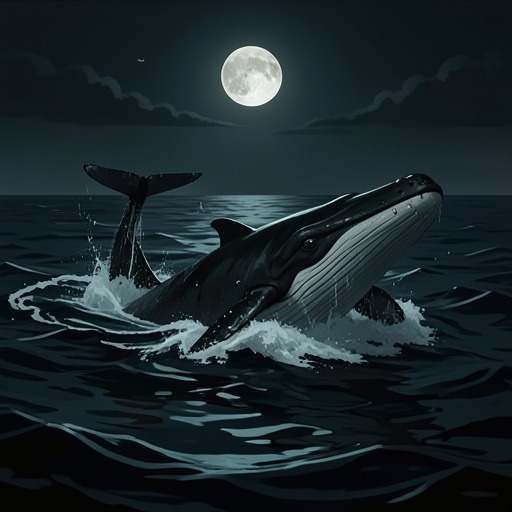
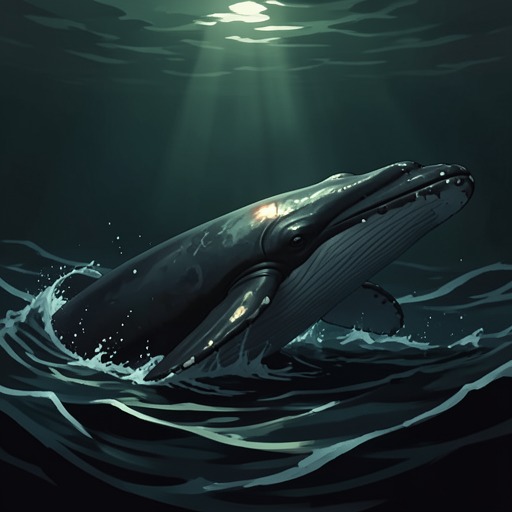
Jonah and the Whale
The WhaleJonah and the Whale is a biblical narrative of being swallowed and returned, but here it also names a wider human fascination with the whale as an immense, inaccessible interior. The book sets the scriptural image beside a rescue aboard a whaling ship, later claims about human survival inside a whale, and the transformation of whale bodies into displayed remains. Across these contrasts, the whale is at once a living animal, a feared enclosure, a possible refuge, and an object made legible by human institutions.
Biblical Pattern and Shipboard Rescue
The biblical account supplies the motif’s simplest shape: Jonah is inside the fish for three days and three nights, and is later returned to dry land. The book invokes both passages, giving the episode a clear movement from engulfment to release. That pattern becomes immediate aboard the ship when Ishmael recounts the danger to Tashtego. While trying to collect spermaceti from the whale’s severed head, Tashtego falls into it. Queequeg, carrying a boarding-sword, dives in and pulls him out by his hair. The rescue makes the old scriptural structure newly physical: a person disappears into the whale’s interior, and another person brings him back.
The scene’s meaning rests on the opposition between the whale as a source of valuable material and as a space that can threaten human life. The head contains the spermaceti that the crew seeks, but the work of extraction turns that storehouse into a perilous enclosure. Ishmael’s comparison of Tashtego’s emergence to a birth gives the rescue a second form: the whale’s interior becomes a place of forced passage as well as a possible tomb. Queequeg’s intervention interrupts that danger, while the familiar Jonah pattern lets the episode resonate beyond its immediate shipboard circumstances.
The Whale’s Interior: Fear, Argument, and Legend
The book traces the fear of being swallowed beyond the biblical story. An account of a sperm-whale dissection at Whitstable in 1829 tells of a scientist descending into the animal and becoming trapped after losing his footing. The incident does not establish Jonah’s survival; instead, it shows how the physical scale of a whale could make its interior seem both real and almost unimaginable. The body is no longer merely a shape seen at sea. It becomes a space that people can picture entering, although the consequences remain uncertain.
In the 1920s, Oxford professor Ambrose John Wilson tried to assess whether Jonah’s fate was biologically possible. His argument distinguished the sperm whale from baleen whales: he reasoned that only the sperm whale could swallow a person, since a baleen whale’s throat could admit nothing larger than a grapefruit. He also argued that the sperm whale’s digestion would act on dead matter rather than consume a living person. The discussion brings scientific reasoning close to the edge of folklore without making the biblical account a proven event. The distinction matters: a physical possibility is not evidence that Jonah’s experience happened as told.
The legend continued in modern stories and reports. In a 1928 letter to The Times, a correspondent claimed to have met a missionary associated with the Southern Whaling Fleet who had been swallowed by a sperm whale and later expelled when the crew harpooned it. The story’s own details preserve the shape of the Jonah episode, but the book places it among persistent tales rather than verified history. References to Pinocchio and to a story recalled by George Orwell show how readily the swallowed person reappears in popular imagination. The recurring plot survives because the whale’s interior remains difficult to know directly.
Shelter and the Whale’s Ambivalence
Orwell’s essay Inside the Whale, written as the Second World War broke out, reverses the usual emphasis on terror. It treats the belly not only as a place of danger but as a closed, cushioned refuge, separated from the pressures of ordinary reality. In this image the whale becomes a shelter large enough for an adult, and its movement through the sea scarcely reaches the person inside. The idea is unsettling precisely because it turns helplessness into comfort: enclosure becomes an escape from responsibility as well as a threat to life.
That reversal deepens the book’s ambivalence about the whale. The imagined interior can be a grave, a womb-like refuge, or simply an unknowable space onto which people project fear and consolation. The scriptural episode offers a temporary passage through that space and a return; the later survival stories try to make the passage bodily plausible, while Orwell’s interpretation makes it psychologically appealing. None removes the whale’s strangeness. Instead, each account gives human meaning to an animal whose actual life exceeds those meanings.
From Living Body to Displayed Remains
Elsewhere, the book places this inward, legendary whale beside the whale made visible in museums. At the New Bedford Whaling Museum, a fifty-ton, sixty-six-foot Blue whale skeleton hangs above the reception area. The animal had washed ashore on Rhode Island in 1998, and an agreement with the Smithsonian Institution required that it be put on public view. Its body was divided into sections and lowered into the river; after two years, the skeleton was reassembled in an atrium. The whale that once suggested an inaccessible interior is now suspended for visitors to inspect, though oil still drips from the bones.
Other displays make the change in scale and purpose still clearer. At the Natural History Museum in London, the book recalls a sperm-whale skeleton once exhibited under the watch of what appeared to be a Victorian policeman. In a climate-controlled collection, cetaceans are held in labelled containers, including a humpback fetus; elsewhere, a bench is built from whale bones and a narwhal tusk serves as a hat stand. These are not episodes of Jonah’s deliverance, but they extend the book’s contrast between the whale as an overwhelming living presence and the whale converted into a specimen, furnishing, or public image. Against such classification, the whale’s interior remains a powerful figure for what cannot be fully possessed or known.