Male friendship and same-sex desire
The WhaleMale friendship and same-sex desire are presented as an intimate but historically difficult dimension of Herman Melville’s life and writing. The book connects the all-male world of the sea with the companionship of Ishmael and Queequeg, then sets Melville’s own intense friendship with Nathaniel Hawthorne against an age that had no established name for love between men. These relationships are neither reduced to a single identity nor treated as merely abstract themes: they show how fellowship could become a source of belonging, creative recognition, and pain, even when its meaning could not be stated openly.
A Masculine World at Sea
The account describes Melville’s books as works set in a world without women, written in an era that lacked a name for love between men. Walt Whitman, Melville’s contemporary, devised the term adhesiveness for the feeling he experienced toward other men, but that vocabulary did not settle what such attachments meant. Melville’s writing instead approached the subject through different literary forms: from the youthful maritime world of Redburn and the discipline of White-Jacket to the phallic imagery associated with Moby-Dick and the virginal figure of Billy Budd. Across those works, he transformed his past while keeping his emotions partly obscured by literary invention.
The sea made that transformation possible. A fatherless, middle-class boy deliberately moved as far from land and female influence as he could, answering to a captain rather than to his mother and sisters and making a new family among sailors. Removed from home’s security, he entered a harsh working community whose members were joined by the common business of killing whales. The account also recalls their voyages to islands where inhabitants were feared as a danger to the crew. This masculine environment was not simply an escape into idealized fellowship: its bonds were formed within labor, danger, and separation from ordinary life. The ship offered Melville another social world, but one whose pressures shaped how intimacy could be lived and represented.
Ishmael and Queequeg
The relation between Ishmael and Queequeg gives this larger question a fictional form. Their companionship belongs to the same all-male world that structures Melville’s maritime writing, while the book’s account of a visit to a Shaker village places their bond beside a sharply different response to men living closely together. Nathaniel Hawthorne regarded the Shakers’ celibate community with hostility, especially their shared sleeping arrangements, which he considered repellent. The narrative observes that Ishmael and Queequeg might have understood such proximity differently. That contrast does not make the Shakers and the fictional sailors interchangeable; it shows how an ordinary fact of communal life could provoke sharply opposed judgments about closeness between men.
The friendship of Ishmael and Queequeg therefore carries significance beyond its place in the voyage. It offers a literary space in which male attachment can be represented through companionship, shared life, and practical trust, even when public language for such feeling is limited. The book’s emphasis remains on what the narrative makes possible rather than on assigning the characters a modern identity. Their relationship also echoes Melville’s own effort to make a new family at sea: fiction revisits the social world he entered as a young sailor, while giving that world a form through which its emotional bonds can be seen.
Melville and Hawthorne
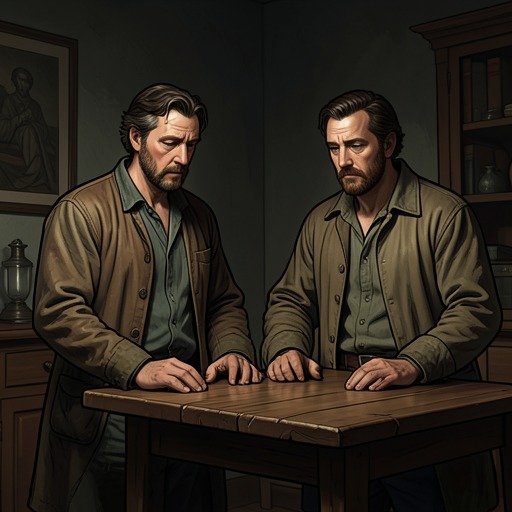
Melville’s friendship with Hawthorne provides the account’s most explicit example of emotional intensity between men. After meeting Hawthorne, Melville moved to a farm south of Pittsfield, close enough to visit Hawthorne in Lenox. Their connection grew through meetings and increasingly long letters. On one visit, Melville arrived with Evert Duyckinck, George Duyckinck, a dog, and a picnic; Hawthorne supplied champagne, and the group travelled to the Shaker village at Hancock. The excursion brought the men into a setting where celibacy and close male association were already charged subjects, though their responses to the Shakers differed.
At Lenox, Melville and Hawthorne sat together in the parlour, smoking cigars that were normally forbidden in the house and talking late into the night about earthly and spiritual matters. Sophia Hawthorne later removed the description of these conversations when preparing her husband’s journal for publication. The editorial deletion gives the friendship a telling afterlife: its intimacy survives in the account, but part of its record was withheld from readers. Their closeness did not mean agreement on everything. They differed over slavery, and Melville’s feelings for Hawthorne appear to have reached beyond what Hawthorne could return. The friendship’s significance lies partly in that unevenness: recognition mattered deeply to Melville, but could not resolve every difference or satisfy every need.
Recognition, Limits, and Literary Consequence
Hawthorne’s understanding of Moby-Dick changed how Melville regarded his own book. Melville had described it as a presentation of the whale fishery, but Hawthorne’s response helped him perceive allegorical and spiritual dimensions he had not recognized in his work. Melville answered with language that joined literary recognition to a vision of shared spiritual life. He imagined their selves as fragments of a larger whole and treated Hawthorne’s reading of the book as an unusually deep act of understanding. The force of this response exceeds ordinary critical approval: for Melville, to be understood by Hawthorne was to feel that the book and the author had been met at their deepest point.
The account frames this intensity as a plea for fellow feeling that went beyond sex or intellect, while also making clear that the relationship could go no further. Melville crossed what the book calls the boundary of normal behaviour, yet the bond did not become a settled or fully reciprocal relationship. Its limits sharpen rather than cancel its importance. Melville sought refuge in Hawthorne from darkness, and his sense of spiritual kinship with him became entangled with his response to Moby-Dick. The book presents this attachment as part of the creative pressure surrounding the novel: Melville’s need for recognition and his inability to secure all that he sought remain in tension, and he never recovered from the work that brought those needs into focus.