Melville Gives Hawthorne a Copy of Moby-Dick
The WhaleHerman Melville’s presentation of a finished copy of Moby Dick to Nathaniel Hawthorne turned a small publication gathering into an intimate test of literary recognition. At the Little Red Inn in Lenox, on a dreary, windy afternoon in November 1851, Melville placed his book in the hands of the one guest he had invited. Hawthorne’s response survives only indirectly, but Melville’s words after it make the exchange legible as both a literary event and a declaration of attachment.
The private publication gathering
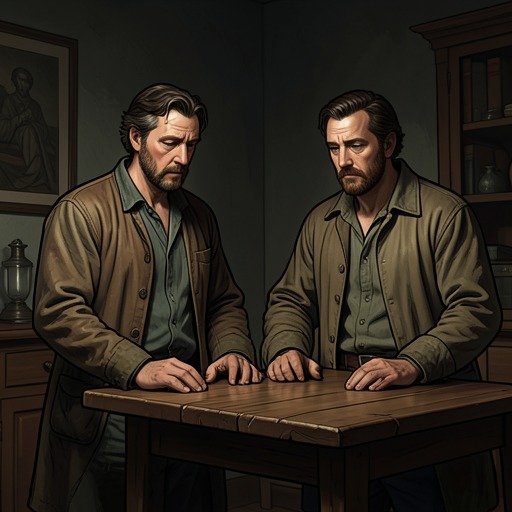
The scene is fixed precisely: the Little Red Inn, Lenox, western Massachusetts, 14 November 1851, late afternoon, with snow and wind outside. Melville had hired a private room for a publication party for Moby Dick. The chairs scraped across the boards as the two men drew nearer to the table, an ordinary sound that gives the ceremonial occasion its physical scale. The gathering was not a public celebration with a crowd of readers; it had a single guest. That guest was Hawthorne.
Melville gave him the finished copy that afternoon. The account makes the transfer itself the scene’s decisive action: for a few seconds the book passed from one man’s hand to the other, between letting go and taking hold. Its significance lies not simply in the completed object, but in the effort and energy Melville had invested in making it. The book is presented as a concentrated account of his life to that point, so handing it over also meant entrusting Hawthorne with the work through which he had most fully expressed himself.
Recognition and the unanswered letter
Hawthorne opened the book and saw words inside, but the passage does not reproduce them. It characterizes the gesture as a public declaration and an infinite demand, emphasizing that the book’s presentation carried a meaning beyond the mechanics of publication. The demand was answered, at least in part, by Hawthorne’s understanding of the work. His reaction is described as one of literature’s great lost letters: its exact contents are unavailable, and its shape has to be inferred from Melville’s reply.
That reply records a sudden sense of security because Hawthorne had understood the book. Melville described himself as having written a wicked book while feeling spotless as a lamb. The contrast joins artistic audacity to a need for moral and personal reassurance: recognition did not erase the book’s troubling quality, but it made that quality feel understood rather than isolating. The scene therefore turns on a change in value. A work completed and offered into uncertainty becomes, through Hawthorne’s response, a work received by someone capable of grasping its central impulse.
Literary kinship and emotional intensity
Melville’s response presents Hawthorne not merely as a discerning reader but as someone who had altered his sense of his own writing. Hawthorne had opened his eyes to allegories and subtleties that Melville had not recognized in his own work. The younger writer answered this intellectual influence with language that fuses gratitude, spiritual speculation, and possessive intimacy. He asked Hawthorne where he came from and by what right he drank from his flagon of life; then he imagined that what Melville brought to his lips belonged to Hawthorne instead.
The image develops into a theology of shared identity. Melville compared the Godhead to bread broken at the Supper, with the two men as pieces of a divided whole, and named the result an infinite fraternity of feeling. He credited Hawthorne with understanding the thought that pervaded the book and imagined him rejecting the imperfect body in order to embrace the soul. These are Melville’s words in an extraordinary mixture of arrogance, blasphemy, faith, and love. Their force comes partly from the gap around them: Hawthorne’s answer is missing, so the reader encounters the relationship through Melville’s intense response rather than a balanced exchange of letters.
A handover without resolution
The account acknowledges that Victorian correspondence could exaggerate, and it refuses to invent Hawthorne’s reply. He may have been grateful that he was about to leave Lenox; what is certain is that Melville’s response makes the gift a moment of exceptional emotional exposure. The book passed physically between the men, while its reception supplied Melville with a form of security he had not possessed when writing alone. The encounter thus joins artistic judgment to personal attachment without resolving the imbalance between the surviving voices.
The scene also resonates with the wider account’s insistence that the sea exceeds easy human mastery. It invokes Henry David Thoreau’s description of the ocean as an enduring, unfathomable wilderness, and elsewhere lingers on the sea as a changing spectacle that can give or take away. Those reflections do not establish what the two men discussed at the inn; rather, they provide a surrounding intellectual landscape for a book whose subject is the whale and the ocean. Against that scale of unknowability, the handover offers a smaller, fragile counterpoint: one reader understands something in the book, and its author recognizes that understanding as a rare source of companionship. The publication gathering ends not with a recorded reply from Hawthorne, but with Melville’s words of gratitude and longing, leaving the gift suspended between a finished book and an unfinished conversation.