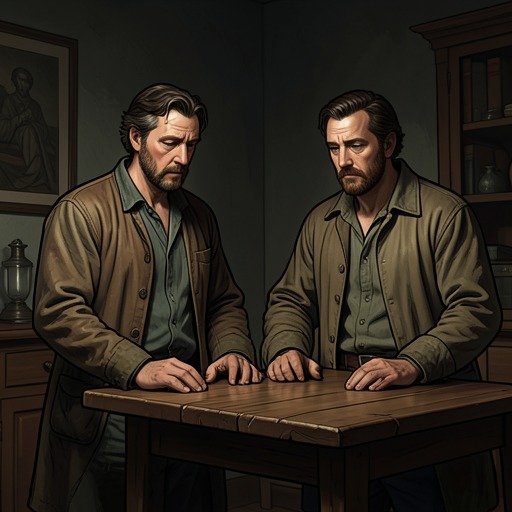
Melville and Hawthorne Reunite in Liverpool
The WhaleMelville and Hawthorne’s reunion in Liverpool was their last meeting, a brief return to friendship that ended with Melville sailing away and leaving his trunk behind. In Southport, against the wind-blown dunes, Melville spoke of what lay beyond human knowledge and of his inclination toward annihilation; Hawthorne saw in him a deeply reverential nature caught between belief and unbelief.
Finding Hawthorne
After travelling through Lancaster and York to Liverpool, where his first sea voyage remained part of the city’s associations for him, Melville lodged at the White Bear on Dale Street. He set out in the rain to find Hawthorne, but the address he had was out of date, and the search came to nothing. The following morning he called at the consulate and found his friend.
Hawthorne had served as American consul in Liverpool for the previous four years, while living with his family in nearby Southport. Now in his fifties and balding, he met a Melville who seemed paler and sadder than before. Hawthorne attributed Melville’s condition to sustained literary labour that had brought little success, and to a troubled state of mind. He also understood the journey as an airing after years of toil at writing and domestic life, following Melville’s adventurous youth.
Southport and the conversation
The two men took the afternoon train to Southport, a faded resort once patronized by Louis Napoleon and now diminished from its former splendour. The next day they walked along the beach, driven by the wind, then sat smoking cigars in a hollow among the dunes. The setting’s exposed, monotonous sand hills accompanied a conversation that turned from their surroundings toward Providence, futurity, and matters beyond human knowledge.
Melville told Hawthorne that he had nearly made up his mind to be annihilated, in a thought associated with Ishmael’s departure from Manhattan. The remark gave their reunion a grave undertow: they had recovered the possibility of intimate conversation, but Melville’s words pointed toward extinction rather than consolation.
Hawthorne’s judgment
Hawthorne later described Melville as persistently wandering through desolate inner territory, unable either to believe or to find comfort in unbelief. He judged that, had Melville been religious, he would have been exceptionally religious and reverential; he considered him a person of unusually high and noble nature, more deserving of immortality than most people.
The account presents Hawthorne’s admiration alongside his recognition of Melville’s distress. The biographical narration treats this tribute as a kind of mirror of the faith Melville had placed in Hawthorne, and suggests that Hawthorne may only then have fully recognized that trust and felt guilty for not having done more. It also leaves open the painful limit of friendship: Hawthorne’s regard did not mean he could save Melville from himself.
Departure and finality
A few days later, Melville sailed from Liverpool for the Holy Land. He left his trunk at Hawthorne’s consulate and took only a carpet-bag with him. The smallness of what he carried sharpened the departure’s sense of severance; no later meeting followed. Their Southport walk and conversation therefore survive in the account not as the beginning of a renewed companionship, but as the last occasion on which the two men saw one another.