Natural History Museum in London
The WhaleNatural History Museum in London is presented as a place where the whale shifts between marvel, scientific specimen, and unresolved presence. Its imposing architecture and public displays make natural history a spectacle, while its sealed collections expose the labor of preservation behind that spectacle. The contrast is essential: the museum can bring immense animals close enough to inspect, yet the whale itself remains shaped by an ocean largely beyond human sight and control.
A gothic entrance to natural history
The approach unfolds as a passage from the everyday city into an extravagant cathedral of science. A tiled tunnel leads visitors out of the underground station and toward a terracotta façade layered to resemble geological strata. Its sculptural inhabitants form an industrial bestiary: heraldic griffins, scaly medieval fish, and toothy pterodactyls with leathery wings and glaring eyes. The building does not present nature as mild or orderly. Before the galleries begin, its exterior makes deep time and monstrous life part of the museum’s public face.
Inside the gothic nave, children move among the dark remains of prehistoric life, including a blackened diplodocus whose tail seems to sweep through the space. The museum’s arrangement makes the building itself part of the encounter: its nave, corridors, and hangar-like hall lead visitors through displays of vanished worlds before confronting them with a modern giant. A century earlier, a sperm-whale skeleton stood in the nave, watched over by a figure resembling a Victorian policeman. The whale’s former position gives the gallery a history of changing display: a once-guarded monster has yielded its place to other monumental specimens, but the museum’s fascination with immense animal bodies continues.
The blue whale and the limits of the model
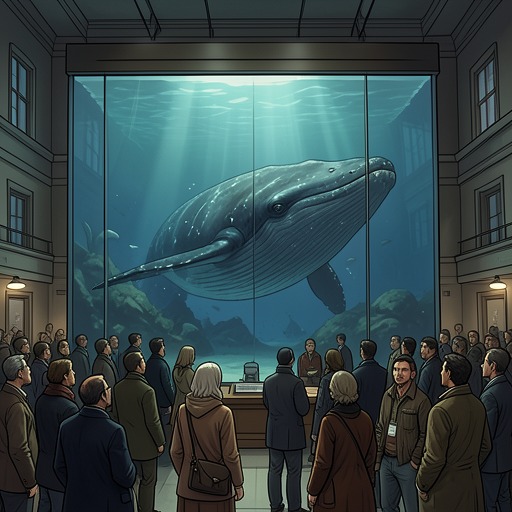
The route through galleries of ichthyosaurs, savannah animals, and jungle fauna opens suddenly into a space compared to an aircraft hangar. There hangs the Blue Whale Model at the Natural History Museum, the largest object in the institution. Nearly one hundred feet long from nose to twenty-foot flukes, it is so large that a household could seemingly fit inside it. Its scale makes the animal feel at once physically present and impossible to contain within the visitor’s ordinary measure.
The model is also an account of how knowledge can be shaped by what observers have not seen. Constructed in the 1930s, before anyone had viewed an entire living blue whale in its element, it was made from plaster and chicken wire over a wooden support. Its makers relied on dead whales hauled out of the water, whose bodies had collapsed and deflated. The resulting form therefore records not simply the whale but the conditions under which people tried to picture it. Its huge mouth and small eye lend it a faintly fairy-tale expression, yet the model’s swollen appearance misrepresents the more streamlined animal. The display can magnify wonder while preserving an error.
That error becomes especially meaningful beside the narrator’s childhood recollection of believing that the model enclosed a skeleton, like a tomb containing a saint’s bones. In fact, the whale is hollow. The imagined interior and the actual construction mark two different kinds of museum knowledge: one built from the visitor’s projection, the other from materials and methods that explain how the image was made. The model invites belief in a complete, knowable animal, then its fabrication unsettles that belief.
The collections beneath the public galleries
Below the Whale Hall, the museum’s work changes from monumental display to controlled storage. Richard Sabin, curator of sea mammals, leads the narrator through automatic doors that lock behind them into a climate-controlled area. Floor-to-ceiling grey lockers contain cetacean parts preserved in alcohol and labelled with Latin names. A small container holds a humpback foetus, its open mouth and pallid skin making it look almost like a toy. Classification gives each body part an orderly name and place; its preserved appearance still resists any simple transformation into a neutral object of study.
Beyond the lockers, shelves hold jars of brown liquid and animals suspended in glass. The room’s specimens include a spiny anteater, a severed shark’s head, and a coelacanth. Some were collected by Darwin. Their handwritten luggage labels suggest that the specimens have been ordered not only for scientific identification but also as things prepared for movement elsewhere. The narrator’s unease grows among these preserved bodies, and a row of closed metal vats intensifies it: their photocopied labels identify unseen contents as entire dolphins and infant whales.
The largest enclosure contains Architeuthis dux, the giant squid, suspended in formalin and seawater in a plate-glass tank. The specimen was pulled from the Southern Ocean by fishermen in the Falkland Islands, frozen, shipped to Kingston upon Hull, and then brought to the museum. At twenty-eight feet long, it is formidable without being the largest squid on record: one caught in New Zealand in 1880 measured sixty-one feet. The glass tank makes a deep-sea animal available to sight, but the specimen’s spectral appearance and the uncertain scale of its kind preserve the sense of an ocean whose inhabitants remain only partly known.
Specimens, violence, and the sea beyond the galleries
The squid’s position in the museum carries a further meaning because it is identified as the sperm whale’s mythical enemy. Nearby, a jar holds squid flesh and beaks recovered from a sperm whale’s stomach. The museum thus keeps predator and prey in the same underground world: evidence of an encounter in the sea becomes a carefully labelled exhibit on land. The account also notes that whales have been found with squid still alive in their stomachs, and that pieces of squid tentacles vomited by dying whales helped confirm the giant squid’s existence. Such remains make the museum’s collections records of relations between animals, not merely isolated examples of species.
The book’s wider history places these preserved bodies against the commercial forces that changed the whale’s prospects. In 1859, Edwin L. Drake’s oil well at Titusville marked a major shift away from sperm-whale oil as a source of illumination, even as the extraction of natural resources continued in another form. Later, Sven Foyn’s grenade harpoon enabled whalers to pursue the great rorquals, including blue and fin whales, that had previously been beyond reach. In 1904, Norwegian and British steamships opened Antarctic waters to industrial whaling; whale products were used in the manufacture of nitroglycerine, and fifty thousand whales perished during the two world wars. These events are not presented as a history contained within one gallery. They form the surrounding human history against which a museum full of whale models, bones, and preserved remains acquires its weight.
Display, disappearance, and narrative meaning
The museum’s public rooms and hidden stores offer different forms of access. In the hall, the blue whale dominates through scale and theatrical suspension. Below, small labels, jars, lockers, and sealed vats disclose how institutional knowledge depends on collecting, preserving, and classifying bodies. Neither arrangement restores an animal to its oceanic life. Instead, the displays make visible the distance between the living whale and the human systems that picture, name, and retain it.
When the narrator finally leaves the galleries, the museum’s gates are locked. The visitor’s route through displays of dead animals ends in an unexpected confinement among them, and the thought of spending the night inside gives the collection a briefly threatening quality. The narrator recalls that whale carcasses were once buried in pits of silver sand on the museum grounds so that rain could hasten decay before their bones were assembled for display. The process could take two years or more; local complaints about the smell eventually brought it to an end. The memory strips away the clean separation between polished exhibition and animal remains: decay, odor, and labor belong to the institution’s history as surely as the finished skeleton does.
This movement from spectacular model to hidden specimen, and from public gallery to locked gate, makes Natural History Museum in London more than a storehouse of natural objects. It is a place where humans attempt to render the nonhuman world legible, even as the whale’s real scale, former life, and threatened future exceed the forms through which it is represented. The sea remains outside the museum’s walls, but its absence presses on every model and preserved body within them.