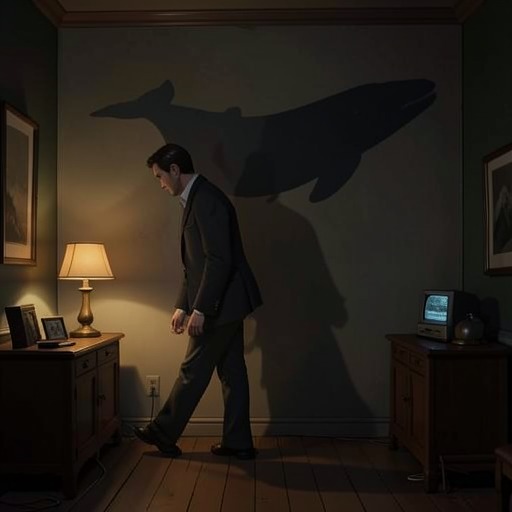
Philip Hoare’s fear of water
The WhalePhilip Hoare’s fear of water, present since childhood and recurring in dreams, becomes most vivid when he enters the sea among sperm whales. In the water, fear is physical before it is explanatory: breath, balance, and orientation fail him. A later encounter brings a marked change, as panic gives way to calm attention, even while the whales remain beyond his comprehension and control the terms of the meeting.
A childhood fear brought into the sea
The book’s index traces Hoare’s fear of water to childhood and records its recurrence in dreams. The supplied swimming scenes show that fear not as a general idea but as a bodily condition: he struggles to breathe, loses his sense of direction, and finds the waves pushing him back beneath the surface. The sea makes the old fear immediate, at the same time that the whales draw him toward an encounter he cannot master.
First immersion: panic and disorientation
As Hoare enters the water, a group of ten or twelve sperm whales hangs near the surface, breathing in rhythm with the sea. The passage from watching them to swimming among them is abrupt. Only minutes after observing the animals, he is fighting for air and trying to remember to breathe through his nose. João Quadresma calls directions from the boat, but Hoare cannot tell left from right; his frantic kicking seems to take him nowhere as the waves push him back and under.
The underwater world compounds the disorientation. Suspended in blue water, Hoare can see tiny drifting organisms but little beyond them; the dense water limits his sideways vision. Then a sperm whale resolves out of the darkness. He comes within thirty feet before its blunt head and immense body fill his field of vision. As the distance closes, his limbs remain frozen between panic and excitement. The animal turns its great head toward him, but Hoare realizes that its eyes cannot take him in: he is approaching through its blind spot. Its nearness makes the encounter both more intimate and more alarming, while the sound he begins to hear heightens the suspense.
A changed encounter, not a conquered fear
On a later swim, Hoare is better protected against the sea’s chill. He lets himself enter the water and find his buoyancy, then moves steadily toward a whale without relying on João’s shouted directions. The animal is a juvenile, about ten years old, and its pronounced melon identifies it as male. Though young, it is still larger than the boat; its grey body shines in the sun.
When the whale comes into view underwater, Hoare’s fear subsides. He forces himself down, relaxes, and feels his heart rate slow as he attends closely to the animal: the skin’s changing texture, the muscles rippling beneath it, the flukes, and the tightly closed jaw. The whale does not hurry away. Its turn toward him no longer produces the same immobilizing panic; Hoare can remain present and observe.
The calmer swim does not amount to mastery. Hoare understands that the whales register him, while he cannot fully comprehend them. Their movements account for his, and they control the choreography of the encounter; he struggles merely to keep his balance and remain part of it. The shift, then, is from being overwhelmed by water to sustaining attention within it. Fear recedes enough for contact, but the encounter preserves the asymmetry between a human swimmer and an animal whose world remains largely unknowable.