Phineas T. Barnum
The WhalePhineas T. Barnum enters this account as an exhibition impresario whose American Museum turned live whales into a public sensation. His display joined popular spectacle to the language of scientific curiosity, but the belugas’ short lives exposed the cost of presenting Arctic animals in conditions far removed from their natural environment.
The American Museum’s White Whales
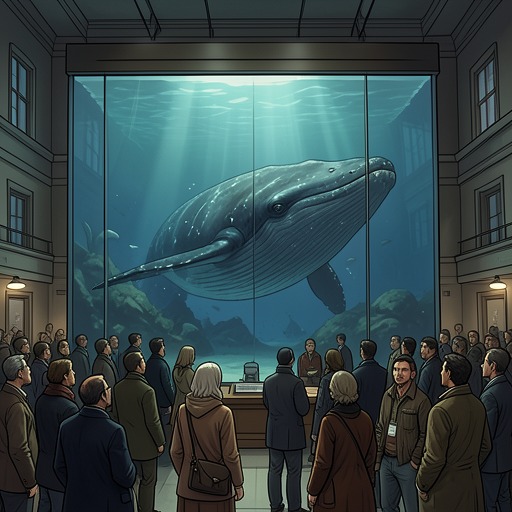
In 1861 Barnum imported two belugas from waters off Labrador for his American Museum on Broadway. Transported south in hermetically sealed boxes lined with seaweed, the whales measured twenty-three and eighteen feet. Their basement tank was fifty-eight feet long and twenty-five feet wide, but only seven feet deep, and held fresh water. The two animals swam together in a scene likened to lovers, even as the inadequate tank and water conditions made their prospects bleak.
The display was promoted as a sensation and imagined as part of a museum that might gather every kind of extraordinary creature. Barnum’s enterprise made the whale available to an urban audience as both living animal and novelty. That promise of an expansive animal microcosm rested on the confinement of creatures brought far from their Arctic habitat.
Repeated Captivity and the Museum Fire
The belugas died within days, victims of conditions compared in the account to those that killed fairground fish carried home in plastic bags. Their deaths did not end the exhibition: Barnum replaced them with successive specimens. The pattern made the whales’ presence seem renewable, although each replacement repeated the same failure to keep them alive.
A fire destroyed the museum in 1865. Attempts to rescue the last beluga proved futile, and a fireman eventually smashed its tank with a hook. The whale died in the fire. Its fate gives the exhibition a grim ending: even the act that broke open the enclosure could not save the animal from the disaster around it.
Spectacle and the Limits of Display
Barnum’s role in the narrative is defined less by personal biography than by the institution and spectacle associated with his name. The museum’s ambition to gather unusual forms of life brought scientific interest and popular entertainment together, but the belugas’ repeated deaths reveal the limits of that arrangement. For the animals, visibility meant confinement; replacing one whale with another kept the attraction going without changing the conditions that had made the display unsustainable.