Second World War
The WhaleThe Second World War transformed whaling without bringing it to an end. Before the conflict, industrial fleets were killing whales on a vast scale; during the war, military demands interrupted much of that activity, while some whalers became part of the war effort. When hostilities ceased, hunger and demand for whale products rapidly reopened the hunt, making the transition from wartime interruption to postwar extraction a central part of the period’s history.
An industry already shaped by war
By the outbreak of the Second World War, large factory ships, carrying crews of as many as 240, were catching 500,000 tons of whale a year. The scale and organization of this industry belonged to a wider history in which whales had already become entangled with military production: during the two global conflicts, an estimated 50,000 whales were killed, while whale oil supplied materials for explosives and other wartime needs. The South Atlantic humpback population had been driven to extinction by 1918, and reports had warned that other populations were approaching similarly alarming declines.
The industrial hunt also made whales into symbols of human violence. Mary Heaton Vorse warned that the animals were shrinking in size and might become fabulous monsters of the past without international action. In March 1939, W. H. Auden’s poem about Herman Melville gave the period a terse moral frame: “Evil is unspectacular and always human”. The Second World War would intensify that connection between human conflict and the destruction of animal life.
Wartime interruption and continued killing
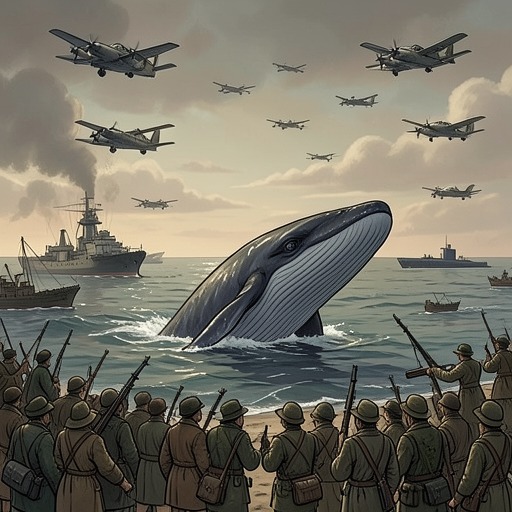
As German U-boats extended their operations south of the Equator and the Pacific became a theatre of war, commercial whaling virtually ceased. Some shore stations continued operating in South Africa and Australia, but most whale-catchers were converted to military uses. Large factory ships that escaped destruction were needed for more urgent purposes. The pause was imposed by the war’s demands, not by a decision to protect whale populations. Contemporary observers could only hope that the enforced close season might help recovery, while recognizing that the virtual extinction of several kinds of whale was already a warning against optimism.
The interruption was not complete. From 1941 to 1943, a Norwegian flotilla working off the coast of Peru captured 8,500 sperm whales. Whaling crews were part of the wider wartime mobilization, just as the author’s mother made machine-gun parts in a Southampton factory. The book also describes an animated propaganda cartoon in which a whale formed from the map of Europe menaced Britain, turning the animal into an image of invasion even as real whales were being hunted. War altered the uses of ships and the public meaning of the whale, but did not remove the animal from industrial and military thinking.
Postwar hunger and renewed whaling
The end of hostilities brought no comparable peace for whales. With food rationed, whale oil and meat were valuable, and whaling nations agreed to extend the first postwar season. In 1945, the newly built British steamer Southern Venturer sailed from the Tyne toward South Georgia with a crew of 400. The hurried voyage reflected the urgency of supplying a hungry population. Whale meat was dehydrated and promoted as a protein source; newspapers printed recipes, and restaurants served dishes such as whale burgers. At a modest price, it could be grilled, braised, or minced and presented as an alternative to familiar meats.
Britain also applied wartime technology to the renewed hunt. In June 1946, ships went out equipped with sonic submarine detectors to locate whales and ultrasonic nets intended to keep them within range. The method proved inferior to the animals it imitated, but the industry itself gathered pace. On 10 May 1948, the whale-ship Balaena returned triumphantly to Southampton with a crew of seventy British and 500 Norwegian sailors. It had captured 3,000 whales during the season, including an animal 94 feet long and weighing 180 tons.
The Balaena was a floating industrial complex, with laboratories, a blacksmith’s shop, and a hospital. Its cargo included 4,500 tons of meat, 163,000 barrels of edible oil intended for margarine, 10,000 barrels of sperm oil, 170 tons of meat extract, and another 3,000 tons of meat for cattle fodder. In the austerity of postwar Britain, these supplies were presented as a contribution to national recovery. The same vessel that embodied technical power and economic hope also carried the evidence of renewed, intensive killing.
Aftermath and significance
The Second World War therefore created a break in the operations of whaling fleets, but not a lasting reversal in the relationship between industry and whales. Ships temporarily diverted to military work returned to a hunt strengthened by postwar demand, and the techniques of detection and large-scale processing helped sustain commercial extraction. The contrast is stark: a wartime close season raised the possibility of respite, yet the immediate postwar priority was to feed people and replenish supplies, not to allow depleted populations to recover.
The period’s history also unsettles any simple division between wartime destruction and peacetime commerce. Whale products served human economies in both settings: they could contribute to military materials, rationed food, and industrial production. The return of the Balaena with thousands of captured whales made that continuity visible at Southampton’s docks. War interrupted the machinery of whaling; recovery started it again.