Sir Thomas Aston Clifford Constable
The WhaleSir Thomas Aston Clifford Constable was the young inheritor of Burton Constable Hall whose fortunes became entwined with the preservation and display of a sperm-whale skeleton. Initially preoccupied with spending his inheritance and living away from Yorkshire, he later arranged the skeleton as a striking outdoor exhibition, transforming an estate possession into a spectacle of natural history.
Inheritance and Distance from Burton Constable
In 1825, Sir Thomas was eighteen and had just inherited a substantial legacy. The whale was far from his mind: his attention was on the opportunities his new fortune afforded. Two years later he married Marianne, the youngest daughter of Charles Chichester, while Burton Constable Hall stood empty and its owner lived in Staffordshire, nearer London and its amusements.
That distance shaped the skeleton’s early place in his life. It belonged to the estate, but it was not yet the focus of his attention. The contrast between the young man’s social and financial pursuits and the whale’s eventual prominence gives his later involvement the quality of a reversal: the specimen that had been peripheral to its owner would become the centrepiece of a deliberate display.
The Whale as a Display
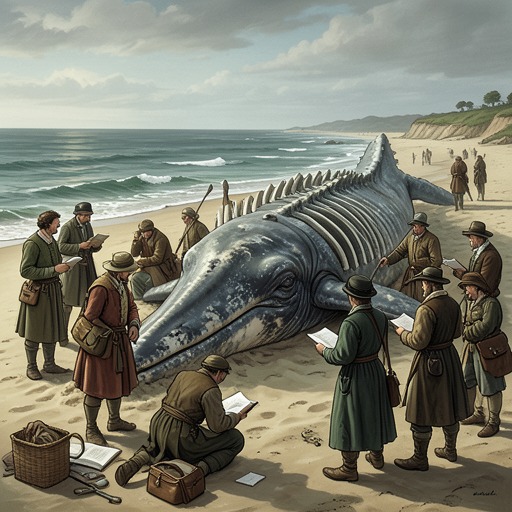
In 1836, when Sir Thomas finally moved to his ancestral home, he had the skeleton articulated. Its spine was split to take an iron rod; stirrup-like irons hinged the ribs, and long bolts passed through the skull. The construction made the remains appear capable of movement, turning the immense skeleton into a made object as well as a natural specimen.
Sir Thomas set it along an avenue of trees that became known as the Whale Belt. This was not simply storage or private possession: the skeleton was arranged to be seen, its scale and engineered joints made part of the encounter. The display also gave lasting form to the whale’s presence at Burton Constable, where its bones could be approached as an imposing, articulated body rather than a scattered collection of remains.
Historical and Narrative Role
The account presents Sir Thomas as a man of fashion and taste, and his decision to exhibit the whale connects his personal status with the period’s wider enthusiasm for natural history and public spectacle. His role is significant less for scientific study than for making the skeleton visible: the owner who had once lived away from the estate became the person who gave its whale a conspicuous place within it.
That display drew Thomas Beale, an authority on sperm whales who had encountered living animals at sea. Alerted by the curator of the Hull Literary and Philosophical Society, Beale came to see the Yorkshire specimen. In the narrative, Sir Thomas’s arrangement thus helps carry the skeleton beyond the estate: his act of display brings the whale into contact with the knowledge and attention of others, and is framed as the means by which it would be made immortal.