Slavery in the United States
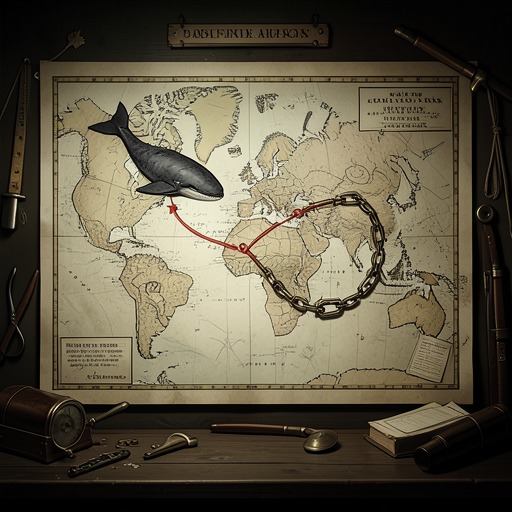
The WhaleSlavery in the United States appears not as a distant backdrop to the whaling industry but as its historical counterpart: both were lucrative, mobile systems built on the extraction and control of living bodies. The comparison becomes concrete in New Bedford of Whaling's Decline and Whale-Oil Industry Debates, where Frederick Douglass found a precarious approach to freedom and where Black labor helped sustain the whale fishery. It also enters the imaginative structure of Moby-Dick, whose meditations on classification, color, and the whale register a nation struggling over who could be treated as property and who could claim protection.
A port shaped by labor and migration
A half-scale replica of a whale-ship in New Bedford of Whaling's Decline and Whale-Oil Industry Debates makes the comparison between the industries physically legible. Its restricted lower decks recall the slave ships of the same age: one vessel carried the yield of dead whales, the other living people. The resemblance is not an assertion that the two forms of labor were identical. It draws attention to how both industries organized human movement and work around the possession of bodies, while assigning the people caught within those systems radically different legal and social positions.
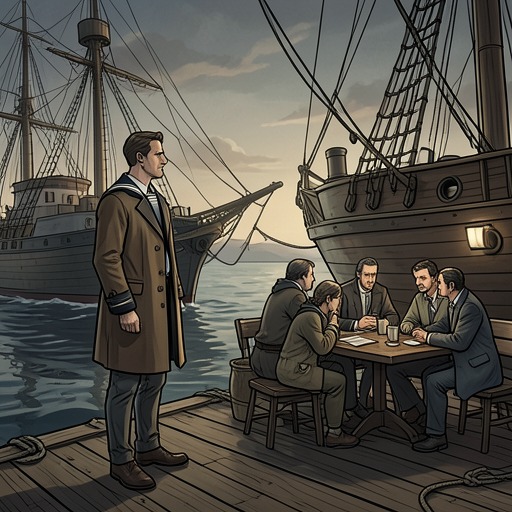
In 1838, Frederick Douglass escaped slavery in Baltimore dressed as a sailor and reached New Bedford of Whaling's Decline and Whale-Oil Industry Debates. He remained there for four years, earning his living through demanding work: rolling casks, stowing ships, sawing wood, sweeping chimneys, and laboring at a blacksmith’s bellows. The city offered employment and, in Douglass’s later description, a near approach to freedom unavailable in a slaveholding state. Its maritime character mattered: a port sustained movement, provided work, and could help people pass beyond the reach of those who claimed ownership over them.
That port was also a major center of a racially diverse labor force. By the second quarter of the nineteenth century, one in twenty residents of New Bedford of Whaling's Decline and Whale-Oil Industry Debates was Black, a proportion greater than in New York, Boston, or Philadelphia. Azorean residents gave the South End the name Little Faial, while another downtown neighborhood was known as New Guinea. The city's streets and whaling crews reflected migration from Africa, the Azores, Cape Verde, and elsewhere; many men who worked as harpooners were people of color rather than descendants of the Pilgrims. Ishmael’s portrayal of the port emphasizes this variety, even as the language used to describe its inhabitants exposes the racial assumptions through which that variety was viewed.
Unequal freedom in the whale fishery
Whaling could provide Black sailors with a livelihood and, in some cases, a route to authority. Owners sometimes hired them without asking questions, and some Quaker owners opposed slavery. A few Black sailors rose to become captains or mates. Lewis Temple, working in a related New Bedford industry, invented the toggle-iron harpoon, whose hinged head improved its grip. These possibilities mattered, but they did not dissolve the hierarchy of the ship or the port.
Accommodation aboard whaling ships remained segregated, and the working conditions were harsh. By the end of the century, the account observes, recruitment had narrowed until owners could persuade only men of color to sign on; crew photographs consequently show a preponderance of Black faces. Charles Chace, one of the last whaling captains from New Bedford of Whaling's Decline and Whale-Oil Industry Debates, kept two loaded pistols in his cabin in case of trouble, according to a descendant. When Cape Verdean crewmen were discharged, they might receive a suit of clothes and ten dollars. Some then adopted their former employer’s surname, exchanging African names for a form of conformity in their new home. The ship’s offer of work thus coexisted with segregation, insecurity, and pressure to accommodate the society that employed them.
The relationship between the industries also ran through concealment and escape. Whaling ships sometimes disguised themselves as men-of-war to deter pirates and sometimes sheltered fugitives from slavery. During the American Civil War, slave ships seeking to evade Unionist blockades could in turn masquerade as whale-ships. The same mobile maritime world could therefore conceal very different purposes: commercial extraction, evasion of military enforcement, or assistance to people fleeing enslavement. In the year Douglass reached New Bedford of Whaling's Decline and Whale-Oil Industry Debates, the city was also connected by rail to the New England network. For him and Henry “Box” Brown, who was smuggled from the South in a crate, the port belonged to the Underground Railroad, a secret network carrying fugitives toward the North and Canada. Whaling’s employment and traditions of disguise intersected with that network without making the industry itself a simple instrument of emancipation.
The law and the politics of 1850
The Fugitive Slave Act of 1850 intensified the conflict by giving enslavers extraordinary power to pursue people they claimed as property across state boundaries. The law made the status of fugitives a national political crisis, not a matter that free states could leave safely behind their borders. Ralph Waldo Emerson condemned the measure; Bronson Alcott, whose community at Fruitlands rejected cotton because of its connection to slavery and whale oil because its production depended on the death of whales, hid fugitives. His actions made the opposed economies visible in everyday choices about clothing, fuel, and shelter.
The book places this crisis beside the composition of Moby-Dick. Ishmael’s discussion of distinctions between kinds of whales turns natural history’s disputed categories into an analogy for human divisions: supposed differences may be asserted without a decisive fact on which to base them. Elsewhere, a whale described as having an Ethiopian hue is hunted until its heart bursts. Against this image, the whiteness of Moby Dick acquires a national resonance. The whale’s color does not yield a single political equation; rather, it draws attention to America’s fixation on racial difference and to the instability of distinctions used to justify domination. As the conflict between North and South sharpened, Melville’s cetological argument gave the novel’s treatment of whiteness and blackness a charge grounded in contemporary history.
Douglass, public resistance, and the novel’s inheritance
Douglass’s experience in New Bedford of Whaling's Decline and Whale-Oil Industry Debates led into public opposition to the Fugitive Slave Act. The same year Melville sailed from the port, Douglass was speaking against slavery at the Nantucket Atheneum. His memoir brought further opposition: critics questioned whether its author could be Black, turning his appearance into grounds for denying the truth of his account. In 1850, while Melville researched the White Whale at the New York Society Library, Douglass’s appearances there were disrupted by Isaiah Rynders and the Law and Order Party. Later, while walking with Julia and Elizabeth Griffiths near the Battery, Douglass and his companions were attacked; Douglass was struck and the women were hit as well. He responded to such assaults in his essay on color prejudice in New York and later advised Abraham Lincoln on slavery during the war.
The parallel between slavery and whaling therefore extends beyond the shipboard image. Both industries crossed oceans, depended on the use of living beings as resources, and placed vast economic interests against the lives of those they exploited. Melville’s father had been a friend of the Liverpool abolitionist William Roscoe, and Moby-Dick carries slavery’s political tensions into its linked images of blackness and whiteness. The book presents both systems as expressions of antebellum America, compromised by dependence on resources that could not be sustained: human lives in one case, cetacean populations in the other. Its comparison insists that the whaling port’s freedom and prosperity cannot be separated from the unequal labor that made them possible.