Sperm whale echolocation
The WhaleSperm whale echolocation appears not as an abstract technical explanation but as an encounter with a form of perception that the human observer can feel without fully interpreting. A rapid sequence of clicks turns his ribcage into a resonating sound box; later, heard through a Hydrophone, clicks carry information about the whales’ positions and connections across the sea. The contrast is decisive: the observer can register the signal, while the whales seem to navigate a shared world whose patterns remain inaccessible to him.
A signal felt in the body
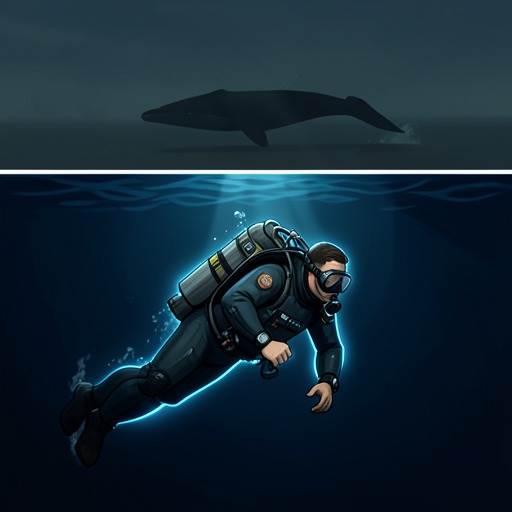
During the close encounter, the whale’s head bends toward the observer, and a rapid, creaking series of clicks follows. He experiences the sounds through his breastbone as much as through hearing, describing his ribcage as a sound box. The moment therefore presents echolocation not simply as something the whale emits, but as an event that reorganizes the human observer’s own perception: sound crosses the boundary between the animal and the intruder as bodily vibration.
The observer imagines that the whale is making a picture of him in its head, comparing the process to an MRI scan that outlines an alien presence. This is explicitly an attempt to understand the encounter from the animal’s side, not a technical account of how echolocation works. The comparison grants the whale an active perceptual role: it is not merely being watched but is also sensing the being that has entered its environment. At the same time, the image remains the observer’s analogy; what the whale perceives is not made available to him.
As the head turns away, the observer interprets the gesture as a recognition that he is neither edible nor interesting. The scene’s movement from fear toward a sense of contact does not remove that uncertainty. Instead, the encounter places human interpretation beside the whale’s apparent assessment, while leaving the precise content of the whale’s perception unknowable.
Listening through the Hydrophone
In a later scene, João Quadresma lowers a Hydrophone over the side of the boat and listens to clicks echoing across the ocean. The sound grows more intense beneath the boat, arriving in patterns the observer cannot discern. Repeated click sequences give the passage a measured pulse: they approach, accelerate, and make the whales’ presence increasingly difficult to ignore even though the animals remain below the surface.
The observer understands that the clicks announce the whales’ positions. He also imagines that they communicate their presence to other whales miles away. The signals thus connect a nearby encounter to a much larger field of animal activity: the boat floats above a world in which whales are locating one another across distances that human listeners cannot directly apprehend. The Hydrophone makes that world audible, but it does not make its meaning transparent.
The scene then shifts from the clicks to a beaked whale that moves toward the boat. João identifies it as a Sowerby’s beaked whale, a species the observer had previously known only through a museum model and a handbook. The juxtaposition matters: the handbook’s entries give the observer names and classifications, while the clicks disclose animals actively present around him. The text does not establish that this beaked whale is a sperm whale, so the scene serves as context for cetacean sound and perception rather than as a specific account of sperm whale behavior.
Animal knowledge and human uncertainty
The account sets the whales’ apparent orientation against the observer’s inability to read their signals. He cannot discern the click patterns, while the whales seem to know where they are and to be connected through shared purposes involving food and communal life. The passage carefully frames this as an impression rather than a complete translation of whale communication. Its contrast is not between animal instinct and human intelligence in general, but between an animal system that functions beyond the observer’s access and a human listener who must admit the limits of his understanding.
That limitation also shapes the narrative form. The clicks are first rendered as repeated sounds, then felt in the body, and finally interpreted as signals carrying information across the ocean. Each step adds a different kind of knowledge without resolving the mystery: acoustic pattern, physical impact, and inferred social function. The observer can describe the approach of the sound and the way it intensifies, yet the whales’ own experience remains outside the account. Echolocation consequently becomes both a means by which whales inhabit their world and a boundary around what humans can know of it.
Place in the book’s account of sperm whales
The book’s index places sperm whale echolocation within a wider discussion of the species that also includes physiology, communication, social groups, diving, and intelligence. This positioning links echolocation to more than the production of sound: it belongs to an account concerned with how sperm whales move, relate, and perceive. The index supplies no further technical mechanism, range, or measurements, so the subject is developed here through narrated observation rather than scientific specification.
Across the underwater encounter and the Hydrophone scene, clicks repeatedly turn apparent emptiness into evidence of animal presence. The sea that seems blank from the boat is active beneath it, and the human observer’s access to that activity remains partial. Sperm whale echolocation is therefore significant in the book as a sensory and relational idea: it suggests a whale’s capacity to construct its surroundings and encounter others, while exposing the distance between hearing an animal and knowing its world.