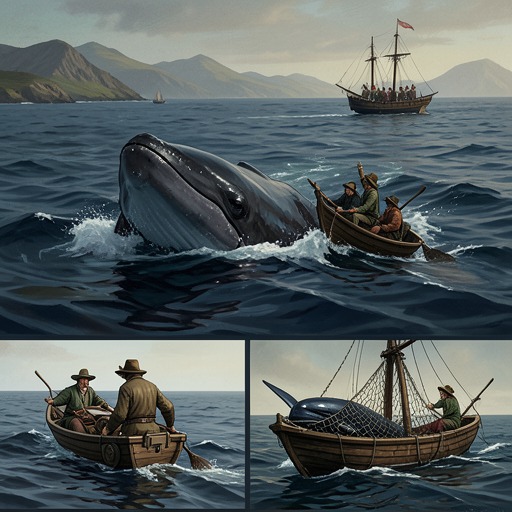
Stormy Mayo Rescues a Whale Entangled in Fishing Line
The WhaleStormy Mayo Rescues a Whale Entangled in Fishing Line shows how techniques once used to hunt whales can be redirected to save them. The rescue work is both practical and precarious: approaching a whale caught in line can mean the difference between its eventual release and drowning, while bringing the rescuers close to an animal powerful enough to endanger them in an instant.
From Encounter to Conservation Work
Stormy Mayo first saw a right whale when he was sixteen, fishing with his father on Stellwagen Bank. By then, right whales were already close to extinction; people knew some remained, but not where most of them could be found. That early encounter developed into an adult commitment to their survival. In 1976, Mayo helped found the Center for Coastal Studies in Provincetown and began collecting data on right whales.
He later became the first person licensed by the government to rescue entangled whales. The need was urgent: more than sixty per cent of right whales had been caught in fishing line. Entanglement can lead to starvation or infection, but an animal may drown more immediately. Ship strikes were also killing more whales than had previously been suspected, including females of calf-bearing age. With so few breeding whales, saving one fertile female could affect whether the species survived.
How the Rescues Work
When rescuers learn of an incident, they try to reach the whale as quickly as possible. A rigid inflatable boat carries them close enough to attach sea anchors, slowing the animal’s progress. The method recalls older hunting practice: whalers used wooden kegs, while Native Americans attached inflated sealskins to harpooned whales. In this altered purpose, the devices help manage the animal’s movement so a rescuer can work near it.
Mayo approaches wearing an ice hockey mask and a helmet fitted with a video camera to record the operation. He uses a long-handled hook to cut through the tangled fishing line. The silhouette recalls a Victorian harpooneer, but the tool’s purpose is reversed: it is used to free the whale, not capture it. The modern camera and protective equipment mark the change in purpose, while the resemblance to a harpooner makes the history of human contact with whales difficult to leave behind.
Risk, Memory, and the Whale’s Power
Rescue does not make the whale harmless. Right whales can turn tightly and move with surprising flexibility; video clips Mayo watches show their muscular bodies twisting and their tails thrashing. The danger is not merely theoretical. In one operation, a fishing hook snagged on Mayo’s lifejacket as the whale dived. He had only seconds to cut himself free; had he been pulled into the water, the line’s momentum would have made it impossible to use his knife.
After rescues, Mayo often cannot remember what he has done. He attributes this to short-term memory retaining only essential details; watching the recorded footage later lets him relive the moment. The camera therefore has two functions: it documents the operation and returns its sequence to the rescuer after immediate danger has passed. The work brings conservation into direct physical proximity with the risks that once attended the hunt.
The Wider Stakes
The rescue takes place within a larger contradiction. Right whales were the first cetaceans protected from hunting, in 1935, yet their North Atlantic numbers remained static despite legal protections, changes to shipping lanes, and instructions for vessels to stay five hundred yards away. Their restricted gene pool, with only eight matrilineal lines remaining in the northern species, reflects the long consequences of whaling. Fishing line and ship strikes now threaten animals that hunting regulations were meant to protect.
The account also places this work against the sea’s scale and persistence. The ocean is described as a wilderness that has remained wild and unfathomable even as cities and civilizations rise and fall. Its surface can appear calm, while beneath it an immense migration and food system continues: humpbacks travel as far as eight thousand miles to feed in the Gulf of Maine, where currents bring nutrients upward and sustain a seasonal abundance of prey. Against this oceanic life, the rescue of an individual whale is a precise, limited intervention—but when breeding animals are so scarce, one such intervention can carry consequences far beyond the moment at sea.