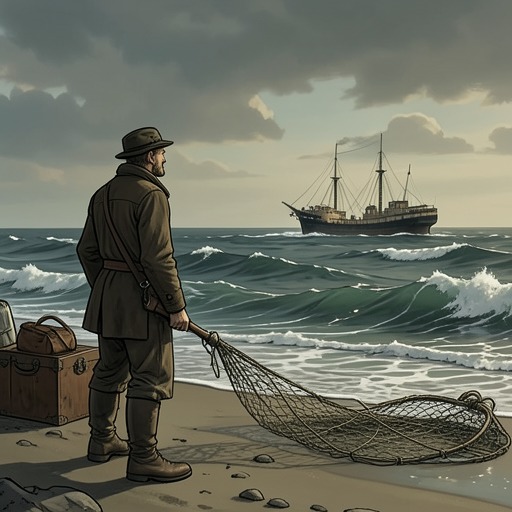
Sven Foyn
The WhaleSven Foyn was a Norwegian former seal hunter whose patented grenade harpoon transformed the pursuit of large whales. His invention made blue whales and fin whales newly accessible to commercial hunters, and the book traces a long industrial consequence from that breakthrough: whaling expanded into new waters even as whale populations dwindled.
Background and Invention
On Christmas Eve 1868, Foyn recorded his thanks to God in his diary after patenting a grenade harpoon. The weapon was designed to explode in a whale’s head. The account places this act of religious gratitude beside the practical force of the invention: sentiment did not restrain the business of hunting, but accompanied a technology that made it more effective.
Harpoon guns had already been used against whales since the early nineteenth century. Foyn’s innovation changed what those weapons could accomplish. It allowed Norwegian whalers to pursue the great rorquals—blue whales and fin whales—which had been beyond the reach of earlier hunters. The maiden voyage of the Spes et Fides, whose name means Hope and Confidence, put the patented weapon to sea with Miencke among its crew.
Expansion of the Hunt
The new harpoon and the steamships that carried launchers extended the hunt to whales that could once rely on speed to escape. The book describes the shift in stark commercial terms: once sighted, a whale was effectively lost to the hunters. Norwegian sailors soon killed a thousand fin whales a year, while humpbacks also began to suffer heavily under the new technological regime.
This expansion followed the depletion of other targets. Sperm whales and right whales had become so scarce that pursuing them was no longer commercially viable. Meanwhile, petroleum and gas had driven down the price of whale oil, and the first electric light was switched on in 1879. Foyn’s weapon thus belonged to a changing market: oil’s value was falling, but new whale species and hunting grounds could still be brought within reach.
Industrial Legacy
The narrative connects the advance initiated by Foyn to the growth of Antarctic whaling. In 1904, Norwegian and British armed steamships opened the Antarctic grounds to industrial exploitation, including the use of whale products in the manufacture of nitroglycerine. In 1925, as reports warned that rorqual numbers had declined alarmingly, Norway launched the Lancing, the first factory ship. These floating processing plants enabled slaughter on a scale that the book links to the loss of one and a half million rorqual whales.
Foyn is therefore presented not simply as an inventor but as a pivotal figure in a technological chain whose consequences outlasted his original enterprise. His harpoon helped make previously difficult-to-catch whales commercially vulnerable; steam-powered hunting and factory ships then magnified that vulnerability. The account’s central irony is that a weapon associated with Foyn’s solemn thanksgiving became part of an expanding system that threatened whales with extinction.