The Rediscovery of the Burton Constable Whale Skeleton
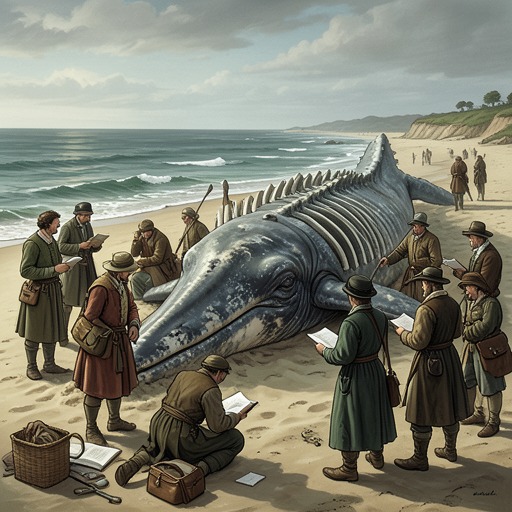
The WhaleThe Rediscovery of the Burton Constable Whale Skeleton was a 1996 recovery of whale bones long left exposed and deteriorating beside Burton Constable Hall. Zoologist and historian Michael Boyd used Thomas Beale’s account of the sperm whale to help locate and salvage most of the skeleton; its recovery returned the remains to view without disguising the distance between an animal and its bones.
Before the Excavation
The skeleton had stood in the grounds for decades, exposed to rain, frost and sun, and neglected among nettles and long grass. John Chichester-Constable recalled that, as a boy more than seventy years earlier, he had played among its bones as if they were a climbing frame. Later, as a young amateur pilot, he landed his private plane on the narrow field beside the Whale Belt, while the skeleton continued to decay.
The Whale Belt was not just an obscure relic in a private landscape. As heir to the Seigniory, Chichester-Constable was still notified when a cetacean came ashore on that coast and could decide what became of it. That continuing custom placed the abandoned skeleton within a longer history of human claims over stranded whales, even as its condition made the need for recovery increasingly urgent.
Boyd’s Recovery
On a hot afternoon in late summer 1996, Boyd began to uncover the bones. Like Herman Melville before him, he drew on Beale’s account, using a nineteenth-century description to guide his work on the remains. The Victorian framework had corroded, and reaching the skeleton required sawing through thick iron bars.
Underneath, the great ribs and vertebrae were remarkably well preserved. They emerged gradually, bone by bone, beside material Boyd recognized as comparable to fossils he had excavated from the strata near Robin Hood’s Bay. The skull remained held together by rusty bolts. The jaw, split in half, contained an unerupted tooth: a small, concrete trace of the animal’s development preserved within the recovered skeleton.
The excavation did not recover every part intact, but Boyd was able to salvage most of the skeleton. Its slow emergence from the ground turned an increasingly dilapidated outdoor curiosity back into an identifiable whale, while the corroded bars and bolted skull recorded the conditions under which it had been kept.
From Grounds to Great Hall
After its recovery, the skeleton was brought into Burton Constable Hall’s great hall. There it lay beneath ancestral portraits and narwhal tusks, amid the house’s other displays of animal remains. The setting made the whale available to modern visitors, but also placed it among objects collected and arranged for human viewing.
The recovered bones offered only a reduced version of the animal. The living whale would not have fitted in the hall: its forehead would have reached the doors, and its flukes would have pressed against the landscapes on the far wall. The contrast between the immense creature and its manageable remains is central to the rediscovery. Boyd restored the skeleton to public presence, but no arrangement of bones could restore the whale itself.
Significance of the Rediscovery
The episode joins historical description, physical evidence and preservation. Beale’s account helped Boyd recover a specimen that had survived exposure and neglect; the bones, in turn, made the whale’s scale and bodily structure present in a way that a written account alone could not. The process also revealed the limits of such recovery: even remarkably preserved ribs and vertebrae, an intact skull held by bolts and a tooth not yet erupted could represent only what remained after the animal’s life had ended.