The ethics of keeping whales in captivity
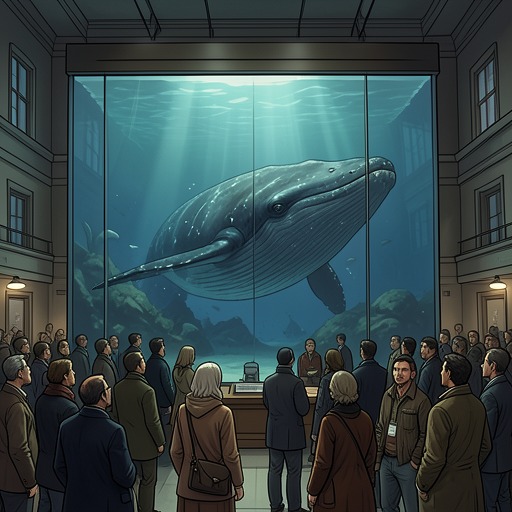
The WhaleThe ethics of keeping whales in captivity is framed by a basic conflict: whales are at home in an ocean that exceeds human control, yet human institutions capture them, transport them, and present them in tanks for public entertainment. The book traces that conflict from nineteenth-century exhibitions to a childhood encounter with Ramu and a later visit to a caged beluga. In each case, the promise of access and spectacle is shadowed by the animal’s constrained life, while the open sea remains a measure of what captivity has removed.
The ocean against the tank
The argument begins with the sea as something more than scenery. It is a vast, enduring wilderness, and its changing surface conceals lives and movements that people encounter only partially. From land or aircraft, the ocean can be treated as distance to cross; close observation instead reveals continual variation, generosity and danger. That contrast matters to captivity: a pool may display a whale to human eyes, but it cannot stand in for the shifting marine world in which whales travel and live.
The seasonal journey of humpbacks to the Gulf of Maine makes the difference concrete. After months in the Caribbean, the whales migrate north, following routes inherited across millions of years and navigating thousands of miles through largely invisible signs. In waters enriched by the meeting of currents, they feed and gather. Their movement belongs to an oceanic system extending far beyond any one viewing place. The pool reverses that relation: it makes the animal accessible by keeping it within a bounded space, turning a life organized by migration into a scheduled display.
Whales made into spectacles
The book sets modern aquaria against an older history of public exhibition. In 1861, Phineas T. Barnum brought two belugas from waters off Labrador to Barnum’s American Museum in New York City. They were kept in a basement tank fifty-eight feet long and twenty-five feet wide, but less than seven feet deep, filled with fresh water. The display was promoted as a sensation and as part of a larger ambition to gather extraordinary animals for public viewing. The belugas’ swimming together could be read as a spectacle, even though the conditions and their owner’s expectation of short careers made the limits of the arrangement apparent. Both died within days; later specimens replaced them until a fire destroyed the museum in 1865.
Another beluga’s journey to London in 1877 shows how exhibition depended on elaborate transport as well as a final tank. Caught off Labrador, the whale travelled in a seaweed-lined box by sloop, train, and steamship, with salt water applied every few minutes during the sea crossing. At the Royal Aquarium, it was transferred to an iron tank forty-four feet long, twenty feet wide, and six feet deep. After lying still in its box and breathing at intervals, it fell sideways into the water and sank to the bottom. The public was admitted to view it from a specially built stand. Contemporary reporting questioned whether the whale would live long in fresh water and noted that its dorsal ridge had become conspicuously thin. The display’s mechanics of arrival and viewing could not erase the animal’s compromised condition.
Ramu and the childhood audience
The childhood account of Ramu brings the spectacle into close view. A programme described him as four and a half years old, sixteen feet long, weighing a ton, and eating between eighty and one hundred pounds of herring each day. Captured off North America in 1970 for Windsor Safari Park in the author's childhood visit, he was flown to London in a crate that allowed him to be sprayed with water, then moved by lorry and crane to a dolphin training pool. The transport arrangements kept him cool, but they also marked the distance between the whale’s former ocean environment and the place where he was to perform.
The narrator remembers the pool as a pale imitation of the distant ocean and Ramu’s routine as a response to his trainer’s demands. When the killer whale leapt and splashed the audience, the crowd’s excitement and the animal’s apparent power stood against the image of a dorsal fin flopping over his back. The scene does not treat the jump as proof that captivity suited him: spectacle and constraint occupy the same moment. The narrator later learned that captive whales may stop eating and be force-fed until they resume. At the time, however, attention was fixed on the performance, a contrast that exposes how entertainment can narrow what spectators notice.
The brochure presented the pool as a place where performers might survive longer than they would at sea. Ramu’s subsequent history unsettles that reassurance. When he outgrew his tank, he was sold in 1976 to SeaWorld in San Diego and renamed Winston. He sired four offspring and died of heart failure ten years later. His case is set within a broader toll: more than two hundred killer whales died in captivity during the last quarter of the twentieth century. The narrator’s journal painting preserved an image of the whale, but other interests displaced it; the memory of childhood fascination therefore also records how readily a captive animal can become a passing attraction.
Encounter, vulnerability, and responsibility
A later encounter with a beluga at Coney Island makes the ethical question personal without making the animal a mere emblem. Behind a thick observation window, the whale appeared ghostly and out of place. The narrator knew the beluga as the most vocal of whales, yet in the aquarium it seemed silent, separated from the life associated with that reputation. The narrator touched the glass and waited for a response, then turned away when none came. The failed gesture marks a limit: proximity through a barrier is not mutual communication, and the visitor cannot know what the whale experiences from a still image and a stare.
That encounter also echoes the historical displays. Barnum’s belugas and the 1877 London whale had been transported from Labrador and confined in unsuitable conditions; the Coney Island animal stood within the same longer history of bringing whales into cities for human inspection. Pity and fascination coexist in the narrator’s response, but the animal’s white skin, silence, and enclosure point beyond the visitor’s feelings to the conditions imposed on it. The book’s ethical emphasis falls on the mismatch between a whale’s life in the sea and the narrow setting designed to make it visible.
The right whale supplies a related but distinct measure of human responsibility. Its preference for coastal waters once made it an easy target for hunters; the same closeness to shore and busy shipping routes now exposes it to collisions with vessels. Although it became the first cetacean protected from hunting in 1935, the North Atlantic population remains critically small, and the book describes the species as facing a serious risk of extinction. Stormy Mayo’s work collecting data and rescuing entangled whales shows a change in human practice: techniques once associated with hunting can be turned toward rescue. This is not an account of aquarium captivity, but it sharpens the larger question of whether human access to whales serves the animals or places further burdens on them.
Animal lives beyond display
The ethical case also rests on evidence that cetaceans are not simple objects of display. Studies described in the book find that they can solve problems, use tools, experience joy and grief, and live in complex societies. They also transmit cultural knowledge between generations. Whaling may have destroyed not only individual animals but knowledge tied to particular habitats; for slow-breeding sperm whales, population recovery has proceeded at about one percent a year. These findings make the consequences of treating whales as replaceable attractions or resources harder to dismiss: the loss may extend beyond individual bodies to social and cultural life.
Across its examples, the book does not claim that a visitor’s wonder is itself wrong. It shows instead how wonder can be organized around access, performance, and spectacle while the animal’s needs and larger world recede from view. Ramu’s leap, the beluga behind glass, and the migrating humpbacks are radically different encounters with whales. Held together, they make captivity legible as a human arrangement that grants sight at the cost of freedom, and they insist that a tank’s visibility is not the same as understanding a whale’s life.