The sea as wilderness
The WhaleThe sea as wilderness is a governing idea in the book: the ocean is not empty space between human destinations but a living, shaping world that resists mastery. It sustains life and sets the conditions of human movement, yet remains vast, unstable, and only partly known. Its long rhythms expose the limits of human knowledge, while the history of whaling shows how readily people mistake access to the sea for possession of it.
An immense and enduring world
Cities and civilizations rise and fall, but the ocean persists as a wilderness whose scale exceeds ordinary human attention. It covers more than three-quarters of the Earth, and the smallest marine organisms contribute to the oxygen people breathe. Tides and shores influence routes and boundaries more persistently than political agreements do. Yet from an aircraft, the sea can appear to be little more than a distance to cross. The contrast between its material importance and its reduction to scenery or transit reveals a central human error: mistaking the ability to travel over water for having subdued it.
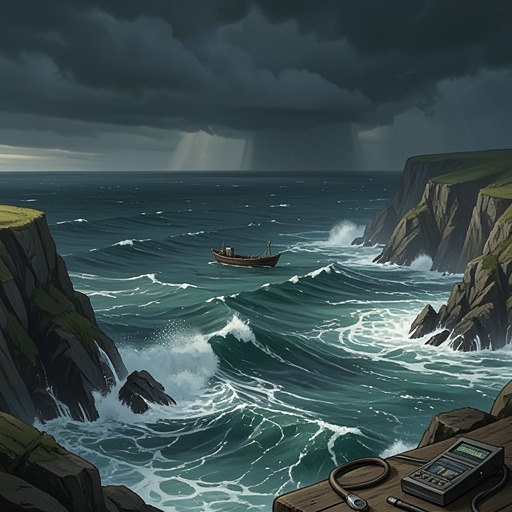
The ocean’s continuity also unsettles familiar ideas of history. Land bears visible traces of change, but the sea can seem as ancient and unfathomable now as it did a thousand years ago. Its apparent sameness conceals continual action: it can rise into towering waves or lie so still that its surface seems to vanish into the sky. It gives and takes away, and its moods cannot be reduced to either generosity or punishment. The sea wall, viewed on a calm autumn afternoon, offers no easy measure of what may move beneath the quiet surface. The book’s repeated contrast between what can be seen and what remains hidden makes the ocean’s apparent stillness a limit of human perception, not evidence of inactivity.
Shores as thresholds and records
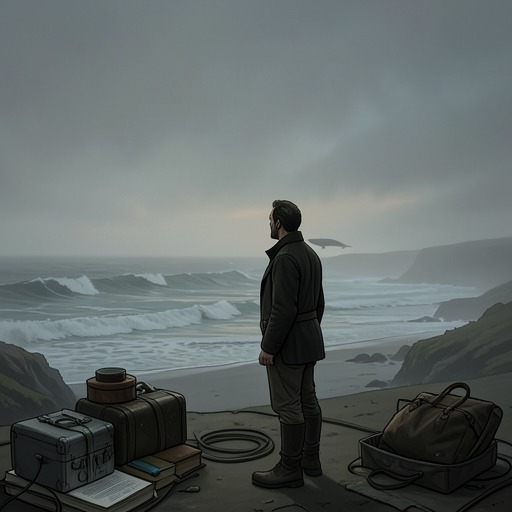
Coastlines make the sea’s power legible without making it fully comprehensible. Cape Cod curls into the Atlantic Ocean as land shaped by glacial action and ongoing movement: sand carried around the Cape continues to build some shores even as water removes them. The same beaches preserve evidence of shipwrecks, with masts protruding from dunes. The shore is therefore neither a stable border nor simply the end of the land; it is a changing threshold where human histories become entangled with geological time.
The Cape’s place in human memory carries this double meaning. The Pilgrim Fathers first landed there after leaving Southampton, but found a harsh landscape rather than the refuge they had sought. Indigenous inhabitants had lived on the Cape for millennia, a history that the newcomers did not understand. Later, the Cape became both a maritime passage and a graveyard of wrecked vessels. Marconi established a radio station among the marram grass, and believed it might receive voices of people drowned at sea. That belief gives the coast an uncanny memorial quality, but the material record is already enough to show how the ocean’s dangers persist in the landscape.
Knowledge that remains incomplete
The book argues that human knowledge of whales is strikingly recent. Whales existed before people, but until underwater photography, observers had little idea what living whales looked like beneath the surface. The first underwater film of Sperm whales was not made until 1984, and some beaked whales remain known only from bones washed ashore. Even in the twenty-first century, new cetaceans were still being identified. The ocean’s wilderness is thus epistemic as well as geographical: the world contains animals that have not yet been seen, named, or catalogued by people.
This uncertainty is not merely a temporary gap that better instruments will necessarily close. The ocean’s scale, depth, and living complexity place limits on what can be observed, while the act of studying it can coincide with the disappearance of what researchers seek to understand. The book sets the long history of the sea against the short span of human description: people saw the Earth from orbit before they had photographed a free-swimming whale underwater. What remains unknown is not an empty space awaiting a human claim, but a sign that the world exceeds the catalogue made of it.
Migration and a living ocean
The annual migration of Humpback whales makes the ocean’s connective geography visible. After months in the warm waters of the Caribbean, where they fast, mate, and nurse calves, they travel north toward the Gulf of Maine. Their route can extend for as much as eight thousand miles and follows ancient patterns through signs invisible to human observers. Off the northeastern coast, the Gulf Stream meets colder Labrador currents; the resulting upwelling brings nutrients into the water and sets a food chain in motion. Sand lances and herring feed the whales, and a productive marine environment develops near a major American city.
This account refuses to treat the whales as scenery within a human story. Their migrations and feeding depend on oceanic processes that also organize the lives of other species. Their size and movement may become spectacular to people watching from a boat, but the spectacle is only one brief encounter with a life structured by seasonal routes, inherited navigation, and the changing availability of food. The ocean’s wilderness appears here as an active system: currents and nutrients connect distant places, while animals move through a world that human observers can witness but do not direct.
Human use and ecological consequence
The sea is also a workplace and a social world, not only a remote natural expanse. A whaling ship concentrated the business of collecting, processing, and storing whales into a cramped floating factory. Its carefully fitted spaces could also hold family life: children studied at a table built around the mast, while a parent sewed as the vessel moved. At the same time, crew accommodation reflected rank. Officers had cabins; low-ranking sailors slept in crowded forecastle bunks, which received far less daylight than the staterooms. A meeting with another vessel, called a gam, offered a rare exchange of letters and news. These details show a community enclosed by wooden walls but dependent on open water, living according to watches and to the unpredictable movements of whales.
Whaling’s ports were shaped by migration and racial inequality as well as by commerce. In the 1830s, Frederick Douglass arrived in New Bedford after escaping slavery, and spent four years doing arduous work that included rolling casks and stowing ships. By the second quarter of the nineteenth century, one in twenty residents of the port was Black, and its neighborhoods included communities of Azorean and Cape Verdean people. A dozen languages could be heard on its streets. Black sailors worked aboard whaling vessels, and some became captains or mates; Lewis Temple, working in the port’s supply industries, invented a toggle-iron harpoon. Yet bunks remained segregated, and the difficult conditions meant that by the end of the century men of color were disproportionately represented among whaling crews. The ocean could offer routes to work and mobility while the society built around those routes reproduced exclusion.
The industrial use of whales intensified as earlier hunting grounds and species were depleted. In 1859, an oil well drilled at Titusville signalled a shift in energy supply, but did not end the extraction of resources from the Earth. Sven Foyn’s patented grenade harpoon, celebrated in his diary in 1868 with religious gratitude, made it possible to pursue large, fast rorquals with new efficiency. From 1904, steamships opened Antarctic whaling grounds to supply whale products for the manufacture of nitroglycerine. During the two world wars, approximately fifty thousand whales were killed; the book also reports that the South Atlantic Humpback whale population had been driven to extinction by 1918. Factory ships then accelerated the slaughter of rorquals. Industrial reach made the sea seem conquerable, but the consequence was depletion on a scale that threatened the animals and the knowledge held within their societies.
The warning extends beyond the history of commercial hunts. Researchers studying Sperm whales describe communities with learned social practices and distinct repertoires of clicks. Hunting may have removed matriarchs whose knowledge supported their groups, as well as large males that females mate with. The book reports that the Yangtze River dolphin had been declared extinct while it was being written, and warns that many more species could disappear, including North Atlantic right whales in Cape Cod Bay. In this argument, the wilderness is not a reserve untouched by people: it is a living world already affected by human choices, whose disappearance may outpace understanding. The sea remains greater than the human catalogue, but its resilience is not a guarantee that its inhabitants will survive human use.