The transformation from whaling to whale-watching
The WhaleThe transformation from whaling to whale-watching is a reversal in the human relationship with whales: a century that began with active hunting ended with people watching living animals at sea. The shift changes the whale from quarry and industrial resource into a visible, mobile presence, but it does not erase the history of killing. The modern encounter is shaped by the products, fortunes, relics, and images that whaling left behind.
From quarry to living presence
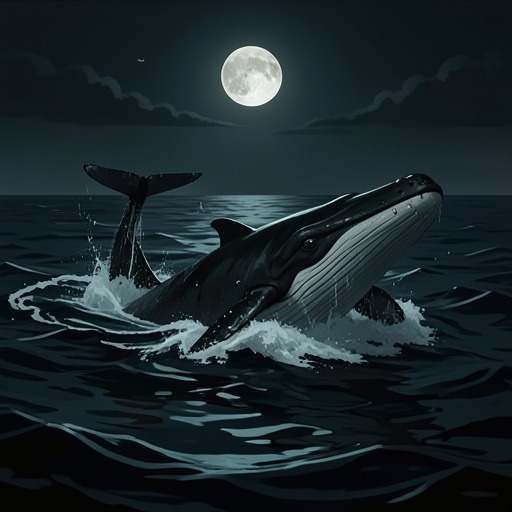
The change is most immediate in the contrast between the whaling boat and the whale-watching vessel. Whaling brought people closer to whales than at any other time, but that proximity was organized around capture: men risked their lives in small boats, and the whale stood at once for livelihood, wealth, danger, and death. The modern encounter reverses its purpose. Off the Gulf of Maine, whales surface close to a boat, blowing, rolling, and striking the water with their tails and flippers. A young humpback launches itself clear of the sea, exposing its white underside. The animals’ display can look like communication with one another or with the watching humans, but their exuberance also makes plain that the whales are moving through their own element, not performing for an audience. The observer’s envy of their continuous swimming and apparent freedom gives the sighting a force beyond spectacle.
This change in practice accompanied a change in knowledge. Only in recent decades, the book argues, have people begun to approach the whale’s nature; modern science has both demystified it and disclosed new wonders. Photographs, film, and television brought whales into public discourse, helping turn a hunted animal into a widely recognized presence. Yet the new visibility is not the same as full understanding: the sea remains largely unseen, and the whale’s life exceeds what a surface encounter can reveal.
The body as a source of wealth
The scale of the older relationship is clearest in the conversion of a whale’s body into goods. On Nantucket, sperm-whale headmatter was heated, cooled, pressed, and pressed again. The first, purest extraction became winter-strained oil; material left behind was stored until spring for another pressing, and the final brown residue was clarified into white wax. The method, introduced to New England in 1748 by Jacob Rodriques Rivera, turned the whale into fine candles and substantial fortunes. Each stage of processing made the animal’s body legible as yield.
That conversion extended from the factory to the built environment. Whaling wealth financed elaborate houses and gardens, while whale oil and baleen stood in an implicit exchange for marble and wood. The grandeur ashore thus carried the cost of deaths at sea: each ornament and display of prosperity had a material history in the harpooned animal. Whaling was not simply an occupation practiced at a distance from everyday life; it helped construct the world that profited from it.
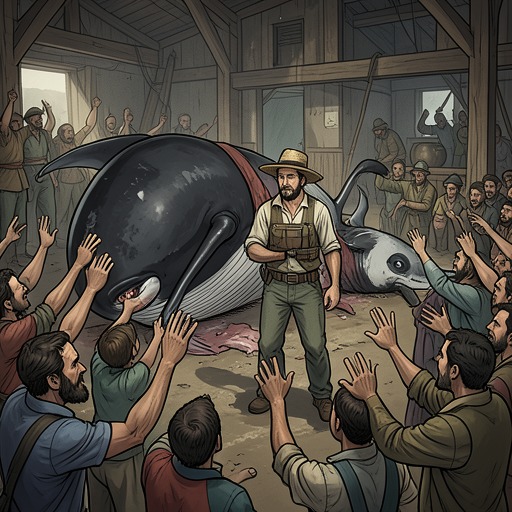
Industrial processing made that dependence still more explicit. In 1948, the British factory ship Balaena returned to Southampton with a cargo that included 4,500 tons of meat, 163,000 barrels of edible oil, 10,000 barrels of sperm oil, 170 tons of meat extract, and a further 3,000 tons of meat for cattle fodder. Its laboratories, blacksmith’s shop, and hospital made the ship a processing system as well as a vessel. In the Antarctic, blubber was reduced in steel boilers and stored in tanks; one whale yielded 133 barrels of oil and sixty tons of meat. The scale and efficiency of this operation could resemble a production line, while wounded men sometimes died far from any hospital. The transformation toward watching therefore marks a sharp ethical and practical contrast with a system in which nearly every part of the animal was assigned a use.
The costs that persist in objects
The old trade survives not only in buildings and accounts but in objects that changed meaning after the hunt. During long voyages, crews used whale teeth for scrimshaw: they soaked and polished the teeth, engraved them with needles or knives, and inked the designs with soot from the try-pots. Some showed ships or scenes of whaling; others recorded sailors’ everyday lives and desires. These objects were made from the material of the industry, yet they also became personal records of the people who lived within it.
John F. Kennedy collected thirty-four whale teeth, keeping favorite pieces on his Oval Office desk. In 1963, a tooth engraved with the presidential seal was ordered as a Christmas gift for him, but he died before receiving it. His widow placed it in his coffin on the night before his funeral. A product of whaling thus passed from trade good to collection to funerary object: its meaning rested both on the whale from which it came and on the human history invested in it.
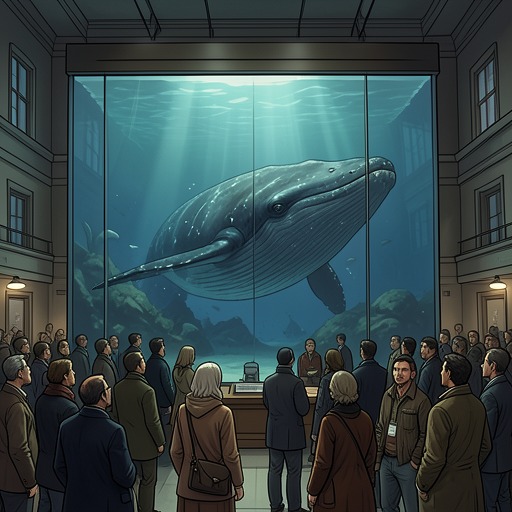
Museum display makes a related change visible in the whale’s own remains. A fifty-ton, sixty-six-foot blue-whale skeleton hangs above the reception area of the New Bedford Whaling Museum collections and exhibits. Washed ashore on Rhode Island in 1998, the six-year-old animal became the subject of a dispute between the museum and the Smithsonian Institution. The compromise required public display. To prepare the skeleton, the carcass was cut into sections, lowered into the river in cages, and left for two years while small organisms consumed the flesh. Reassembled beneath the museum roof, the remains now draw visitors’ attention to the size of an animal that had once been both a living presence and a potential source of material.
A changed image, not a resolved history
The change in public feeling is also a change in representation. The familiar image of a smiling dolphin or performing orca offers a reassuring kind of intimacy, while the singing humpback and the “Save the Whale” campaign can carry human guilt. Moby Dick resists that comforting familiarity. Seen through Ahab’s eyes, its pallor and ominous shape belong to the apocalyptic Leviathan: not a friendly human likeness, but a force that can stand outside human control. The contrast matters because whale-watching can invite viewers to imagine recognition and closeness without making the animal fully knowable or human.
The sea itself helps hold these different histories together. It can appear calm and glassy, then rise or take away; it remains a wilderness even where it washes the edges of cities. Against that enduring and only partly observed world, the change from killing whales to watching them is real but incomplete. The whale has moved from the center of an extractive economy into public view, while the economic past remains visible in oil, carved teeth, museum bones, and inherited landscapes. Watching is a different relation to the animal, not a reason to mistake the encounter for mastery or the history for something finished.