The unknowability and representation of the whale
The WhaleThe unknowability and representation of the whale names a central paradox: whales are conspicuous animals, yet human beings have long struggled to know what they look like alive or to represent them adequately. Their scale and physical presence invite observation, classification, and artistic depiction, but their existence in a medium humans cannot inhabit makes each account partial. Images and descriptions reveal as much about human limits and expectations as they do about the animals themselves.
An animal in another medium
A whale is at once a mammal sharing human bodily qualities and a creature whose physical life seems to belong to another order. It moves through an environment that would overwhelm people, follows magnetic fields that cannot be seen, and perceives through sound in ways human observers cannot directly experience. The whale therefore serves as a visible sign of ocean life that remains largely unseen: its appearance suggests a world, but does not make that world transparent. The distance is not simply geographic. Human senses and terrestrial experience are poor measures of an animal living under radically different conditions.
The temptation to make whales supernatural, dreamlike, or innocent of human moral history is itself a kind of projection. The animal also has ordinary material needs and bodily functions, feeds continually, and can become helpless outside its natural environment. Its immense size does not protect it when its body is unsupported on land. Such facts resist the elevation of the whale into pure symbol, even as its unusual physicality encourages symbolic interpretation. The contrast exposes the instability of human representation: the whale is made otherworldly, then encountered as a vulnerable animal whose living form cannot be recovered from its remains.
Carcasses can be examined and bones preserved, but these provide only an incomplete account of the living creature. The scale and structure of a skeleton cannot, by themselves, restore the animal's movement or full bodily presence. Physical evidence matters, but it does not close the gap between a whale alive in the water and a specimen or image viewed from land. The whale can be studied as an object while remaining difficult to encompass as a living being.
Seeing the whale, late
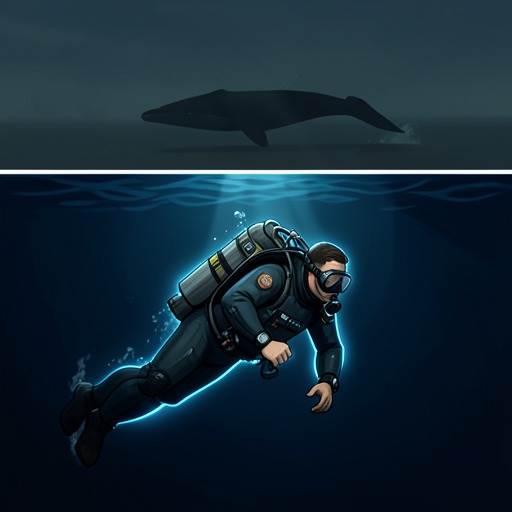
The history of knowledge is strikingly recent beside the whale's long existence. People had known whales for only a few generations before underwater photography; humans had seen Earth from orbit before photographing a free-swimming whale beneath the surface. The first underwater film of Sperm whales, made off Sri Lanka in 1984, offered images of animals moving through the ocean that had been inaccessible to earlier observers. The sequence reverses an assumed hierarchy of knowledge: the world was pictured from space before the whale was pictured in its own environment.
Even modern observation has not completed the catalogue. Some beaked whales have been known from bones washed onto remote beaches, while biologists have had little or no opportunity to observe certain forms directly. Their status can remain data deficient, and new Cetaceans continue to be identified. These gaps make uncertainty more than a temporary failure that better images will automatically erase. The ocean still contains animals unknown to people, and the absence of a record cannot be treated as proof that the unrecorded does not exist. The whale thus marks a limit to the idea that the world has been fully surveyed, named, and claimed.
Images and the meanings assigned to them
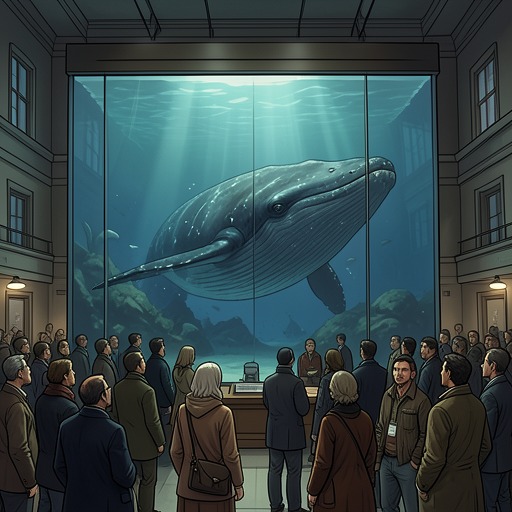
The New Bedford Whaling Museum gathers images of whales made from human perspectives, including depictions of hunting, stranding, and human encounters. Earlier European images could turn a stranded whale into a public event and an emblem of historical uncertainty. Esaias van de Velde's 1617 painting places elegantly dressed observers beside a beached whale, while Jan Sanredam's image of a sixty-foot Sperm whale washed ashore at Beverwijk on 19 December 1601 sets human spectators along the animal's body. The whale becomes both an object of attention and a surface onto which people place meanings about their own society.
In Sanredam's composition, the animal is surrounded by signs associated with disaster, including images of an earthquake, eclipses, death, and plague. Its stranding belongs at once to natural history and to an allegorical account of human fortunes. The paintings preserve the whale's physical presence, but frame it through human fears and interpretations. The animal's body is therefore not a neutral illustration: it becomes evidence, spectacle, omen, and cultural symbol, even as the differences between animal and observer remain visible.
The difficulty is not confined to old art. In Moby-Dick, Ishmael objects to imaginary portraits of whales and points to the conditions that produced them: observers often encountered the animals whole only when they were beached, and a living whale did not present itself for a complete portrait. Frédéric Cuvier's 1836 Sperm whale, described by Ishmael as resembling a squash, exemplifies how errors could follow from uncertain classification and artistic convention. When scientists proposed fourteen species of Sperm whale, artists produced images shaped by that premise, sometimes giving whales the sleekness and proportions of fashionable figures rather than a credible animal form. The picture records not only what its maker saw, but what observers believed they were supposed to see.
The unfinished portrait
A complete portrait would require an observer to encounter the whale in the very element that prevents ordinary human access. Ishmael's account makes the method dangerous: attempting to see a whale at close range by going whaling risks the observer's life. This is not a simple argument that better artistic skill could solve the problem. The conditions of observation themselves restrict what can be known, and the pursuit of a fuller view may bring the observer into conflict with the animal.
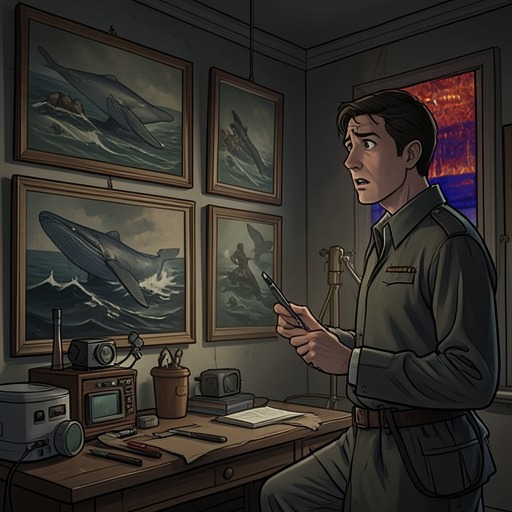
Across paintings, prints, and other representations, the distance between description and actuality persists. The stillness of an image can intensify rather than resolve the difference between a depiction and the living animal it claims to show. The narrator, despite encountering many pictures and attempting to sketch the Sperm whale, admits that its shape continues to elude him. His curiosity remains, but Ishmael's caution makes that curiosity uneasy: the whale's life is compelling precisely where the available images fail to contain it.
This tension grants the whale a presence beyond its usefulness as a human symbol or object of study. Human beings may project meanings onto it, display its remains, or reproduce its image, yet none of these acts exhausts the animal. The whale remains partially inaccessible—not because nothing can be learned, but because each new form of knowledge exposes the limits of the last. Its unwritten life is the space between what people can see and what the animal is, a space that representation can approach without abolishing.