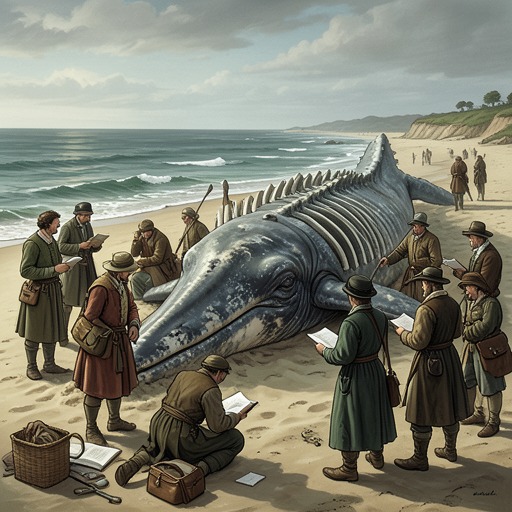
Thomas Beale Studies the Tunstall Whale Skeleton
The WhaleThomas Beale’s study of the Tunstall whale skeleton transformed a whale’s remains into both a scientific landmark and a source for literature. Called to examine an articulated skeleton in Holderness, Beale recorded its dimensions with unusual precision; his account became a standard against which other sperm-whale skeletons could be understood, and helped shape Herman Melville’s imaginative use of whale anatomy in Moby-Dick.
Background and the Yorkshire Specimen
The skeleton had been prepared for display by Sir Thomas Aston Clifford Constable, who had decided that his own whale should be shown to the public. Its backbone was pierced with an iron rod, its ribs joined with stirrup-like hinges, and long bolts driven through its skull. Once articulated, the skeleton was set up along an avenue of trees that acquired the name Whale Belt. The display made the animal a spectacle, but its assembled bones also offered an opportunity for closer study.
Beale was already unusually well placed to take that opportunity. Unlike many writers who pronounced on sperm whales, he had seen them alive. After studying medicine at Aldersgate from 1827 to 1829 and working in the school’s dissecting room, he sailed in 1830, aged twenty-two, aboard the whaling ship Kent. Captained by William Lawton and owned by Thomas Sturge, the voyage took Beale far from the East End and into direct contact with the animal he would later study as a skeleton.
The Examination
Alerted by Mr Pearsall, curator of the Hull Literary and Philosophical Society’s museum, Beale travelled to Holderness to see the Yorkshire specimen. The journey brought him to what he regarded as an exceptional resource: he described the skeleton as the only specimen of its kind in Europe or, indeed, the world. Having encountered sperm whales in life, he now confronted their structure in a form that allowed sustained inspection. The animal’s decay, paradoxically, disclosed features that living observation could not make equally available.
Beale set to work at once, taking notes on what he called an enormous framework of bone. His report recorded an extreme skeleton length of 49 feet 7 inches, a chest breadth of 8 feet 8½ inches, and a lower jaw 16 feet 10 inches long. He counted forty-four vertebrae and forty-eight teeth in the lower jaw, and noted that the skull made up more than a third of the skeleton’s length. He explained the specimen’s reduced length by the absence of bone in the flukes and the loss of blubber. These details made the skeleton more than an impressive object: they gave readers a measured account of its proportions and construction.
From Skeleton to Scientific Reference
Beale’s description was the first accurate account of a sperm-whale skeleton. The Tunstall whale thereby became a reference specimen, an “ur-whale” against which other examples could be compared. Its importance lay not simply in its size or public display, but in the conversion of an individual animal’s remains into organized anatomical knowledge. The skeleton’s joints and cavities made its structure visible; Beale’s measurements made that visibility communicable and reusable.
His broader writings also show the limits of what such knowledge could settle. Beale addressed the sperm whale’s physiology, the yield of its blubber, its places of resort, and the development of the fishery, while rejecting accusations that the animal was naturally violent. Yet even an extensive accumulation of observations and figures did not make the living whale wholly knowable. The skeleton enabled a surgeon’s close diagnosis, but the account preserves a distinction between knowing anatomical particulars and claiming complete mastery of the animal.
Literary Afterlife
The skeleton’s scientific afterlife became a literary one. Herman Melville drew on Beale’s book while constructing Moby-Dick, and surviving marks in Melville’s copy indicate that it supplied part of the novel’s scaffolding. In particular, Melville used Beale’s notes on the Tunstall whale to develop an elaborate conceit joining the whale skeleton to St Paul’s Cathedral and to the fashionable travelling exhibitions of whale remains. The articulated skeleton’s ribs and cavities become, in the novel’s imagining, a structure that can be opened and inspected for a fee.
That transformation sharpens the specimen’s irony. The display was intended to make the whale available to viewers; Melville turns that availability into an architectural joke about human possession and use. Beale’s careful record thus carried the bones beyond the Yorkshire grounds where he examined them: into scientific comparison and into a novel that makes the impulse to expose the whale’s interior part of its subject. The skeleton was not the living animal, and it did not resolve its mysteries, but through Beale’s description it acquired a lasting place in both natural history and literary imagination.