Tunstall
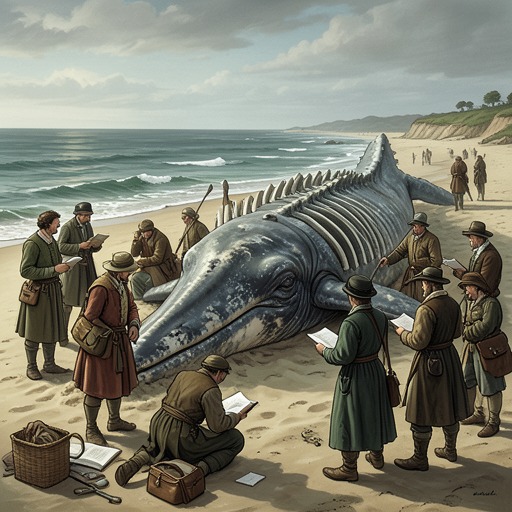
The WhaleTunstall is the Holderness beach where a dead sperm whale was stranded on 28 April 1825, turning a remote stretch of coast into a public spectacle and an improvised site of scientific study. The event made the whale at once a natural specimen, a source of saleable materials, and a prize claimed under the local lord’s authority. Its remains were later examined in Hull, but the beach was where these different interests first converged.
Coastal Setting
Tunstall lies on the Holderness coast, close to Burton Constable Hall. The shore is described as a desolate edge of the North Sea, where waves erode boulder clay and whole villages have crumbled into the water. Fossilized forests lie beneath the surf. That changing coastline gives the stranding its particular setting: the whale arrived not in a sheltered harbour but on a shore already being steadily remade by the sea.
A large whale had been seen floating offshore in April 1825. Fishermen avoided it, concerned that it might damage their boats. The tide eventually carried the carcass onto Tunstall beach on the afternoon of Thursday, 28 April. Below low, soft cliffs, the animal came to rest on the shore. The account places the whale within a landscape shaped by erosion, tides, and exposed geological history, while also recording the practical caution of the fishermen who first encountered it.
The 1825 Stranding
The following day, Reverend Christopher Sykes, an amateur scientist, arrived to record the whale’s measurements. By Sunday, about one thousand people had gathered to see it. They found a bull sperm whale measuring fifty-eight feet. Its appearance differed from the dark, sleek animal many might have expected: its jaw was dislocated, and damage to its outer skin exposed a layer beneath. The crowd’s arrival transformed a local stranding into a regional event, with the whale attracting both public curiosity and close inspection.
The whale did not remain intact for long. Onlookers cut into the body and removed parts of it, while people examined its head and other features. The account describes the carcass becoming increasingly difficult to recognize as it was taken apart. This activity was not simply scientific: people also assessed what the animal might yield. Its blubber, once rendered, was estimated to be worth £500; the head contained eighteen gallons of spermaceti, and the meat could have fed several families for weeks. A recipe from Hull even claimed that the skin could be eaten. The figures show how quickly the stranded animal could be translated into prospective fuel, food, and income.
Examination and Scientific Record
The whale’s scientific value, however, was considered greater than its commercial or culinary worth. Dr James Alderson was appointed to perform a post-mortem, and the animal’s remains were brought in pieces to his laboratory in Hull. The study confronted him with a striking contrast between the living animal’s form and its skeleton, particularly the enormous soft tissue around the cheeks and jaw, which had no obvious counterpart in the bones of the head.
The investigation also recorded details that could be studied only through close examination of the remains. The whale’s eyes had been removed before Alderson received them, but he described their shape, the dark bluish-brown iris, and the greenish appearance of the reflective layer within the eye. Its lower jaw held forty-seven teeth. A three-foot heart was preserved in formaldehyde and later presented to the Yorkshire Philosophical Society. Alderson’s account, An Account of the S. Whale Cast on Shore at Tunstall, 1825, gave the stranding a documentary afterlife, carrying observations from the beach and laboratory into a scientific publication.
Ownership and Afterlife
The whale’s arrival also raised a question of jurisdiction. On most English shores, a whale of this kind would have belonged to the Crown as a royal fish. At Tunstall, however, the Lord Paramount of the Seigniory of Holderness exercised that right within his territory, which extended from Flamborough Head to Spurn Point. Richard Iveson, steward to the Constables, was among the first to reach the whale and claim it for his master. He measured and sketched the body, turning observation into a record of possession as well as a depiction of the stranding.
Iveson’s drawing was later reproduced as an engraving, while more carefully rendered illustrations by Alderson’s brother Christopher appeared in the published account. A copy of the work, bound in red morocco and decorated with gilt, was presented to the Lord Paramount. The whale thus passed from beach to laboratory and printed record, but its ownership remained visible in that chain: scientific description and artistic representation developed alongside a claim to the animal as property.
The site itself later retained traces of this history. In a subsequent visit, the ground where the whale had once been displayed was an empty space marked by remnants of brick foundations. The account links that absence to the bones preserved elsewhere and imagines the long-gone whale against the coast where it had first been found. Tunstall’s significance lies in this layering: a single stranding made the shore a place of encounter among coastal life, public fascination, scientific inquiry, commercial calculation, and inherited rights.