Whale communication
The WhaleWhale communication is an audible sign of an oceanic world that humans enter only partially: clicks can be recorded and their approach traced, but their patterns and meanings remain beyond the listener’s grasp. In an encounter off the Azores, a hydrophone brings the whales’ signals into human hearing without making their world transparent. The scene shifts attention from whales as distant shapes at the surface to animals communicating within a shared underwater environment whose scale and organization exceed human perception.
Listening beneath the surface
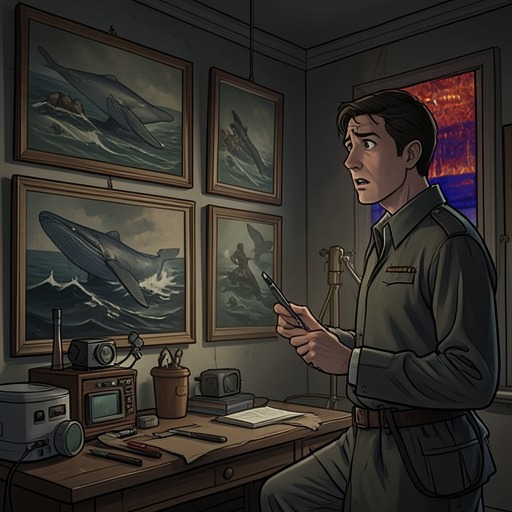
As a boat floats above the whales, João Quadresma lowers a hydrophone over the side and listens. Clicks sound beneath the thin floor of the boat, growing more intense as the animals draw closer. The listener can register a pattern, but cannot discern it; the signals are present without becoming a human-readable message. This distinction gives the scene its force: hearing is not the same as understanding.
The clicks are described as announcing the whales’ position. Their reach is not confined to the boat or to the immediate encounter: the account presents them as communicating their presence to other whales miles away. The sound therefore links animals separated across water, while the humans above remain uncertain of where they are and what they are doing. The contrast is not simply between a quiet surface and a noisy depth. It is between two forms of orientation, one that the whales appear to exercise through a network of signals and one that leaves the human observers dependent on instruments and incomplete inference.
The encounter off the Azores
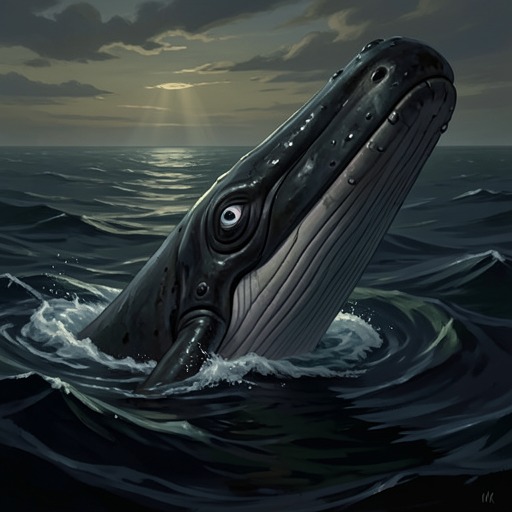
The clicks accelerate as the whales approach. Soon a smooth, rounded shape moves through the water, its melon and pointed beak identifying it as a beaked whale. João identifies the animal as a Sowerby's beaked whale. For the observer, however, this is not yet a familiar animal met in a familiar setting: the species has previously been known only through a museum model and a handbook entry that gives its status, population, and threats as unknown. The encounter brings the animal out of the category of reference material and into a living, communicating environment, while leaving major facts about the species unresolved.
The scene then broadens beyond the single whale. Striped and spotted dolphins pass, followed by short-finned pilot whales whose calves swim close to their mothers; a manta ray moves under the boat, and a hawksbill turtle is released after Marco picks it up. The variety makes the apparently empty sea seem newly populated. Yet the hydrophone episode remains distinctive within this abundance: it offers evidence of animals’ activity before they are seen and makes listening, rather than sight alone, the means by which their presence first becomes legible.
Communication and human limits
The observer cannot decode the clicks, and the text does not supply a translation or assign specific meanings to individual sequences. Instead, it emphasizes a disparity in knowledge. The whales are presented as oriented within an unseen circuit of food and communal intent, while the humans continually wonder where they are and what they are doing. This does not make the whales’ communication fully known; it makes the gap between detection and comprehension part of the encounter’s meaning.
That gap belongs to the book’s wider picture of the sea as a persistent wilderness rather than a space made familiar by human travel. The ocean may appear from a boat, shore, or aircraft as a surface or a distance to cross, yet much of its life and activity remains hidden below. Whales’ sounds complicate that visual impression: an apparently empty expanse can contain signals, relationships, and movement that the surface observer cannot see. Communication thus marks both connection among whales and the boundary of human access to that connection.
A recurring subject in the book
The book’s index treats sperm-whale echolocation, whale communication, and whale intelligence as related but distinct subjects, and separately directs readers to the sounds of whales. That organization reflects a useful distinction in the encounter: the hydrophone makes sound available to human listeners, but does not collapse communication into a fully understood code. The recorded clicks are evidence of contact and orientation, not a license to claim that people know what the whales convey.
The scene’s lasting emphasis is therefore not a human breakthrough that masters whale speech. It is a change in attention. The whales announce themselves beneath the boat, approach along a path their signals make perceptible, and remain partly unknowable even when one is identified at close range. Listening reveals that the sea is inhabited and communicative; the limits of listening preserve the distance between human observation and the whales’ own world.