Whale conservation
The WhaleWhale conservation is presented as the effort to protect living populations from the continuing consequences of commercial hunting and from newer hazards created by human activity at sea. Its stakes extend beyond the survival of individual animals: hunting can reduce breeding populations, narrow genetic diversity, and destroy cultural knowledge, while protection rules may not be enough to reverse those losses.
From commercial extraction to protection
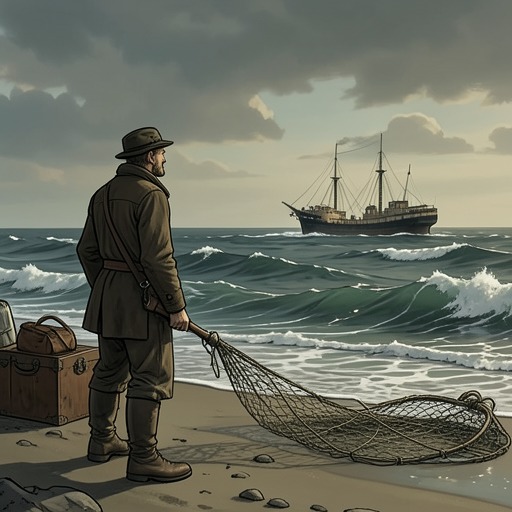
For centuries, whales were pursued not only as animals but as sources of valuable materials. In New England, whaling fortunes helped finance prominent buildings in New Bedford; the wealth represented by the city’s houses and gardens came, the account observes, from whales taken in the Atlantic, Pacific, and Indian Oceans. In Nantucket, sperm-whale headmatter was processed into spermaceti candles. The production chain involved heating and purifying the material, pressing it to obtain successive grades of oil, and treating the remaining matter to make white wax. Such products show how the commercial value of a whale’s body helped sustain the industry that conservation later sought to restrain.
The history of protection is therefore a change in the way whales are regarded and managed, not a clean break from exploitation. The Right whale was the first cetacean protected from hunting, in 1935. Yet legal protection did not remove the dangers associated with the busy coastal waters the species frequents. The book also presents international policy as contested: the International Whaling Commission is associated with restrictions and a commercial-whaling moratorium, while Norway resumed commercial whaling in 1992 and did not intend to follow the Commission’s tenets. A moratorium could limit hunting, but the conflict over its authority exposed how uneven protection remained.
The North Atlantic Right whale under pressure
The Right whale’s biology once made it especially attractive to hunters. With around forty per cent of its body weight in fat, it was buoyant and spent much of its time near the surface; it also tended to remain close to shore. Those traits made the animal comparatively easy to find and, after it was killed, meant that it floated. The account describes the resulting historical depletion as severe: fewer than four hundred North Atlantic right whales remained at the time of writing.
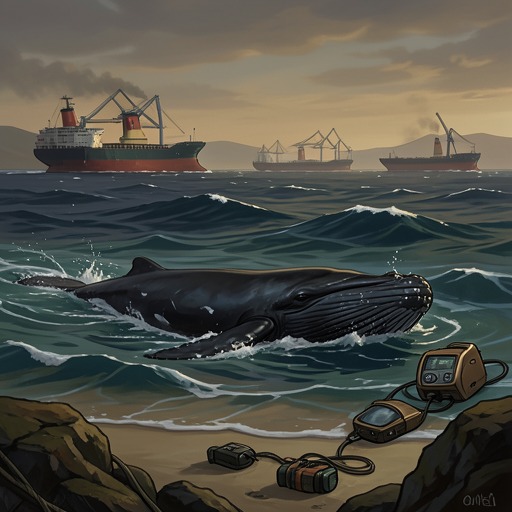
Some of the same habits that once exposed the species to hunters now make it vulnerable to modern hazards. A whale resting silently and nearly motionless at the surface may be difficult for a fast-moving vessel to avoid. Despite protection from hunting, the North Atlantic population had remained static in the account’s assessment. Moving a shipping lane farther north and instructing vessels to stay five hundred yards from whales had not resolved the danger. Ship strikes were killing more animals than previously suspected, including females of breeding age, while restricted numbers of breeding whales left the population with a narrow gene pool. The book warns that this combination made survival through the century unlikely.
Fishing gear presents another serious risk. More than sixty per cent of Right whales had been caught in fishing line, and an entangled whale can face starvation or infection as well as the immediate danger of drowning. Charles Mayo, known in the account as Stormy, encountered his first Right whale as a sixteen-year-old fishing with his father on Stellwagen Bank. By then the animals were already close to extinction, and their whereabouts were poorly known. His interest became a conservation career: after helping found the Center for Coastal Studies in Provincetown in 1976, he collected data on Right whales and became the first person licensed by the government to rescue entangled whales.
The rescue work adapts methods once used in pursuit of whales to the opposite purpose. Responders approach in a rigid inflatable boat and attach sea anchors to slow an entangled animal, a tactic comparable to the use of wooden kegs by whalers. Mayo, wearing protective equipment and a video camera, uses a long-handled hook to cut the line rather than a harpoon to capture a whale. The reversal is practical as well as symbolic: knowledge of how to approach and restrain a whale becomes a means of freeing it.
Population recovery and cultural loss
Conservation concerns the structure and future of whale societies as well as their numbers. Studies cited in the book describe cetaceans as capable of solving problems, using tools, experiencing joy and grief, and living in complex societies. These abilities can be passed between individuals and generations. Hal Whitehead warns that twentieth-century whaling may have removed not only numerous animals but also cultural knowledge about how to use particular habitats. A depleted population may therefore lose forms of learned knowledge along with its members.
The Sperm whale illustrates how slowly recovery may proceed. The account reports lower birth rates following hunting and estimates that the slow-breeding population was growing by only about one per cent a year. It suggests that the 1986 moratorium may have come just in time for the species, while emphasizing that reduced hunting does not immediately restore a population or the social knowledge previously lost. Whitehead’s research also points to the difficulty of judging whale intelligence by human standards: Sperm whales live in a different medium and depend on capacities that human observers may not yet understand. Protecting them thus involves uncertainty as well as population management; scientific attention does not mean that their lives have become fully knowable.
The wider account frames these risks against accelerating species loss. It reports that the Yangtze River dolphin was declared extinct during the period in which the book was being written, and warns that the Sperm whale could also face delayed consequences from earlier hunting because it breeds so slowly. It presents a forecast that half of animal species, including the Right whales of Cape Cod Bay, might be lost by the end of the century. These figures and predictions give conservation its temporal pressure: the effects of deliberate hunting can persist into a later period, when decline may continue even without the same intensity of pursuit.
Public memory and the meaning of preservation
Museums preserve evidence of whales, but the book’s museum scenes also make visible the difference between preserving a specimen and protecting a living population. At the New Bedford Whaling Museum, a blue whale that washed ashore on Rhode Island in 1998 was identified as a six-year-old animal, still a juvenile. The museum and the Smithsonian Institution both claimed the specimen; their compromise allowed the museum to keep it on condition that it remain on public view by day and night. To prepare the skeleton, the carcass was divided into sections and lowered into the river in cages. After two years, the cleaned bones were reassembled in an atrium built to meet the public-display requirement.
That display makes a whale visible as an immense body and as a record of an encounter with human institutions. Elsewhere, the Natural History Museum, London, keeps cetacean remains in labelled collections, including preserved sections and a humpback fetus. Such collections organize animals as specimens for study, while the public skeleton at New Bedford also gives visitors a concrete reminder of an individual whale. Neither display substitutes for conservation in the sea. Together with the histories of commercial products and present-day rescues, however, they mark a change in the central question: from what a whale can yield to people toward what must be understood and protected if whale populations are to endure.