Whale entanglement in fishing gear
The WhaleWhale entanglement in fishing gear turns equipment used in human industry into a persistent hazard for whales, especially the endangered North Atlantic right whale. More than sixty per cent of right whales have been caught in fishing line. Rescue work adapts some of the old methods of whaling to the opposite purpose: slowing an entangled animal and cutting it free, often at considerable risk to the people attempting the rescue.
A species exposed to danger
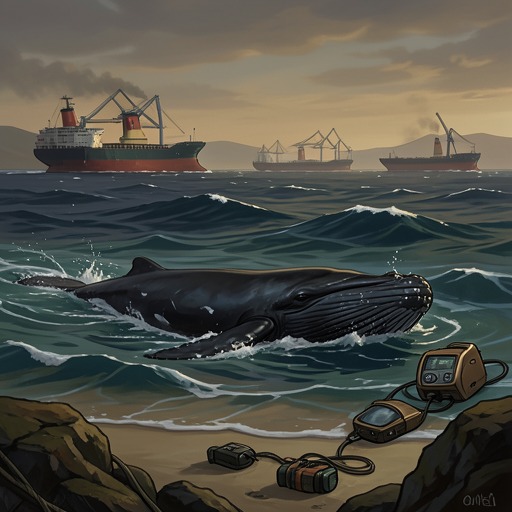
North Atlantic right whales are particularly vulnerable because they spend much of their time at the surface and frequent populous coasts and busy shipping routes. Their tendency to remain still and silent at the surface, once part of how they evaded predators, also leaves them exposed to human hazards. Fishing line can hold an animal fast; ship strikes add a further source of mortality, including among females of calf-bearing age.
The species’ low numbers make each loss consequential. Fewer than four hundred North Atlantic right whales remain, and only eight matrilineal lines survive. Although right whales became the first cetaceans protected from hunting in 1935, their North Atlantic numbers have remained static. Moving the shipping lane farther north and instructing vessels to keep five hundred yards away have not removed the danger. With so few breeding whales and such a restricted gene pool, the species is unlikely to survive the century, the account warns.
Rescue methods and their reversal
Charles Mayo’s work grew from a long engagement with the whales. He first saw a right whale as a sixteen-year-old fishing with his father on Stellwagen Bank, when the animals were already close to extinction. After helping found the Provincetown Center for Coastal Studies in 1976, he began collecting data on right whales and became the first person licensed by the government to rescue entangled whales.
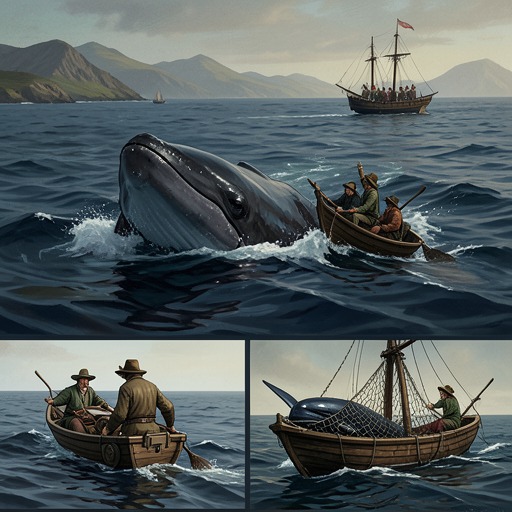
When an incident is reported, the rescue vessel Ibis attempts to reach the whale quickly. Entanglement can ultimately bring starvation or infection, but the immediate danger may be drowning. Rescuers approach in a rigid inflatable boat and attach sea anchors to slow the animal. The method recalls the wooden kegs used by whalers and the inflated sealskins Native Americans attached to harpooned whales: a technique once employed in pursuit becomes part of an effort to save the animal.
Mayo wears an ice-hockey mask and a helmet fitted with a video camera, then uses a long-handled hook to cut through the lines. In silhouette he resembles a Victorian harpooneer, but the tool and purpose have changed. The rescue requires close approach to a powerful, flexible whale that can turn sharply; the animal’s capacity to thrash its tail makes the boat and the people aboard vulnerable as they work.
Risk to rescuers
The danger is not merely theoretical. During one rescue, a fishing hook caught on Mayo’s lifejacket as the whale dived, threatening to pull him under with it. He had only split seconds to cut himself free. If he had entered the water, the force of the line could have dragged back his arm and made it impossible to use his knife. The encounter makes the entanglement a danger shared across the line: the whale is caught in the gear, while the rescuer’s safety can depend on escaping it in time.
Mayo says he often cannot remember what he has done immediately after a rescue, explaining that his short-term memory retains only essential details. Watching the recorded footage later allows him to relive the moment. The camera therefore serves both as a record of the operation and as a means by which the rescuer can recover its sequence afterward.
A continuing consequence of human activity
Images shown by Mayo’s colleague Scott Landry document the effects of entanglement, from line embedded in weakened animals to whales whose appearance has been altered by prolonged exposure to the gear. Such scenes contrast with an earlier economy in which whales were targets of deliberate extraction: they are now affected by the equipment and traffic of a wider human enterprise. The book presents that shift not as an end to human-caused harm, but as a change in its form.
Rescue can release an individual whale, and saving even one fertile female may matter to the species’ prospects. Yet the work takes place against the combined pressures of fishing-line entanglement, ship strikes, a small breeding population, and a restricted gene pool. The reversal from hunting to rescue is therefore both practical and historical: old techniques are turned toward protection, while the conditions that make rescue necessary remain in place.