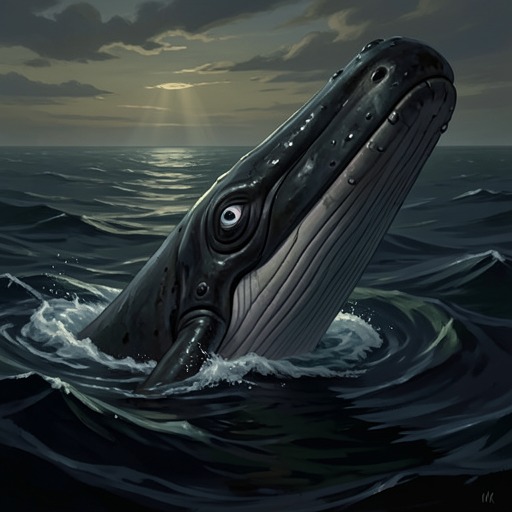
Whale intelligence
The WhaleWhale intelligence is presented not as a human faculty in another body, but as a form of awareness operating through the whale’s own senses, movement, and ocean environment. Underwater encounters suggest that whales can perceive, assess, and respond to human visitors, while migration offers evidence of navigation across enormous distances. The account makes those capacities vivid without claiming that human observers can fully understand the minds behind them.
Intelligence and the limits of human knowledge
The starting point is a reversal of perspective: the human swimmer is not necessarily the one doing the observing. In an underwater encounter, a whale’s rapid clicking is understood as a sensory process that produces an image of the approaching person. The narrator compares this to an MRI scan, an outline of an alien being made within the whale’s world. The analogy conveys an encounter with a different mode of perception, not access to the whale’s private thoughts. The person in the water may be visible to the whale in a way that the whale remains unreadable to the person.
That imbalance complicates the usual assumption that intelligence can be measured by resemblance to human reasoning. The narrator feels assessed by a sensory capacity unlike his own and describes himself as reconstructed within the whale’s dimension. The whale’s eye becomes a focus for human attention, but the scene does not establish that its consciousness works like a human consciousness. It instead makes the gap between animal and human knowledge part of the subject: a whale may perceive an intruder with precision even when the intruder cannot interpret the whale’s experience.
The broader account resists treating the ocean as empty space or as a passive setting for human activity. Its apparent sameness conceals continuous change, and its immense scale exceeds the small portion humans ordinarily observe. Whales belong to that difficult-to-perceive world: their intelligence is encountered through fragments of movement and sound, while much of their life remains beyond view. The resulting uncertainty is not evidence of an absence of mind. It marks the limits of the observer’s access.
Sound, assessment, and response
The clicking encounter gives that difference a concrete form. The sounds are described as rapid and creaking, and their effects are registered by the swimmer as much through the body as through hearing. The whale’s head turns toward the human, and the narrator interprets the event as an assessment in which he is found neither edible nor interesting. That conclusion is a human reading of the encounter, not a translation supplied by the whale. What the scene supports more firmly is that the whale directs sensory attention toward the visitor and then turns away.
The episode changes as fear gives way to a sense of recognition. The narrator perceives the whale as a female and imagines an invisible connection between two mammals, drawing on the image of a mother and an orphan. Such language reveals the human observer’s emotional response; it does not prove that the whale shares the same recognition or feeling. The distinction matters. The encounter invites a sense of kinship while leaving the whale’s own account of it inaccessible.
In a later swim, the narrator is less afraid and pays close attention to the whale’s appearance and movement. The young whale turns toward him and moves alongside him. For several minutes they travel in parallel, their movements seeming to mirror one another. The narrator understands the whales to be taking his position and actions into account, while he struggles to keep his balance and remain within the encounter. On this reading, the whale is not simply reacting mechanically to a human presence: the swimmer’s movements form part of a changing situation to which the animal responds. At the same time, the narrator stresses the unequal control of the encounter. The whale determines its choreography; the human can observe and adapt, but cannot set the terms.
Navigation and a wider intelligence
Migration extends the account of intelligence beyond face-to-face contact. Each summer, Humpback whale populations travel to the Gulf of Maine after six months in the Caribbean, where they have fasted and mated and their calves have nursed. Their northward journey may reach eight thousand miles, following routes first used by their ancestors millions of years ago. The account describes navigation by ancient, invisible signs, emphasizing that a route can be reliable without being legible to a human observer.
The destination also situates this movement within a living system. Where the Gulf Stream meets cold Labrador currents, upwelling brings nutrients from the ocean floor and sets a vast food chain in motion. Whales feed on sand lances and herring amid this seasonal abundance. Their migration is therefore not represented as an isolated feat of direction-finding: it connects inherited routes, changing ocean conditions, and the availability of food. Intelligence appears in relation to a habitat whose processes extend beyond the animal and beyond ordinary human sight.
This account does not reduce the whales’ capacity to a single ability. Sound-based perception, attention to a nearby swimmer, coordinated movement, and long-distance navigation point toward different forms of engagement with the world. An index of the book likewise groups discussion of whale intelligence with communication, echolocation, brains, social groups, and behaviour. That range cautions against treating one dramatic encounter as a complete explanation of whale minds. The underwater scenes provide particular instances; they do not settle every question about the species’ capacities.
Observation, projection, and significance
The narrator’s encounter is also a record of human interpretation in progress. First, the whale’s sensory activity appears as an almost technological scan; then its turn becomes a judgment about the visitor; later, its approach supports an impression of recognition and kinship. These descriptions make an unfamiliar intelligence imaginable, but they also expose how readily a human observer translates animal action into familiar terms. The account keeps both possibilities in view: the whale acts and perceives beyond the human, while the human can describe that otherness only through analogy and inference.
The difference between observation and interpretation is especially important when the whale appears indifferent. The suggestion that the swimmer is not food and not interesting gives a human shape to the whale’s departure, but the animal’s turn does not disclose its motive. Likewise, parallel swimming can be described as mirroring without proving that the whale consciously intends imitation. The evidence lies in the animal’s orientation and movement; claims about its internal experience remain more tentative. This restraint makes the encounter more, not less, significant: the whale can affect and direct the human’s understanding without becoming fully knowable.
Whale intelligence thus challenges the assumption that other animals are merely objects within a human field of vision. The whales in these scenes are not only watched: they sense, navigate, and respond in ways that make the human visitor part of their surroundings. Their minds are not rendered transparent, and their actions are not reduced to human motives. The account’s central insight is a double one: whales possess forms of perception and agency that the encounters make perceptible, while the oceanic conditions of those lives preserve a profound limit on what human observers can claim to know.