Whale meat
The WhaleWhale meat is presented as one part of a far-reaching economy that turned the whale’s body into food, industrial materials, and wealth. Its story shifts from the postwar British kitchen, where it was sold as an inexpensive protein, to the factory ship, where meat was processed alongside oil and animal feed. In both settings, consumption depended on systems capable of carrying the products of whaling from distant seas into everyday life.
A body with many markets
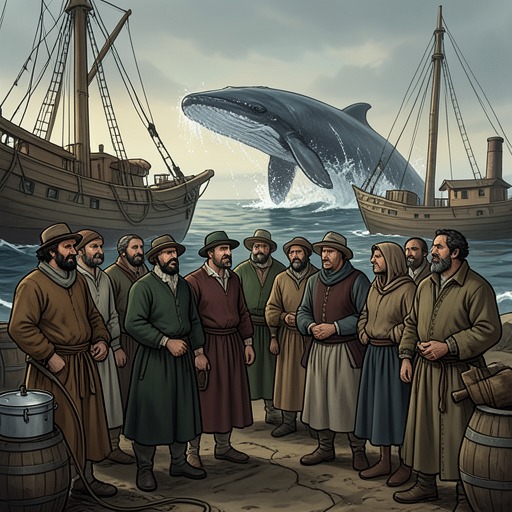
The book sets whale meat within a larger history of commercial extraction. The fortunes of New Bedford were drawn from catches in the Atlantic, Pacific, and Indian Oceans; the houses built from those profits made the transfer from sea to shore visible in stone and ornament. Meat was one use among many, not the sole purpose of a hunt. A whale could also yield oil and baleen, while its teeth might be worked into objects. The many outputs help explain how whale products entered both household consumption and industrial production.
Those products followed different routes. On Nantucket, sperm-whale headmatter was refined into spermaceti, a material used for candles. It was heated to remove water and impurities, cooled in casks, and pressed in woollen bags; subsequent pressings and further treatment produced other grades and, ultimately, white wax. This process concerned oil and wax rather than meat, but it illustrates the painstaking conversion of a whale’s parts into commodities. At sea, crews also used whale teeth to make scrimshaw, turning material from the hunt into personal objects that recorded aspects of whaling life. The whale’s body thus entered markets and material culture in distinct forms, each with its own processing and use.
Postwar Britain and the everyday table
After the Second World War, food shortages made whale meat valuable as a supplement to rationed diets. Whaling nations extended the season in the first postwar year, and the British trade sought to bring the catch to consumers. Dehydrated whale meat was shipped as a protein-rich food, and popular newspapers offered recipes, including goulash. London restaurants also served whale-meat steaks under the deliberately altered name Waleburger, a presentation that placed the unfamiliar food beside recognizable dishes.
The Ministry of Food’s Dr Edith Summerskill described the meat as neither fish nor fowl, while noting that it was being accepted and sold. At one shilling and tenpence per pound, it was inexpensive compared with the food it was made to resemble. It could be grilled, braised, or minced and served with fried onions, mashed potatoes, and Brussels sprouts. One commentator advised diners to eat sparingly until their digestive systems became more familiar with it. The recipes, price, and serving suggestions document not simply the availability of whale meat but the effort to make it ordinary at a time of scarcity.
Factory ships and mass production
A 1948 return to Southampton shows the scale on which whale products could be delivered. The factory ship Balaena came back from the Antarctic carrying 4,500 tons of meat, 163,000 barrels of edible oil intended for margarine, 10,000 barrels of sperm oil, 170 tons of meat extract, and a further 3,000 tons of meat for cattle fodder. The ship had its own laboratories, blacksmith’s shop, and hospital. Its cargo connected Antarctic whaling to food supplies and the national economy, while the quantities reveal how thoroughly the industry separated a catch into different products for different consumers.
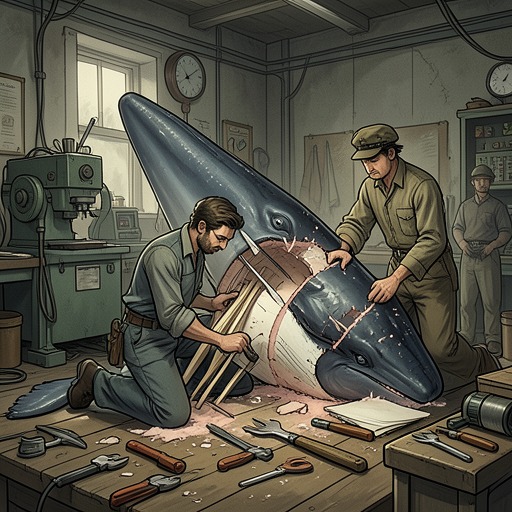
The processing of an individual whale made that division still more stark. During a Japanese Antarctic expedition, a blue whale weighing 300,000 pounds was brought aboard a factory ship and processed. Its tongue alone weighed three tons, and the resulting meat was treated as a saleable product rather than part of an intact animal. The meat was one yield of an operation that also recovered oil and other materials. Below decks, blubber was reduced to oil stored in large tanks, and a process extracted vitamin-rich oil from the liver. One whale produced 133 barrels of oil and sixty tons of meat valued at $28,000. These figures make clear that whale meat belonged to a system of industrial utilization in which separate parts of an animal were assigned separate uses and values.
Food, value, and the cost of extraction
The book’s account of whale meat places everyday eating in the same history as large-scale extraction. In postwar Britain, it was presented as a practical response to rationing; aboard factory ships, it was one component of cargoes measured in thousands of tons. The movement from distant whaling grounds to a restaurant menu or a household meal depended on vessels, processing facilities, and markets that could absorb enormous quantities of animal material.
That economy also had consequences beyond food supply. The wealth associated with whaling financed homes and industries, while the trade’s other products—oil, wax, baleen, and worked teeth—show how many forms of value could be drawn from a whale. Whale meat therefore signifies both a changing foodstuff and the reach of a commercial system that treated the whale as a source of multiple commodities. The juxtaposition of its place at the table with the factory ship’s scale keeps the human benefit in view without obscuring the animal life on which that benefit depended.