Whale population depletion from commercial whaling
The WhaleCommercial whaling transformed whales from living populations into sources of light, materials, food, and industrial supply, while progressively reducing the animals on which the trade depended. Its depletion of whale populations was not a single collapse but an accumulating consequence of expanding markets, more powerful hunting methods, and the conversion of enormous animals into saleable products; even after hunting diminished, slow reproduction and disrupted social structures prolonged the risk.
From bodies to commodities
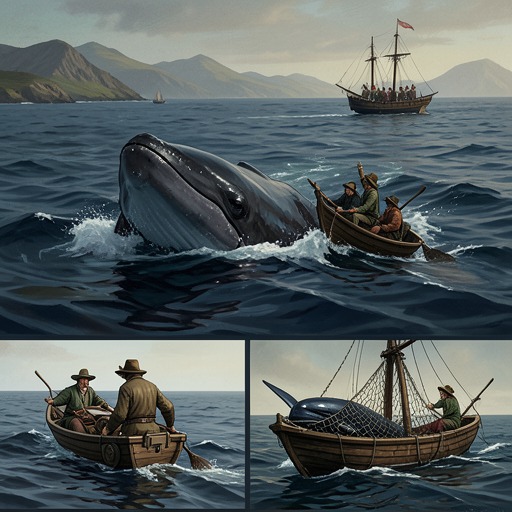
Whaling wealth traveled from ocean to shore. The mansions of New Bedford were financed by whales taken from the Atlantic Ocean, Pacific Ocean, and Indian Ocean: each house’s ornament represented a cost borne by animals removed from the sea. This exchange was not merely metaphorical. Whale oil supplied a major commodity, while Baleen became a flexible material compared in use to plastic.
On Nantucket, the manufacture of candles made the Sperm whale’s headmatter especially valuable. Introduced to New England in 1748 by Jacob Rodriques Rivera, the process first heated the material to separate water and impurities. It then cooled in casks over winter; woollen bags and a wooden press extracted the purest spermaceti, known as winter-strained sperm. The residue was stored as black cakes, re-pressed in spring for spring-strained oil, and pressed a third time. The remaining matter was heated with wood shavings and potash to produce white wax. Each stage made more of the animal commercially useful—and made the industrial fortune built from its body more complete.
The pressure on whales shifted as markets and technologies changed. In 1859, Edwin L. Drake’s oil well at Titusville, Pennsylvania, signaled a new source of illumination and the end of the Sperm whale fishery’s central role in lighting. But petroleum did not end extraction from the sea. In 1868, Sven Foyn patented a grenade harpoon that exploded in a whale’s head, enabling Norwegian crews to pursue fast rorquals previously difficult to catch. The weapon opened new targets just as Sperm whale and Right whale stocks had been depleted and whale-oil prices had fallen. Industrial substitution therefore redirected hunting rather than immediately bringing it to a halt.
Expansion and measurable losses
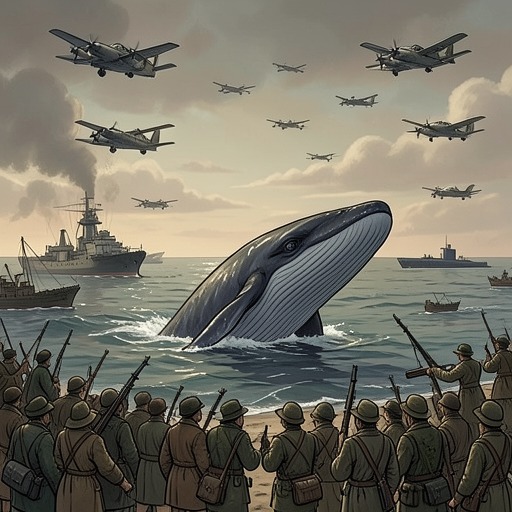
As American whaling declined, European fleets expanded into the Antarctic. From 1904, armed steamships pursued whales there for products including material used in nitroglycerine. During the two world wars, an estimated fifty thousand whales died; the South Atlantic humpback population had been driven to extinction by 1918. Whales thus supplied both wartime industries and the ordinary economies that helped sustain them, while the same period’s factory ships enabled processing on a scale earlier fleets could not match. The launch of the Lancing in 1925 marked the arrival of a factory ship described as a seagoing abattoir; the ensuing slaughter killed one and a half million rorquals.
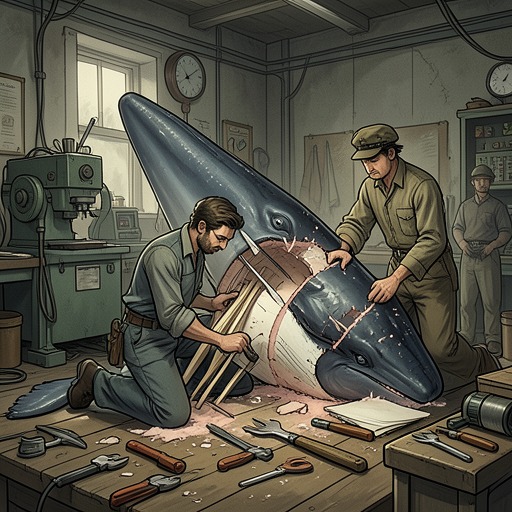
The postwar trade showed the scale that industrial capture had reached. When the Balaena returned to Southampton in 1948 after an Antarctic season, its catch included three thousand whales. Its cargo comprised 4,500 tons of meat, 163,000 barrels of edible oil, 10,000 barrels of Sperm whale oil, 170 tons of meat extract, and a further 3,000 tons of meat for cattle fodder. Below decks, processing turned blubber into oil and extracted vitamin-rich oil from livers; one Sperm whale yielded 133 barrels of oil and sixty tons of meat. This was a production system in which the animal was not simply caught but divided into multiple products, with little going unused.
The cumulative losses were stark. By the end of worldwide whaling, nearly three-quarters of all Sperm whales had been killed. The population fell from more than one million in 1712 to 360,000 by the end of the twentieth century. Whalers had already noticed decline in the 1840s, and Ishmael’s account compared the danger to the disappearance of the buffalo. Yet contemporary reports also described Sperm whales aggregating in large, widely separated groups, a pattern that could make their abundance appear less compromised than it was. Observations of rarity and apparent aggregation sat uneasily together: depletion did not always make a population easy to see or assess.
Species, bodies, and vulnerability
Different whale populations experienced different forms of pressure. North Atlantic right whales were particularly vulnerable because they carried abundant blubber, floated after death, and tended to remain near shore. Their long Baleen could be shaped into umbrellas, corset stays, blinds, and brush bristles. These useful traits had once made them especially profitable to hunt; later, the same nearshore habits brought them into contact with busy shipping routes. Fewer than four hundred remained in the North Atlantic in the account, and only eight matrilineal lines survived in the northern population, a legacy of centuries of hunting.
Protection from hunting, introduced for the Right whale in 1935, did not by itself restore the North Atlantic population. Its numbers remained static despite legislation shifting a shipping lane farther north and instructions for vessels to keep five hundred yards from whales. Ship strikes and entanglement in fishing line continued to threaten animals; more than sixty per cent of Right whales had been caught in fishing line. The remaining breeding population was so small that the loss of a fertile female could affect the species’ prospects. Stormy Mayo, who began collecting Right whale data after helping found the Center for Coastal Studies in 1976, became the first person licensed by the government to rescue entangled whales. His work represents a changed human use of knowledge about whales, but also the scale of danger that made individual rescues matter.
Depletion also distorts what can be known about the animals themselves. Historical accounts recorded exceptionally large Sperm whales, but modern animals do not reach the sizes reported in older records. The book presents the possibility that selective hunting of the largest bulls altered the population and reduced the likelihood of such size, while emphasizing that past estimates of longevity rely on records made after many older, larger animals had already been killed. The loss of the most profitable individuals could therefore remove both animals and evidence: later observers inherited a population already changed by hunting.
After the hunt: slow recovery and lost knowledge
The consequences extended beyond head counts. Sperm whales reproduce slowly, and the remaining population was described as growing at only about one per cent a year. Hal Whitehead’s research further suggests that commercial hunting may have destroyed social knowledge alongside individual whales. Sperm whales live in complex societies and transmit cultural practices; killing matriarchs can remove knowledge of how to use particular habitats, while killing large bulls changes the population with which females mate. A population can therefore remain diminished in ways that a tally of survivors alone cannot capture.
The risk is not identical across cetaceans. The book contrasts the relatively slow recovery of Sperm whales with the severe reduction of Mysticetes such as the Right whale, while warning that the Sperm whale’s slow breeding may itself produce delayed losses. The 1986 moratorium may have come just in time for the species, but it could not restore animals, ages, or learned behaviors already removed. Between the beginning and completion of the book, the Yangtze River dolphin was declared extinct; the account also warns that many more animal species, including Right whales in Cape Cod Bay, could disappear. Commercial whaling’s legacy is thus both historical and ongoing: the killing may recede, but depleted populations, narrowed genetic lines, and broken cultural transmission can continue to shape whether whales endure.