Whale watching
The WhaleWhale watching is presented as more than a leisure activity: it is a way of meeting whales that reverses the direction of the old hunt, from pursuit and extraction toward attention, proximity, and protection. The book sets this altered encounter against a sea that remains immense and only partly visible, and against the long consequences of treating whales as resources. Its most intimate example comes when Philip Hoare spends days at sea swimming near whales, briefly entering a world that human observers can approach but cannot claim to understand.
From pursuit to observation
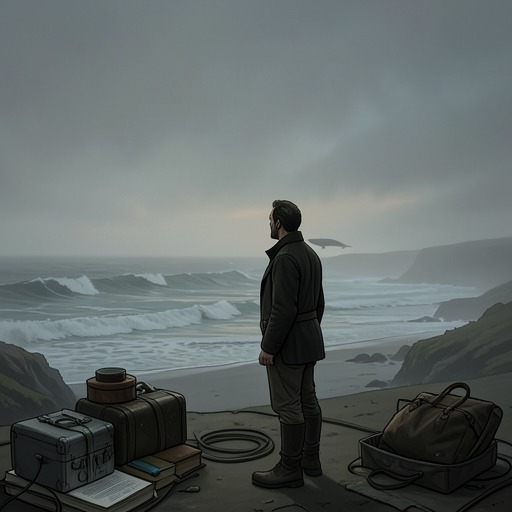
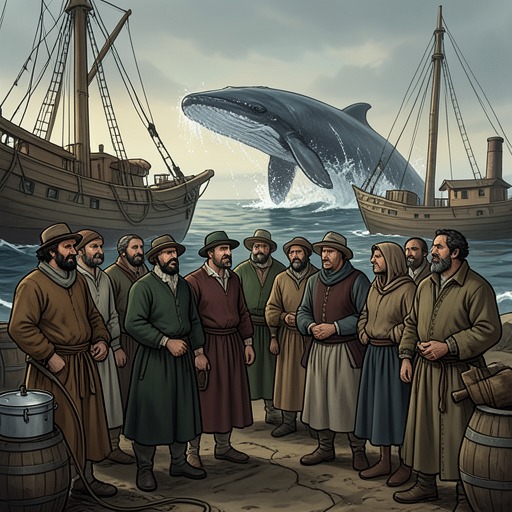
The contrast begins with the history of whaling. Whales were sought for their bodies and their useful materials; the North Atlantic right whale, for example, was especially vulnerable because it carried abundant fat, floated when killed, and often stayed close to shore. Its baleen, like whale oil, could be turned into everyday goods. The name “right whale” itself records the logic of the hunt: this was a whale considered convenient to catch. Whale watching reverses that practical gaze. The animal becomes the focus of attention while alive, not a source of material after its death. The reversal is not simply a matter of changing human intentions. The sea remains a powerful presence, capable of appearing glassy and still or rising into dramatic motion, and much of its life remains hidden from people moving across its surface. The book describes the ocean as a wilderness extending around the globe, even where it reaches city wharves and inhabited shores. Watching whales therefore takes place within an environment that cannot be reduced to a stage for human recreation; the observer is also small and exposed within it.
Encountering whales at their own level
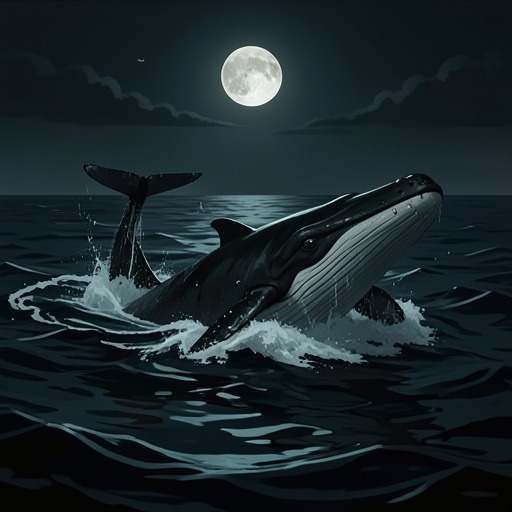
The book’s fullest account of whale watching comes from Hoare’s time at sea near Pico. For several days he leaves ordinary routines behind and swims with whales. He does not always see the animals when entering the water, relying on João Quadresma’s shouted directions; sometimes the whales move too quickly and disappear before he can reach them. At other moments he draws close enough to see their heads rise with each blow and their great tails lift before they dive. The encounter changes the usual viewing angle: rather than looking down from above, he is in the water, at the animals’ level. That shift in perspective is central to the experience. The whales’ movements remain their own: they may pass out of sight, recede into the blue, or descend beyond what the swimmer can follow. The book does not present proximity as mastery or as a complete revelation of whale life. Instead, closeness sharpens awareness of distance and difference. Hoare can enter the whales’ medium for a time, but he cannot command their approach or make their world transparent. The encounter also has a human setting. Marco Avila hauls Hoare back into the boat, while João Quadresma responds to the experience by telling him he is fortunate. The following days are spent at sea, apart from the ordinary activities continuing on land. This contrast makes whale watching a temporary reordering of attention: the whales’ presence determines where the observer goes and what he waits for, while weather can stop the boats and keep them in harbour.
Watching and the work of protection
Whale watching is also connected to the practical work of protecting whales. At Provincetown, the book associates whale watching with a coastal community and with the Center for Coastal Studies. Stormy Mayo, who first saw a right whale as a sixteen-year-old fishing with his father, later helped found the centre and collected data on right whales. He became the first person licensed by the government to rescue entangled whales. In this account, attention to whales is not limited to seeing them: observation can lead to collecting knowledge and responding to the dangers they face. Those dangers make the change from hunting to watching incomplete rather than triumphant. Fewer than four hundred North Atlantic right whales remain, and their preference for populous coasts and busy shipping routes exposes them to vessel strikes. More than sixty per cent have been caught in fishing line. Although the species became the first cetacean protected from hunting in 1935, its numbers remained static; the limited number of breeding animals and restricted gene pool put its future at risk. A whale encountered at the surface is thus both an individual animal and part of a threatened population. The rescue work described in the book makes the reversal especially concrete. Rescuers approach an entangled whale by boat and attach sea anchors to slow it, adapting equipment once used in whale hunting. Mayo then uses a long-handled hook to cut through fishing line. The purpose has changed: tools and close approach are directed toward freeing an animal rather than killing it. Whale watching belongs to this broader change in human practice, though it does not by itself remove the risks created by shipping, fishing, or the older economy of extraction.
The limits of seeing
The book places whale watching within a larger uncertainty about what whales know and how they live. Studies described in the text indicate that cetaceans solve problems, use tools, show social complexity, and pass knowledge between generations. Whaling may have removed not only animals but also cultural knowledge associated with particular habitats. In slow-breeding sperm whales, the population was growing at only about one per cent a year, underscoring how slowly a damaged population may recover. Seeing a whale, then, is not the same as knowing its society or the losses that have shaped it. The experience in the water preserves this limit. Whales may vanish before a swimmer reaches them; even when they come close, their descent takes them beyond view. Whale watching offers a changed relation—one based on attention rather than possession—but not an uncomplicated reconciliation. The book’s encounters hold together wonder, vulnerability, and partial knowledge: the whale can be seen, approached, and sometimes helped, while remaining an independent animal in a sea that humans have never truly mastered.