Whales as omens of disaster
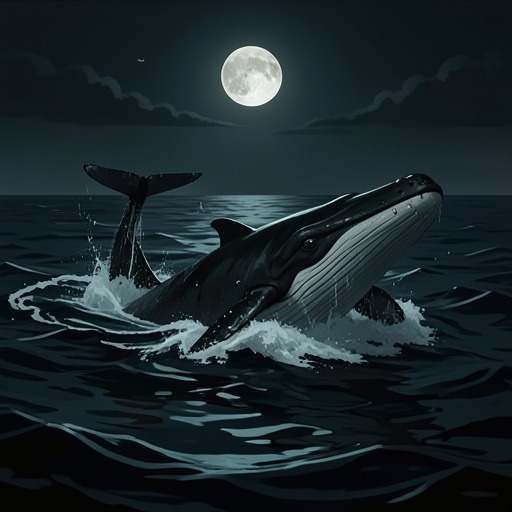
The WhaleWhales as omens of disaster are presented as a recurring human interpretation of encounters at the boundary between ocean and city. A stranded or disoriented whale may be taken as a portent, but the book also shows how such readings arise from the animal’s conspicuous arrival in a human world that it cannot safely inhabit. The omen belongs both to the whale and to the people watching: it expresses anxiety about political death, environmental harm, and the limits of human control, while the animal’s fate often has a more immediate explanation in its circumstances.
From a gift to a warning
The book distinguishes between communities accustomed to whales coming ashore, for whom a beached animal might be received as a gift from the gods, and observers who regarded a dead cetacean as an evil sign, comparable to a comet or eclipse. The whale therefore had no single, fixed meaning. Its arrival could be interpreted through local custom, religious expectation, or the political events that happened to follow it. Such readings turn an unusual animal encounter into a public story about what might be coming.
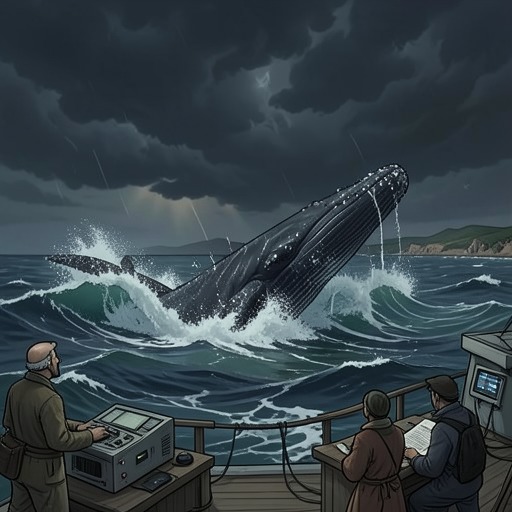
The 1658 whale in the River Thames became especially entangled with political augury. It appeared during a storm, near Dagenham, and was associated with the death of Oliver Cromwell, who died the following day. John Evelyn, whose estate overlooked the river, recorded the arrival and the great crowd drawn to see it. The animal was not merely a private curiosity: its presence gathered spectators from London and elsewhere, and its proximity to the capital made the encounter available for interpretation as a sign concerning the state of the realm.
The whale’s appearance also mattered materially. It first emerged at low water; at high tide, the account suggests, it might have endangered boats. When people cornered it, the struggle ended in its death. The book recounts this outcome without making the animal’s suffering supernatural evidence: the whale had entered a busy, inhabited waterway where people responded to it as a threat and spectacle. Its death was then given a lasting public presence. Evelyn measured and described the animal, and its bones were set up beside the road as a monument. Decades later, Daniel Defoe recorded the whale-bone landmark; the place-name Whalebone Lane and the bones preserved in a local museum extend the event beyond the moment of stranding. A creature read as an omen was also converted into a specimen, a spectacle, and a memorial.
The city and the displaced animal
The later London whale revisits the old pattern in a changed public culture. Instead of being treated simply as a dangerous intruder or killed for its remains, the northern bottlenose whale became a global media event. Crowds and boats surrounded it, helicopters and film crews followed it, and images travelled to audiences far beyond the river. The book describes an animal out of its marine soundscape and confined within the noise and traffic of a major city. Its appearance could look portentous precisely because it seemed so profoundly out of place.
The outcome undercut any easy claim that public attention meant protection. The whale was carried back toward the sea on a pontoon, but died near Gravesend, still short of freedom. The event was interpreted as a new omen, yet its death was attributed by the necropsy to dehydration and stress. Months later, Richard Sabin showed the narrator the animal’s preserved dorsal fin at the Natural History Museum. That remnant made the incident tangible as evidence of a particular animal’s final ordeal, rather than merely an emblem through which observers could express their fears.
The book places the London whale amid other contemporary events that invited a broader reading. Six Arnoux’s beaked whales had appeared in Cape Town harbour the month before. Shortly before the London incident, a dead Fin whale was brought from the Baltic to Berlin and displayed outside the Japanese Embassy as a protest against Japan’s continuing whaling in the sanctuary of the Southern Ocean. On the day the London whale appeared, four Cuvier’s beaked whales stranded in Spain; subsequent tests indicated that naval sonar exercises had caused their deaths. These occurrences made the London animal seem part of a worldwide pattern, but they did not establish a supernatural message. They connected the language of omen to human actions and environmental pressures that could be investigated.
Competing interpretations
The London whale’s public reception divided around what its treatment said about people. Some newspaper leaders presented the response as a test of humanity; others saw the animal’s arrival as a reminder of the brutality of whaling nations. The whale also became the subject of national debate and commemoration, with tabloid sections bordered in black. A satirical cartoon portrayed it on a flag-draped catafalque, surrounded not by guards but by photographers. The mixture of mourning, spectacle, and satire shows how the animal’s death could be made to signify several incompatible things at once: compassion, hypocrisy, public obsession, or the failure of attempted rescue.
Religious interpretation sharpened the sense of warning. The reading at Mass that Sunday came from the book of Jonah, and a clergyman connected the biblical story of Nineveh with the whale’s appearance in London. He proposed that the animal might be hinting at the need to confront consumption, dwindling oil, global warming, and violence. The force of this reading lies in its moral analogy, not in evidence that the whale had arrived to deliver a message. The book preserves the interpretation as one response among many, then sets it beside the necropsy’s account of dehydration and stress. The omen can prompt reflection, but it cannot replace explanation of what happened to the animal.
The sea beyond the omen
The broader account of the sea helps explain why these encounters acquire such weight. Henry David Thoreau describes the ocean as an enduring wilderness, older in its wildness than human settlements and still reaching the wharves and seaside gardens of cities. The book likewise presents the sea as a force that sustains life, shapes human movement, and remains largely unknown even when people treat it as a distance to cross. Its surface can appear calm or empty while concealing processes and creatures beyond ordinary view. A whale breaking into a river or harbour makes that hidden marine world suddenly visible, but does not make it fully knowable.
The annual migration of humpbacks to the Gulf of Maine offers a counterweight to the impression that whales simply arrive as inexplicable signs. After months in Caribbean waters, they travel north by ancient routes, reaching waters where currents bring nutrients and support the food chain on which they feed. Their movement belongs to oceanic patterns that extend across great distances and long timescales. By contrast, a whale stranded in a city is encountered through the short, intense duration of human attention. The difference cautions against mistaking a rare sight for a visitation directed at people.
The Azores, described as volcanic islands scattered across the Atlantic and situated on the meeting of tectonic plates, further evoke the immense and unstable geography in which human lives and marine lives intersect. The islands’ scale and position make the ocean more than a backdrop: it is a material world with histories and forces that exceed human political boundaries. In this setting, the whale as omen is best understood as a form of human interpretation produced by that encounter. The animal’s appearance can expose fears about death or ecological damage, while its actual vulnerability insists that the warning may be less a message from the sea than a consequence of how people meet it.