Whales imprinted with the image of the age
The WhaleWhales imprinted with the image of the age describes how human eras leave their mark on whales—and how whale bodies, in turn, become embedded in the material culture of those eras. The phrase gathers together an immense range of uses: whale products entered homes, workplaces, transport, medicine, and war, while teeth, bones, and oil preserved traces of the industry long after its commercial fortunes changed. What appears at first to be a record of human ingenuity is also an account of extraction: a living animal made legible to its age through the things people could take from it.
From whale to commodity
The book makes that transformation tangible through the narrator’s childhood recollections of whale products in ordinary domestic life. Whale-oil margarine sat in the refrigerator in yellowish blocks; whale fat touched children’s cheeks in cosmetics. New industrial processes—including sulphurization, saponification, distillation, and hydrogenation—expanded and rationalized the uses of whales. Their oil went into lubricants, paint, varnish, ink, detergent, leather, and food; their livers yielded vitamin A, and their glands supplied materials used to make insulin and corticotrophin.
The inventory continues across the household and the working day. Whale oil lubricated cars and sewing machines; whale products appeared in ice cream, soap, fertilizer, crayons, cat food, lipstick, typewriter ribbon, tennis-racquet strings, and photographic film. Shoelaces could be made from whale skin. The point is not simply that whales were useful in many ways: their remains linked childhood, domestic labor, consumer goods, transport, and industry in one chain of dependence. The animal’s presence was pervasive precisely because it had been converted into objects that no longer announced their source.
Industry, energy, and historical change
This material dependence changed with technology rather than ending when one use became obsolete. In 1859, Edwin L. Drake drilled for oil at Titusville, Pennsylvania; the gush from the ground resembled a whale’s spout, but petroleum also signaled a shift away from the sperm-whale fishery. Later, whale products continued to circulate in applications that were less visible to consumers. Even after Britain began banning whale products in 1973, exceptions remained for sperm-whale oil and spermaceti wax, while whale material could still enter manufactured goods abroad. A product could disappear from public view without disappearing from the supply chain.
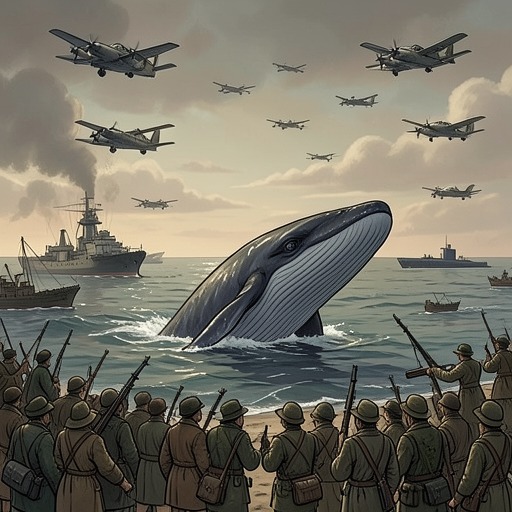
The hunt also followed changing industrial and political demands. Sven Foyn’s patented grenade harpoon, which exploded in a whale’s head, enabled Norwegian whalers to pursue fast rorquals that earlier hunters had found difficult to catch. The weapon helped make blue and fin whales newly accessible to commercial killing; steamships and harpoon-launchers intensified the pressure on humpbacks as well. When European whaling expanded into the Antarctic in 1904, whales supplied nitroglycerine manufacture. During the two world wars, an estimated fifty thousand whales died, while humpbacks in the South Atlantic were driven to extinction by 1918. Whale oil helped prevent trench foot, and whale products went into glycerine for munitions. The same age that used whales to sustain and equip human life also used them to support its wars.
Objects that keep the hunt visible
Not every whale product became anonymous. On long voyages, crews were given teeth to carve during idle hours. Seamen soaked them in brine, polished them with sharkskin, and etched designs with needles or knives; soot from the ship’s try-pots supplied the ink. Some carvings depicted ships or episodes of whaling, while others drew on illustrations, imagined classical scenes, or sailors’ private desires. Up to ten inches long, these objects became records made by men whose carvings could serve as journals even when they could not write. Their polished surfaces carried both the intimacy of a handled possession and the history of an industry built on killing.
John F. Kennedy collected thirty-four whale teeth, keeping favored examples on his Oval Office desk. In 1963, a whale tooth engraved with the presidential seal was ordered as a Christmas gift for him. He died before receiving it; two weeks later, on the night before his funeral, his widow placed the tooth in his coffin. The carved tooth had moved from a product of whaling to a collectible, then to a personal gift and a funerary object. Its successive meanings show how an artifact could retain the material history of the hunt while acquiring an entirely different public and intimate life.
Remains, display, and the limits of use
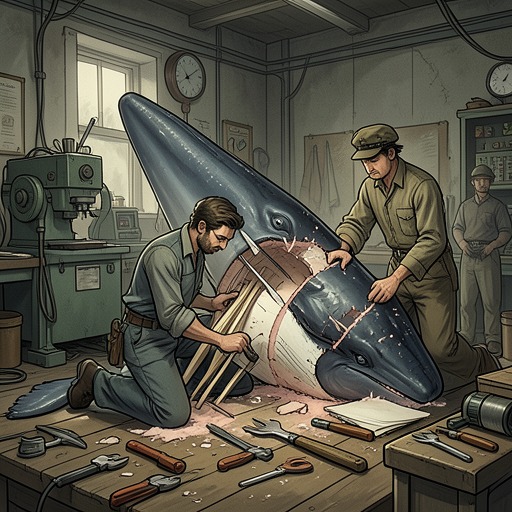
The whale’s body also persists in museums as something more than a source of commodities. A fifty-ton, sixty-six-foot blue-whale skeleton hangs above the reception desk of a whaling museum. Washed ashore on Rhode Island in 1998, it was only six years old. After the museum and the Smithsonian Institution both claimed it, the agreement required the specimen to remain on public view by day and night. The carcass was cut into sections, lowered into the river in cages, and left for two years while small organisms consumed its flesh. Reassembled beneath the museum’s roof, the skeleton still drips oil and lends an ocean scent to the hall. A once-living body becomes an exhibit, but its material presence resists becoming wholly clean or abstract.
Elsewhere, a sperm-whale skeleton once stood outdoors, articulated to resemble the animal in water and supported by iron struts. When those supports rusted away, some Boy Scouts tried to burn the remains; the bones were later rescued and stored in an outhouse. A guide’s grand claim that it was the only whale from Moby Dick to exist sharpened the incongruity of the scene: enormous remains, once arranged for visitors, now lay scattered beside farm equipment and a disused caravan, awaiting reassembly. The whale’s image survives not only in polished displays but in damaged, displaced fragments.
A life-size cross-section of a female sperm whale offers a different kind of encounter with the body. Beside the painted anatomy, a sample of the spermaceti sac rests in a plastic container, its oil crystallized like old honey; a piece of blubber feels almost like wood, its tough mesh recalling the difficulty of cutting it. A jar holds ambergris, whose origin in the whale’s rectum overturns the assumption that this valuable substance forms like a pearl. Such displays expose the matter behind the commodity: animal tissue with its own texture, resistance, and origin, not merely a name on a product label.
The age written into the sea
The phrase also sets human history against a sea that exceeds any single industry or era. The ocean remains a wilderness even as cities rise beside it, and its shifting surface can seem calm while concealing immense creatures. Humpbacks, after fasting and mating in the Caribbean, migrate as far as eight thousand miles toward the Gulf of Maine, where currents bring nutrients and seasonal food. Their routes, followed through age-old signs, belong to a scale of time and movement that industrial schedules cannot contain.
Against that continuity, the whale’s incorporation into consumer life and warfare looks less like mastery than a temporary, consequential claim upon a living world. Whale products carried the image of their age because they entered its defining systems—energy, manufacture, domestic consumption, and conflict. Yet skeletons, carved teeth, and the stubborn traces of oil preserve another image as well: not simply what people made from whales, but the animal history their uses could never entirely erase.