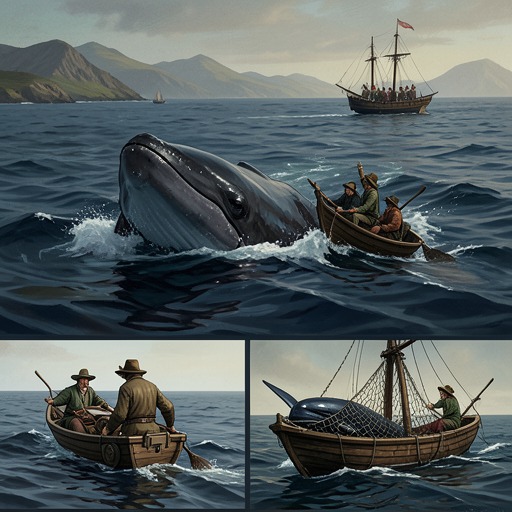
Whaling as warfare
The WhaleWhaling as warfare is a governing analogy for the hunt: a small crew advances in a fragile boat against an animal of overwhelming size and power, and the harpooneer must deliver the first blow under conditions compared to combat. The analogy is not merely a flourish. It shapes the hunt’s language of command, courage, weapons, and peril, while the whale’s response complicates any simple division between attacker and victim. The men face fear and possible death; the animal, startled and wounded, answers with force that can scatter the whole school and threaten the boats.
The Hunt as an Organized Attack
The pursuit depends on the boat’s commander, whose urgency turns rowing into a test of collective effort. One mate pleads with his crew to pull, alternating affection with increasingly desperate promises and reproaches; Stubb uses a different rhythm, beginning with soothing endearments before berating his rowers for their sluggishness. These appeals show command working through intimacy, mockery, and pressure at once. The crew must keep the boat moving, although it remains small and vulnerable enough to be smashed in the encounter.
Approach requires tactical knowledge as well as force. The hunters use the whale’s blind areas at the front and rear, avoiding a direct approach toward its eye, where it could see them. They pull close, then put aside their oars and wait. This pause is not safety but concentrated exposure: the men are near enough to act, and near enough to be overwhelmed. The enormous flukes visible through the surface make the mismatch tangible before the attack begins.
Fear on Both Sides
The passage presents the moment before the harpoon as a trial for the men in the boat. It is described as the point at which each man is judged and his prospects depend on what he does. For an inexperienced hunter, the whale’s immense head can make the approach feel like entering battle. In the twentieth century, Norwegian ships hunting bottle-nosed whales considered the work so dangerous that they sent single men rather than husbands with families. The comparison therefore extends beyond the first dramatic encounter: the risk remained serious enough to shape who was sent to do the work.
The fear is reciprocal, though not equal in its consequences. The harpooneer prepares to spear a living creature many times his size; the whale encounters unfamiliar movement and noise and reacts with panic. Its hearing is connected through the bones of its head to the auditory canal, while a film of oil protects its eyes. The animal’s sudden alarm can carry the entire school away at speed, usually to windward. Charles Nordhoff’s account of a whale disappearing almost at once gives the hunt a disorienting reversal: a vast animal beside the boat can seem to vanish, leaving the hunters’ control uncertain.
The First Blow
At the prow, the harpooneer braces himself against the boat, fitting his thigh into a curved cut in the gunwale. The vessel becomes an extension and support for the throw, just as Ahab’s peg-leg fits its socket on the Pequod. Yet the comparison also emphasizes the difference between the hunter’s constructed equipment and the whale’s natural strength: wood and iron are set against blubber and immense bodily power. The harpooneer rows until the last moment, drops his oar, takes up the weapon, and casts it toward the whale. The throw demands such exertion that Ishmael says a man’s blood vessels might burst.
The attack is a coordinated manoeuvre, but its decisive instant belongs to one person. The iron spear travels on its wooden shaft, attached to the boat by a line. It may draw or miss rather than find its intended hold. Melville’s account even registers the hunters’ appetite for the chase separately from the work that follows capture: the excitement of pursuit is not identical to the labor and violence of killing. The moment of release briefly suspends the ordinary passage of time, while the danger is so absorbing that later rescuers of whales would recognize how present peril can erase awareness of anything else.
Counterattack and Consequence
When the barb succeeds, the conflict expands beyond the single boat and whale. The blow is felt across the school, which scatters; the struck animal bucks and rears, trying to dislodge the harpoon. The weapon may bend double, but its flexible iron can be beaten back into shape. Sailors preserve unusually bent harpoons as mementoes of encounters that they understand as heroic. The keepsake turns damage into evidence of endurance, much as military culture makes a record of battle out of its weapons.
The line then makes the hunt resemble a dangerous machine as well as a battlefield. It can run for a mile or more from its bucket, and the crew wets it to keep friction from burning it as it pays out. The men guide it with canvas protection, but the whipping rope can still seize someone and drag him overboard. The hunt’s military language thus does not imply secure mastery: command, courage, and equipment organize the attack, yet the whale’s response and the moving line can turn the hunters’ own system against them. Warfare is both a model for human aggression and a measure of its limits.