Whitby
The WhaleWhitby is a coastal town in which family memory, Arctic whaling, and Gothic fiction converge. Approached through childhood recollection and ancestral history, it is more than a picturesque harbor: the town holds traces of a working relationship with the sea that the narrator once knew nothing about, while its setting gives old maritime stories a persistent presence. Whitby’s importance lies in this layered quality. A modern journey through familiar seaside places leads into the lives of earlier generations and, beyond them, into the dangerous northern waters where British whaling took place.
The town and the coastal journey
Driving north from Burton Constable, the narrator passes Bridlington, Filey, and Scarborough, resorts bound to childhood memories of amusement arcades, fish and chips, candy floss, and family holidays in a caravan. The journey changes in character as the coast recedes: safe fields give way to broad, empty moorland, the radio becomes white noise, and the road eventually descends to Whitby. The transition makes the town feel half-hidden rather than simply remote. Its red roofs, steep streets, narrow snickleways, and horseshoe harbor distinguish it from the open moorland above.
That movement from familiar resorts to a more enclosed harbor landscape also participates in the book’s larger contrast between land and sea. The ocean is presented as an enduring wilderness beside human settlements, not as a distance already mastered or a passive view. It can appear calm and almost invisible, yet its surface conceals immense animals and forces beyond ordinary human perception. Whitby’s harbor is therefore a threshold: the town’s streets are lived-in and specific, but its maritime past opens onto a much larger, less knowable world.
Family history in Whitby
The town becomes personal through the history of the narrator’s great-grandfather, Patrick James Moore. The son of a Dublin blacksmith, he joined the large movement of people leaving Ireland and passed through Liverpool’s docks before arriving in Whitby by 1882 with his wife, Sarah. She had worked as a housemaid in Faversham. Six months after their marriage, she gave birth to their first child, Rose Margaret. The family lived in Grove Street, in a poor part of town close to Scoresby Terrace; nearby, at the end of the lane, were riverside works where James Cook’s ship Endeavour was built.
The next generation deepens the connection. The narrator’s grandfather, Dennis, was born in Whitby in 1885. He became a tailor, making suits for J. B. Priestley and an overcoat for Winston Churchill. By the end of his life he had retired to Morecambe, where he died in a home facing the bay. The narrator remembers him only vaguely as a dapper, white-haired man in dark suits, always wearing a watch and chain. His passion for reading was so absorbing that he sometimes missed his bus stop. As a child, the narrator did not know that this grandfather had been born in a town shaped by the memory of whales. The belated discovery turns an ordinary family connection into a route back to Whitby’s maritime past.
Whaling and the Arctic past
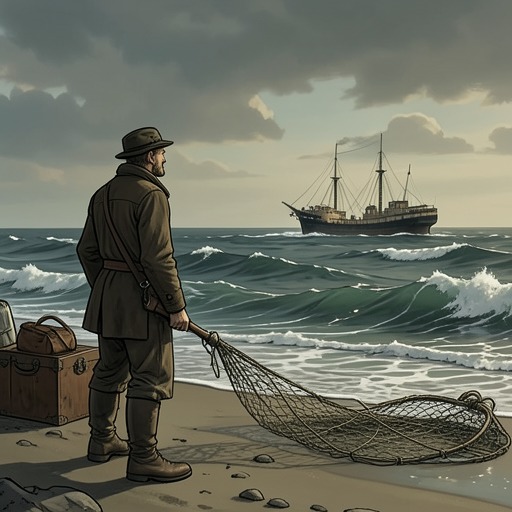
Whitby’s history in the book reaches beyond the harbor to the freezing Arctic. The narrator connects the town with an industry carried out far from the mild seas more commonly associated with maritime adventure. The old whaling world appears through the figure of an aging sailor in Bram Stoker’s Dracula, a work inspired by Stoker’s holiday in Whitby. Mina climbs to the clifftop graveyard and meets a man who says he sailed to Greenland when Waterloo was fought. He tells her about the whale-fishing in the old days. Nearly a century old, he is presented as a remnant of a vanished industry and of a period when Whitby’s maritime reach extended into Arctic waters.
The contrast between the elderly sailor and the young narrator’s ignorance is significant. Whitby’s history has not vanished simply because it is no longer part of everyday family awareness: it survives in local memory, in the town’s literary representation, and in the wider record of British whaling. The book’s account of whaling ranges across ports and regions, and identifies Whitby among the British centers connected with the trade. Its mention of William Scoresby senior, alongside the town’s Scoresby Terrace, further places Whitby within the book’s network of maritime names and histories, without making the family story itself a whaling narrative.
Literary memory and the sea
Stoker’s use of Whitby makes its physical landscape carry historical weight. The clifftop graveyard, the steep approach, and the old sailor’s recollection bring the Arctic into a town on the English coast. The sailor’s testimony gives the local setting a Gothic dimension: an almost century-old witness links the present to a hazardous, distant past, while the sea beyond the harbor suggests a wilderness that remains only partly understood. The effect depends on the meeting of an actual coastal town and an immense maritime world, rather than on treating Whitby as merely a supernatural backdrop.
Elsewhere, the book emphasizes that the sea may seem unchanged and familiar from shore, though careful attention reveals a continuous drama beneath its shifting surface. That idea resonates with the narrator’s discovery of his grandfather’s birthplace. Whitby had been present in the family’s history without being understood as a place of whales; what was hidden was not only beneath the water, but inside the ordinary passage of generations. The town thus joins private memory to maritime history: its streets preserve the lives of migrants and workers, while its harbor and literary associations point outward to the Arctic and to the enduring wildness of the sea.